
If you live in Brazil or spend enough time immersed in the culture, you’ll quickly notice one thing: Brazilians hate saying “no.”
As a Brazilian who happens to be a very direct person, I’ve struggled with this my whole life. For me, saying “no” is easy and efficient, but in my home country, that level of bluntness is often seen as incredibly rude.
The Social Game: Reading Between the Lines
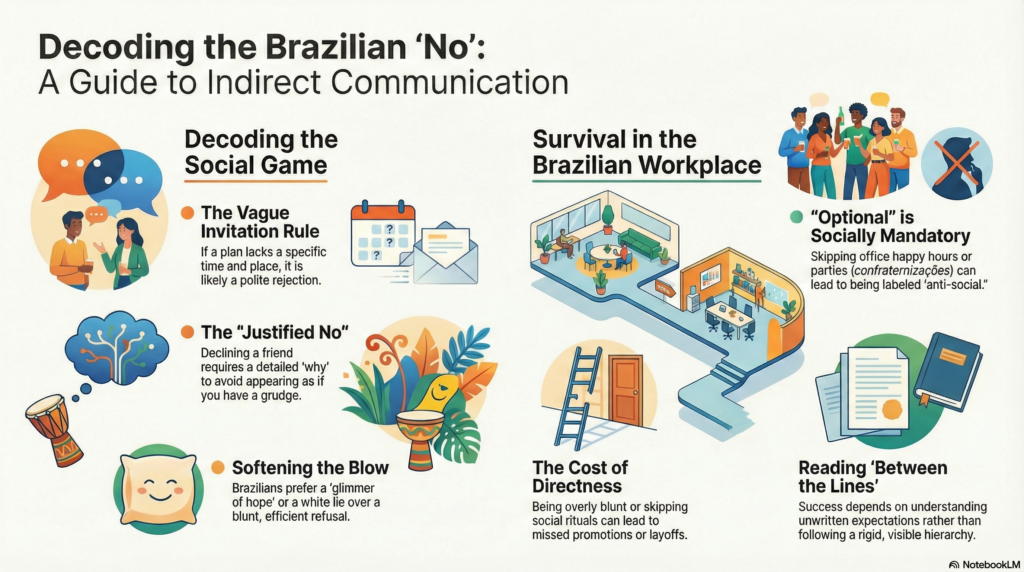
In many cultures, a “no” is just a “no.” But in Brazil, being too sincere can be shocking. If you need to decline something, there is a complex “social game” involved. You have to provide justifications or offer a glimmer of hope—even if both parties subtextually understand that nothing will come of it.
For expats or foreigners who don’t understand these social codes, communication can be frustrating. Let’s look at a common example:
The “Fake” Invitation Imagine you ask someone out, but they aren’t interested. They will rarely reject you directly. Instead, you’ll hear things like:
- “Let’s schedule something soon!”
- “We should do something this weekend.”
- “I’ve been so tired/busy with work lately.”
The Rule of Thumb: If the person doesn’t give you a clear instruction—like “Let’s meet Friday at 9 PM at this specific restaurant”—and keeps sending vague messages, they are likely not interested.
Friendship and the “Justified No”
This isn’t just about dating; it affects every area of life. If a friend invites you out and you simply aren’t feeling up to it, saying “No, I can’t” isn’t enough. Without a long explanation, the other person might assume you have a grudge against them.
To maintain the relationship, you have to provide a “why.” You’re busy, you’re unwell, or you just need a quiet night in. While some people resort to white lies—which I personally dislike—the key to getting along is to soften the blow. Even a short, delicate justification is better than a “no” standing alone.
Survival in the Brazilian Workplace
In the corporate world, refusing social invitations can actually hurt your career. In medium to large companies, happy hours and end-of-year holiday parties (confraternizações) are technically optional, but socially mandatory.
Unlike the rigid hierarchy of Japan, Brazilian workplace expectations are hidden “between the lines.” If you skip the post-work drinks or the office party, you might be labeled as “anti-social” or “not a team player.” This reputation can lead to being passed over for promotions or being the first on the list during layoffs. It’s a lesson many young Brazilians learn the hard way.
Adapting to the Environment
Brazil celebrates extroversion. If you are an introvert or naturally direct, it is a challenge. Over time, I’ve had to learn how to be less “harsh” with my rejections. I’ve had to mold my social personality to fit the context.
I’m currently experiencing a version of this in the American South. My version of being polite is a simple “Good morning” or “Thank you,” but here, people prefer “Southern Charm”—a more sugary, warm way of interacting. Once again, I’ve had to adapt.
In any society, you have two choices:
- Adapt: Give up a bit of your natural style to maintain social harmony and avoid “punishment.”
- Be Yourself: Stay 100% authentic and accept the social consequences.
Summary
Understanding these signals will save you from a lot of confusion and potential heartbreak. Whether you are dealing with a Brazilian friend or navigating a Brazilian office, remember that the “no” is rarely direct. If you want to grow in your career or keep your social circle tight, sometimes you have to make the sacrifice, show up to the party, and play the game. I’ve learned this the hard way so you don’t have to!