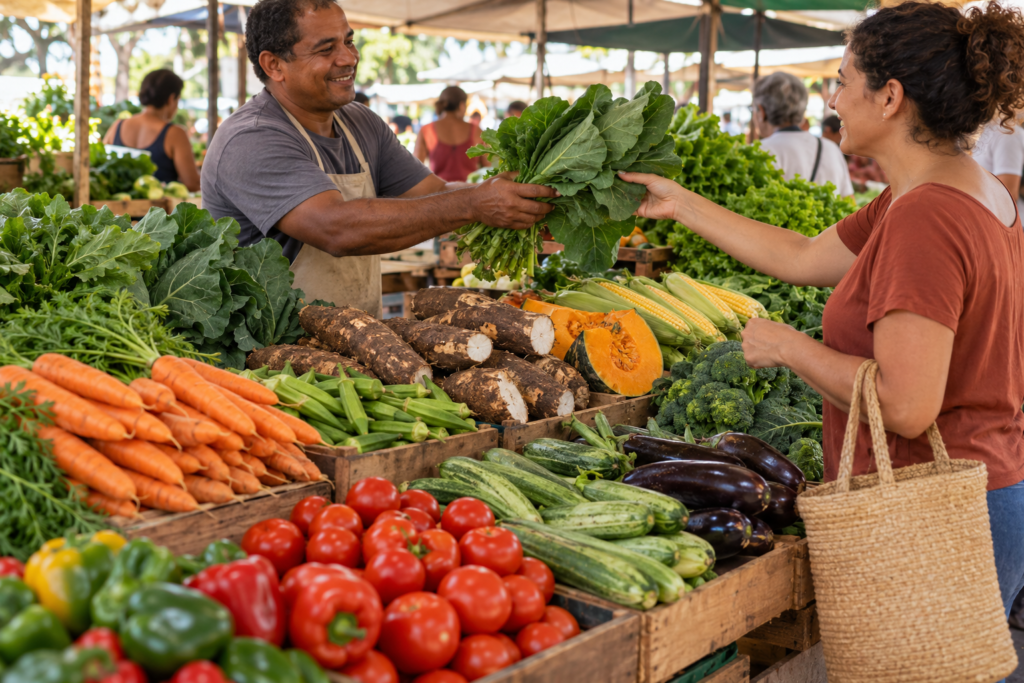

Brazilian Portuguese vegetable vocabulary helps you shop at a street market, understand a menu, and follow a Brazilian recipe. However, translating a vegetable name word for word can lead to the wrong purchase. In Brazil, for example, zucchini is abobrinha, bell pepper is pimentão, and a bunch of leafy greens is um maço de verduras.
This guide covers everyday produce, less familiar ingredients, and practical shopping phrases. Along the way, you will learn which European Portuguese terms need a Brazilian equivalent. You will also discover why some familiar labels, including inhame, acelga, and feijão-verde, require extra attention.
Brazilian Portuguese Vegetable Vocabulary: The Basics
Start with three useful umbrella terms: legumes, verduras, and hortaliças. Although their everyday meanings overlap, each word helps you understand a different shopping context.
| Portuguese term | Practical English meaning | How people use it |
|---|---|---|
| os legumes | vegetables, especially non-leafy ones | Carrots, zucchini, and similar ingredients |
| as verduras | leafy greens; sometimes vegetables more broadly | Lettuce, arugula, and collard greens |
| as hortaliças | vegetables and edible garden crops | A broader term in agriculture and food education |
| os vegetais | vegetables; plants or plant foods in broader contexts | Meaning depends on the sentence |
| a feira / a feira livre | street market | A place to buy produce and other foods |
| o feirante / a feirante | market vendor | The person selling at a market stall |
| o hortifrúti | produce store or produce department | A useful sign to recognize while shopping |
| o sacolão | produce market or store | A common store name in parts of Brazil |
Watch the false friend: Portuguese legumes does not mean only beans, peas, and lentils. For the English food category “legumes,” leguminosas is usually the relevant Portuguese term.
For example, Vou comprar legumes para a sopa means “I’m going to buy vegetables for the soup.” By contrast, feijão e lentilha são leguminosas means “beans and lentils are legumes.”
For learning purposes, this guide follows kitchen and shopping categories. Therefore, you will find tomatoes alongside other vegetables and mushrooms in the produce section.
Everyday Vegetables in Brazilian Portuguese
Learn the article with each noun whenever possible. As a result, phrases such as a cenoura and o pepino will feel more natural when you start speaking.
| English | Brazilian Portuguese | Useful detail |
|---|---|---|
| carrot | a cenoura | Cenoura ralada means grated carrot |
| potato | a batata | Batata inglesa distinguishes it from sweet potato |
| sweet potato | a batata-doce | The flesh can vary in color |
| onion | a cebola | Red onion is cebola roxa |
| garlic | o alho | A clove is um dente de alho |
| tomato | o tomate | Common in salads and sauces |
| cherry tomato | o tomate-cereja | A small tomato variety |
| cucumber | o pepino | Pepino japonês names a common market type |
| zucchini / courgette | a abobrinha | Prefer this to Portugal’s curgete |
| eggplant / aubergine | a berinjela | Brazilian spelling differs from beringela |
| bell pepper | o pimentão | Green, red, or yellow: verde, vermelho, amarelo |
| chili pepper | a pimenta | Add the variety when you need a specific pepper |
| beet / beetroot | a beterraba | Beterraba cozida means cooked beet |
| turnip | o nabo | Different from rabanete |
| radish | o rabanete | Often small and round, depending on the variety |
| cauliflower | a couve-flor | Feminine: uma couve-flor |
| broccoli | o brócolis | A common Brazilian form with a final s |
| okra | o quiabo | Useful in Brazilian recipe vocabulary |
| corn / maize | o milho | Fresh corn is commonly milho-verde |
| green beans | a vagem / as vagens | The edible whole pods |
| peas | a ervilha / as ervilhas | Fresh or frozen: frescas or congeladas |
Try this simple sentence: Quero cenoura, abobrinha e pimentão para refogar. It means “I want carrot, zucchini, and bell pepper to sauté.”
Meanwhile, Você tem milho-verde? means “Do you have fresh corn?” The word verde here describes the fresh stage, so the kernels do not need to look green.
Pimentão, Pimenta, and Pimenta-do-Reino
English uses “pepper” for several ingredients. However, Brazilian Portuguese makes an important distinction.
| What you want | What to ask for |
|---|---|
| Bell pepper | pimentão |
| Chili pepper | pimenta |
| Black pepper | pimenta-do-reino |
| Malagueta pepper | pimenta-malagueta |
| Dedo-de-moça pepper | pimenta dedo-de-moça |
Pimenta-malagueta names a particular pepper, rather than every chili pepper. Therefore, avoid translating a generic red chili as malagueta unless you know the variety.
For example, ask Essa pimenta é muito ardida? to find out whether a pepper is very hot. Alternatively, say Quero um pimentão vermelho when you want a red bell pepper.
Leafy Greens, Cabbages, and Salad Vegetables
Leafy greens contain some of the most misleading translations in picture dictionaries. In particular, couve, repolho, and radicchio should not share one English translation.
| English | Brazilian Portuguese | Shopping note |
|---|---|---|
| lettuce | a alface | Feminine: a alface, despite the ending |
| arugula / rocket | a rúcula | Usually sold in bunches or packages |
| watercress | o agrião | Masculine: o agrião |
| spinach | o espinafre | A common leafy-green name |
| collard greens | a couve / a couve-manteiga | A useful Brazilian cooking term |
| curly kale | a couve crespa / a couve kale | Specify the curly type |
| cabbage | o repolho | The standard word for headed cabbage |
| red cabbage | o repolho roxo | Different from radicchio |
| Savoy cabbage | o repolho crespo | Wrinkled leaves forming a head |
| Brussels sprouts | a couve-de-bruxelas | Usually discussed as individual sprouts or a package |
| Swiss chard | a acelga | Market labels can cause confusion |
| radicchio | o radicchio | A red-leaf chicory, not red cabbage |
| escarole | a escarola | A broad-leaf salad green |
| curly endive / frisée | a chicória crespa | Check the variety when shopping |
| Belgian endive | a endívia | Often means the compact pale heads in shops |
| sorrel | a azedinha | More useful in Brazil than simply azeda |
| dandelion greens | as folhas de dente-de-leão | Specifies the edible leaves |
| kohlrabi | a couve-rábano | Different from turnip and rutabaga |
| napa cabbage / Chinese cabbage | a couve-chinesa / o repolho chinês | Frequently sold as acelga |
| bok choy / pak choi | o pak choi / o bok choy | Also look for chingensai |
Why Couve Does Not Always Mean Kale
In everyday Brazilian cooking, couve often refers to the broad leaves of couve-manteiga, commonly translated as collard greens. Meanwhile, curly kale needs a more specific description, such as couve crespa or couve kale.
Headed cabbage is repolho. Consequently, translating every English “cabbage” as couve can create confusion at a Brazilian market.
Compare these requests:
- Um maço de couve, por favor.: A bunch of collard greens, please.
- Quero meio repolho.: I would like half a cabbage.
- Você tem couve crespa?: Do you have curly kale?
Similarly, red cabbage is repolho roxo, while radicchio keeps its own name. Their red-purple color does not make them the same vegetable.
The Acelga Label Problem
Acelga means Swiss chard, but Brazilian market labels do not always follow that distinction. In fact, Embrapa notes that vendors frequently sell Chinese cabbage under the name acelga.
Therefore, check the shape as well as the label. Napa cabbage forms an elongated head, whereas Swiss chard has separate leaves with prominent stalks. For bok choy, asking for pak choi or chingensai can help avoid another mix-up.
Source: Embrapa’s guide to acelga and its guide to Chinese cabbage.
Chicória, Escarola, and Endívia
These names do not fit a simple one-word translation chart in every shop. For example, English “endive” can refer to curly endive or Belgian endive, depending on the context.
Use chicória crespa when you mean frisée and escarola for broad-leaf escarole. Meanwhile, specify endívia belga if you need the compact pale heads.
For botanical context, NC State Extension distinguishes curly endive and escarole from Belgian endive and radicchio. Consequently, a photo or a more specific name can help when a recipe depends on one exact type.
Roots, Tubers, and Regional Brazilian Names
Root-vegetable vocabulary becomes easier when you separate everyday names from exact species. However, a few Brazilian regional names overlap, particularly inhame and cará.
| English | Brazilian Portuguese | Important distinction |
|---|---|---|
| cassava / manioc | a mandioca | Also aipim or macaxeira, depending on the region |
| true yam | o cará / o inhame | Regional names vary; usually refers to Dioscorea species |
| taro | o taro / o inhame | Inhame often names taro in parts of Brazil |
| ginger | o gengibre | A piece is um pedaço de gengibre |
| parsnip | a pastinaca / a cherovia | Different from mandioquinha |
| arracacha | a mandioquinha / a batata-baroa / a mandioquinha-salsa | Names vary by region |
| celeriac | o aipo-rábano | Different from celery stalks |
| horseradish | a raiz-forte | A practical Brazilian name |
| rutabaga / swede | o rutabaga / o nabo-sueco | Different from kohlrabi |
| Jerusalem artichoke / sunchoke | o tupinambo / a alcachofra-de-jerusalém | Different from globe artichoke |
| water chestnut | a castanha-d’água | Often appears in Asian ingredient contexts |
| new potato | a batata nova | Refers to a young potato, not simply any small potato |
Mandioca, Aipim, and Macaxeira
These are regional names that commonly refer to cassava used in cooking. For learners, mandioca is a useful starting term, while aipim and macaxeira help you recognize local menus and conversation.
For example, aipim frito and mandioca frita can both mean fried cassava. Similarly, a menu may offer macaxeira cozida, or boiled cassava.
Learning all three terms helps you recognize the ingredient without assuming that every region uses the same name.
Inhame and Cará Need Context
The English words “yam” and “taro” describe different crops. Nevertheless, Brazilian everyday names can overlap across regions.
Embrapa identifies taro as Colocasia esculenta and notes regional naming differences involving inhame and cará. Therefore, ask to see the product when an exact ingredient matters.
A useful question is Você pode me mostrar qual é?: “Can you show me which one it is?” For a precise recipe, pairing a photo with the ingredient name works better than relying on a single translation.
Source: Embrapa’s taro guide.
Parsnip Is Not Mandioquinha
Pastinaca, or cherovia, corresponds to parsnip. By contrast, mandioquinha, batata-baroa, and mandioquinha-salsa refer to arracacha.
Although these roots may look similar, they are different plants. Embrapa identifies mandioquinha-salsa as Arracacia xanthorrhiza, an Andean crop.
Consequently, do not translate a Brazilian recipe’s mandioquinha as “parsnip” without explaining a possible substitution. A substitute and an exact translation serve different purposes.
Source: Embrapa’s introduction to mandioquinha-salsa.
Squash, Pumpkin, and Less Familiar Produce
English squash names do not always match one Brazilian market label. Instead, Brazilian sellers may identify the variety or use a broader name such as abóbora.
| English | Brazilian Portuguese | How to use the name |
|---|---|---|
| pumpkin / mature squash | a abóbora | A broad everyday category |
| round pumpkin | a moranga | A familiar type in Brazilian cooking |
| kabocha squash | a abóbora cabotiá / a abóbora japonesa | A useful additional market term |
| butternut squash | a abóbora tipo butternut | Some sellers use abóbora-manteiga; confirm the variety |
| acorn squash | a abóbora tipo acorn | Abóbora-bolota may appear in translations |
| gourd | a cabaça | Not a dependable generic translation for butternut squash |
| artichoke | a alcachofra | Different from Jerusalem artichoke |
| asparagus | o aspargo / os aspargos | The plural is common when ordering a portion |
| celery | o salsão / o aipo | Both names occur in Brazil |
| fennel | o funcho / a erva-doce | Specify the bulb when you need the vegetable |
| leek | o alho-poró | The usual Brazilian alternative to alho-francês |
| scallion / green onion | a cebolinha | Use the feminine form in Brazil |
| shallot | a chalota | Different from an ordinary onion |
| mushroom | o cogumelo | A fungus, grouped here for shopping purposes |
| truffle | a trufa | Specify trufa fresca to distinguish the fungus from chocolate |
| bamboo shoots | o broto de bambu / os brotos de bambu | More precise than simply bambu |
| bean sprouts | o broto de feijão / os brotos de feijão | Moyashi commonly names mung bean sprouts |
| soybean sprouts | o broto de soja / os brotos de soja | Different from mung bean sprouts |
| hearts of palm | o palmito | Palmitos is also possible in context |
| fava bean / broad bean | a fava | Other beans can also carry local fava names |
| runner bean | o feijão-de-espanha | Ask about the variety and whether the seller offers pods or seeds |
| breadfruit | a fruta-pão | A fruit that also appears in savory cooking |
For fennel, say Quero o bulbo de funcho if you need the bulb. Otherwise, erva-doce may suggest seeds or an herbal-tea ingredient.
Similarly, brotos de bambu means bamboo shoots. Simply requesting bambu leaves out the edible part you want.
Vagem Versus Feijão-Verde
In Portugal, feijão-verde commonly means green beans eaten in their pods. In Brazil, vagem is the more useful starting word for that ingredient.
However, feijão-verde also has a Brazilian meaning, particularly in Northeastern food contexts. It can refer to immature beans, often cowpeas, including the shelled green grains.
Embrapa’s research on cowpeas discusses both green pods and immature grains for this market. Therefore, feijão-verde and vagem should not automatically share one translation in a Brazilian shopping guide.
Source: Embrapa research on cowpeas for green pods and grains.
Milho-Verde Versus Milho-Doce
Milho-verde is a common Brazilian term for corn harvested for fresh consumption. Meanwhile, milho-doce identifies sweet corn more specifically.
As a result, the two expressions can overlap in some shopping situations without describing identical categories. For an everyday request, Quero três espigas de milho-verde means “I would like three ears of fresh corn.”
European Portuguese to Brazilian Portuguese: Key Changes
Use this table when adapting a Portuguese picture dictionary for Brazil. However, remember that some changes concern the actual vegetable, rather than a regional word preference.
| Term in a European Portuguese reference | Brazilian wording to learn | What changes |
|---|---|---|
| a curgete | a abobrinha | Zucchini |
| o pimento | o pimentão | Bell pepper |
| a beringela | a berinjela | Eggplant spelling |
| o alho-francês | o alho-poró | Leek |
| o cebolinho, when the image shows scallions | a cebolinha | Brazilian everyday name and gender |
| o brócolo | o brócolis | Common Brazilian form |
| o feijão-verde, meaning edible green pods | a vagem | Avoid confusion with immature beans |
| o rebento de soja | o broto de soja | Broto is the useful Brazilian word; verify the sprout species |
| biológico, meaning organic food | orgânico | Typical Brazilian food wording |
| o saco de plástico | a sacola plástica / o saquinho plástico | Choose according to the bag |
| a couve, meaning headed cabbage | o repolho | Use the Brazilian kitchen category |
| a couve-roxa, when the English label says radicchio | o radicchio | Radicchio is not red cabbage |
| a cabaça, when the English label says butternut | a abóbora tipo butternut | Confirm the actual squash variety |
| a azeda, meaning sorrel | a azedinha | A useful Brazilian ingredient name |
| o rábano picante | a raiz-forte | Horseradish |
For example, replace Vende legumes biológicos? with Você vende legumes orgânicos? Alternatively, Vocês têm verduras orgânicas? works well when you ask about leafy greens.
Vegetable Parts, Textures, and Preparation Words
Once you know the vegetable name, add a word for the part or preparation. This way, you can understand recipes and explain exactly what you need.
| English | Brazilian Portuguese | Example |
|---|---|---|
| leaf | a folha | folhas de couve |
| stalk | o talo | talos de salsão |
| seed | a semente | sementes de abóbora |
| corn kernel / grain | o grão | grãos de milho |
| root | a raiz | raízes in the plural |
| skin / peel | a casca | com casca means with the skin |
| flesh / pulp | a polpa | polpa da abóbora |
| tip | a ponta | pontas dos aspargos |
| heart / inner core | o miolo / o coração | The choice depends on the vegetable |
| raw | cru / crua | cenoura crua |
| cooked | cozido / cozida | batata cozida |
| frozen | congelado / congelada | ervilha congelada |
| fresh | fresco / fresca | verduras frescas |
| firm | firme | tomate firme |
| ripe | maduro / madura | tomate maduro |
| bitter | amargo / amarga | folhas amargas |
| sweet | doce | abóbora doce |
| spicy / hot | picante / ardido | pimenta ardida |
| grated | ralado / ralada | cenoura ralada |
| chopped | picado / picada | cebola picada |
| peeled | descascado / descascada | mandioca descascada |
| sliced | em rodelas / fatiado | pepino em rodelas |
| diced | em cubos | abóbora em cubos |
| sautéed | refogado / refogada | couve refogada |
| roasted / baked | assado / assada | legumes assados |
| steamed | no vapor | brócolis no vapor |
Notice the agreement in cenoura crua, tomate maduro, and ervilhas congeladas. Meanwhile, em cubos and no vapor keep the same form across these examples.
For garlic, distinguish uma cabeça de alho, a whole bulb, from um dente de alho, one clove. Otherwise, a small vocabulary mistake could change an entire recipe.
How to Buy Vegetables at a Brazilian Market
Shopping becomes easier when you learn the unit together with the ingredient. For example, a vendor may sell carrots by weight, leafy greens by the bunch, and corn by the ear.
Kilos, Bunches, Heads, and Packages
| Portuguese unit | English | Natural example |
|---|---|---|
| um quilo | one kilogram | Um quilo de batata, por favor. |
| meio quilo | half a kilogram | Meio quilo de cenoura. |
| duzentos gramas | two hundred grams | Duzentos gramas de gengibre. |
| um maço | a bunch | Um maço de couve. |
| uma cabeça | a head / bulb | Uma cabeça de alho. |
| uma unidade | one item | Uma unidade de berinjela. |
| uma bandeja | a tray / punnet | Uma bandeja de cogumelos. |
| uma espiga | an ear of corn | Duas espigas de milho. |
| um pé | a whole lettuce plant / head in shopping contexts | Um pé de alface. |
| um pacote | a package | Um pacote de ervilha congelada. |
Grammar detail: Say duzentos gramas, rather than duzentas gramas, for the unit of mass. In this meaning, grama is masculine.
For a simpler request, use meio quilo. Meanwhile, remember that um maço has no fixed universal weight, so compare the actual bunches.
Useful Shopping Questions
| Brazilian Portuguese | English |
|---|---|
| Quanto custa o quilo? | How much is it per kilogram? |
| Quanto está o quilo da cenoura? | How much are carrots per kilogram? |
| É por quilo ou por unidade? | Is it by weight or per item? |
| Quanto custa o maço? | How much is a bunch? |
| Tem abobrinha? | Do you have zucchini? |
| Vocês têm legumes orgânicos? | Do you have organic vegetables? |
| Esses produtos são daqui da região? | Are these products from this region? |
| Como chama isso? | What is this called? |
| Como se chama esta verdura? | What is this leafy vegetable called? |
| Pode cortar ao meio? | Can you cut it in half? |
| Tem uma menor? | Do you have a smaller one? |
| Vou levar estes. | I’ll take these. |
| Não preciso de sacola, obrigado / obrigada. | I don’t need a bag, thank you. |
Como chama isso? is a common conversational question. For a more formal structure, use Como se chama isso?
A Short Market Conversation
Customer: Bom dia! Quanto está o quilo da abobrinha?
Good morning! How much is zucchini per kilogram?
Vendor: Está oito reais. Vai querer quanto?
It’s eight reais. How much would you like?
Customer: Meio quilo, por favor. Também quero um maço de couve.
Half a kilogram, please. I also want a bunch of collard greens.
Vendor: Mais alguma coisa?
Anything else?
Customer: Só isso. Não preciso de sacola, obrigado.
That’s all. I don’t need a bag, thank you.
This dialogue uses an illustrative price, rather than a current market quotation. To adapt it, simply replace abobrinha with another vegetable and change the unit when necessary.
Pronunciation and Grammar Tips for Beginners
First, practice the names you actually plan to use. Then, attach each one to a short request, such as Quero uma berinjela.
- Alho: lh has a palatal sound, roughly like the joined “lli” sound in “million” for some English speakers. This is an approximation.
- Pimentão and agrião: ão marks a nasal sound. Avoid adding a strong separate English “n” at the end.
- Cebolinha and abobrinha: nh sounds roughly like “ny” in “canyon.”
- Rúcula and brócolis: the accent marks help you locate the stressed syllable.
- Couve-flor: keep both parts when naming cauliflower; couve alone suggests a different ingredient in Brazil.
For gender, memorize a alface, a couve, o repolho, and o agrião as complete units. After that, practice adjective agreement with alface fresca and repolho roxo.
Common Mistakes to Avoid
Several mistakes come from trusting an English label without checking the Brazilian context. Fortunately, a few targeted corrections cover many everyday situations.
| Common mistake | Better choice | Why it helps |
|---|---|---|
| Asking for pimenta when you want bell pepper | pimentão | Separates sweet bell peppers from hot peppers |
| Using couve for every cabbage | repolho for headed cabbage | Matches common Brazilian usage |
| Calling radicchio repolho roxo | radicchio | Identifies a different vegetable |
| Assuming feijão-verde always means green beans | Ask for vagem for edible whole pods | Avoids a regional ingredient mix-up |
| Translating every yam as inhame without checking | Confirm the product or species | Accounts for regional naming |
| Calling parsnip mandioquinha | pastinaca or cherovia | Keeps two different roots separate |
| Calling all bean sprouts soybean sprouts | Check whether they are mung bean or soy sprouts | Preserves the ingredient distinction |
| Asking for uma grama of produce | um grama, or a practical larger quantity | Uses the masculine mass unit |
| Treating cabaça as an exact butternut translation | Specify the squash variety | Avoids an unreliable one-to-one match |
Practice Brazilian Portuguese Vegetable Vocabulary
Now turn the list into a shopping task. Translate each request before checking the suggested answers.
- A bunch of collard greens, please.
- Do you have zucchini?
- How much is it per kilogram?
- I would like a red bell pepper.
- Two ears of fresh corn, please.
- I need one clove of garlic.
- Is this pepper very hot?
- I would like half a kilogram of carrots.
Suggested Answers
- Um maço de couve, por favor.
- Você tem abobrinha?
- Quanto custa o quilo?
- Quero um pimentão vermelho.
- Duas espigas de milho-verde, por favor.
- Preciso de um dente de alho.
- Essa pimenta é muito ardida?
- Quero meio quilo de cenoura.
Next, make your own list with five ingredients you use at home. For each item, add the article, shopping unit, and one preparation word.
For example: a cenoura → meio quilo de cenoura → cenoura ralada. This method connects vocabulary with a task you can repeat in real life.
Frequently Asked Questions
How Do You Say Vegetables in Brazilian Portuguese?
Use legumes for many everyday vegetables and verduras for leafy greens. Meanwhile, hortaliças offers a broader term in agricultural and educational contexts.
What Is Zucchini Called in Brazil?
Zucchini is abobrinha. By contrast, European Portuguese commonly uses curgete.
Does Couve Mean Cabbage or Kale?
In Brazilian cooking, couve often means collard greens, especially couve-manteiga. For headed cabbage, use repolho; for curly kale, specify couve crespa or couve kale.
Are Mandioca, Aipim, and Macaxeira Different Vegetables?
These names commonly refer to cassava in regional Brazilian usage. Therefore, learning all three helps you recognize menus and market conversations across Brazil.
Is Feijão-Verde the Same as Vagem?
Not in every context. Vagem is the useful Brazilian term for green beans eaten as whole pods, while feijão-verde can refer to immature beans, particularly cowpeas in Northeastern food contexts.
How Do You Ask for Organic Vegetables?
Say Vocês têm legumes orgânicos? For leafy greens, ask Vocês têm verduras orgânicas?
Put Your Vegetable Vocabulary to Work
Start with the ingredients you buy most often: cenoura, batata, cebola, tomate, abobrinha, and pimentão. Then, add a few greens and useful units, including um maço, meio quilo, and uma espiga.
Finally, practice a complete request: Quero meio quilo de abobrinha e um maço de couve, por favor. With that sentence pattern, you can turn Brazilian Portuguese vegetable vocabulary into a practical skill for your next market visit.