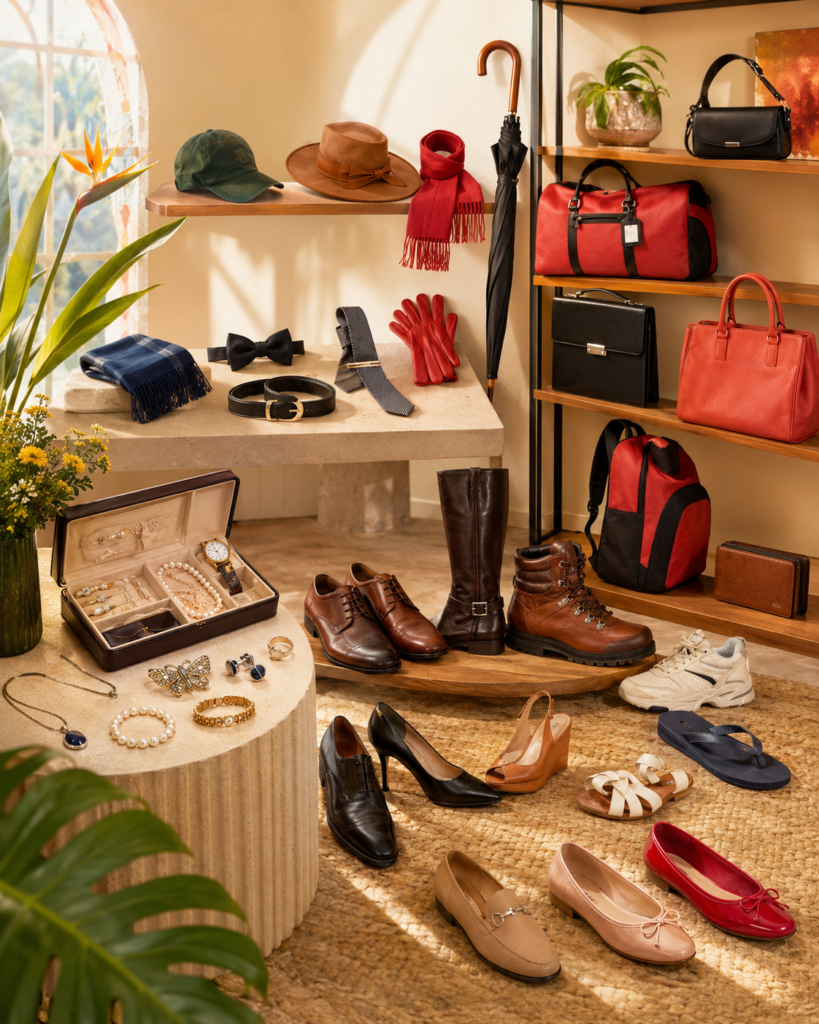

Brazilian Portuguese Vocabulary for Accessories, Jewelry, Bags, and Shoes
Learning Brazilian Portuguese vocabulary becomes much easier when you organize words by real-life categories. Accessories, jewelry, bags, and shoes are useful topics because they appear in everyday conversations, shopping situations, travel, fashion, and descriptions of personal style.
In this guide, you will learn common words in Portuguese from Brazil with English translations. Some terms from European Portuguese were adapted to sound more natural in Brazilian Portuguese.
Accessories in Brazilian Portuguese
Accessories are items people wear or carry to complete an outfit. In Brazilian Portuguese, the word for accessories is os acessórios.
Common Accessories
| Brazilian Portuguese | English |
|---|---|
| o boné | cap |
| o chapéu | hat |
| o cachecol | scarf |
| o cinto | belt |
| a fivela | buckle |
| o lenço | handkerchief / scarf |
| a gravata-borboleta | bow tie |
| o prendedor de gravata | tie clip |
| as luvas | gloves |
| o guarda-chuva | umbrella |
| o cabo | handle |
| a ponteira | tip |
Usage Examples
Eu uso boné quando está muito sol.
I wear a cap when it is very sunny.
Ela comprou um cachecol vermelho para o inverno.
She bought a red scarf for winter.
O cinto tem uma fivela dourada.
The belt has a gold buckle.
Jewelry Vocabulary in Brazilian Portuguese
Jewelry is called as joias in Brazilian Portuguese. These words are useful when describing accessories, buying gifts, or talking about fashion.
Common Jewelry Words
| Brazilian Portuguese | English |
|---|---|
| o pingente | pendant |
| o broche | brooch |
| a abotoadura | cuff link |
| os brincos | earrings |
| o anel | ring |
| o colar | necklace |
| o colar de pérolas | strand of pearls |
| a pulseira | bracelet |
| a corrente | chain |
| o elo | link |
| o fecho | clasp |
| a pedra | stone |
| o relógio | watch |
| o porta-joias / guarda-joias | jewelry box |
Brazil-Specific Notes
In Brazil, broche is more common than alfinete de peito for “brooch.”
For “cuff links,” Brazilians usually say abotoaduras, not botões de punho.
For a jewelry chain, corrente sounds more natural than fio.
Usage Examples
Ela está usando brincos pequenos.
She is wearing small earrings.
Meu relógio é de couro.
My watch is leather.
Ele me deu um colar de presente.
He gave me a necklace as a gift.
Bags in Brazilian Portuguese
The category “bags” can be translated as bolsas e malas in Brazilian Portuguese. In Brazil, bolsa is commonly used for handbags, shoulder bags, and purses, while mala is usually used for luggage or travel bags.
Common Bag Vocabulary
| Brazilian Portuguese | English |
|---|---|
| a carteira | wallet |
| a carteira feminina | change purse / small purse |
| a bolsa de ombro | shoulder bag |
| a bolsa de viagem / mala de viagem | duffel bag |
| a pasta | briefcase |
| a bolsa de mão | handbag |
| a mochila | backpack |
| o fecho | clasp |
| a alça | strap / handle |
| as alças | handles |
Brazil-Specific Notes
In Brazil, mala de ombro is not very natural. A better option is bolsa de ombro.
The word asas for bag handles is common in Portugal, but in Brazil people usually say alças.
For “handbag,” Brazilians commonly say bolsa de mão.
Usage Examples
Minha carteira está dentro da mochila.
My wallet is inside the backpack.
Ela levou uma bolsa de ombro para o trabalho.
She took a shoulder bag to work.
Eu preciso comprar uma mala de viagem.
I need to buy a travel bag.
Shoes in Brazilian Portuguese
Shoes are called os sapatos in Portuguese, but Brazil has many specific words depending on the style of footwear.
Common Shoe Vocabulary
| Brazilian Portuguese | English |
|---|---|
| o sapato com cadarço / sapato de amarrar | lace-up shoe |
| o cadarço | shoelace |
| a lingueta | tongue |
| o ilhó | eyelet |
| a sola | sole |
| o salto | heel |
| a bota | boot |
| a bota de trilha / bota de caminhada | hiking boot |
| o tênis | sneaker |
| o chinelo | flip-flop |
| o sapato social | dress shoe |
| o sapato de salto alto | high-heeled shoe |
| o sapato de salto anabela | wedge |
| a sandália | sandal |
| o mocassim | slip-on / loafer |
| a sapatilha | flat |
Brazil-Specific Notes
In Brazil, people say cadarço, not atacador.
Instead of sapato de atacadores, say sapato com cadarço or sapato de amarrar.
For “shoe tongue,” lingueta sounds more natural than pala.
For “heel,” Brazilians say salto, not tacão.
For “flat,” the Brazilian Portuguese word is usually sapatilha, not sabrina.
Usage Examples
Meu tênis é branco.
My sneaker is white.
O cadarço do meu sapato desamarrou.
My shoelace came untied.
Ela está usando uma sapatilha vermelha.
She is wearing a red flat.
Quick Vocabulary Review
| Category | Key Brazilian Portuguese Words |
|---|---|
| Accessories | boné, chapéu, cachecol, cinto, luvas, guarda-chuva |
| Jewelry | brincos, anel, colar, pulseira, relógio, abotoadura |
| Bags | carteira, bolsa de ombro, mochila, pasta, bolsa de mão |
| Shoes | tênis, bota, chinelo, sandália, mocassim, sapatilha |
Conclusion
Learning Brazilian Portuguese vocabulary for accessories, jewelry, bags, and shoes helps you speak more naturally in everyday situations. These words are especially useful for shopping, describing clothing, packing for travel, and talking about personal style.
To sound more natural in Brazil, remember these important differences: use cadarço instead of atacador, alça instead of asa for bag handles, sapatilha instead of sabrina, and abotoadura instead of botão de punho.