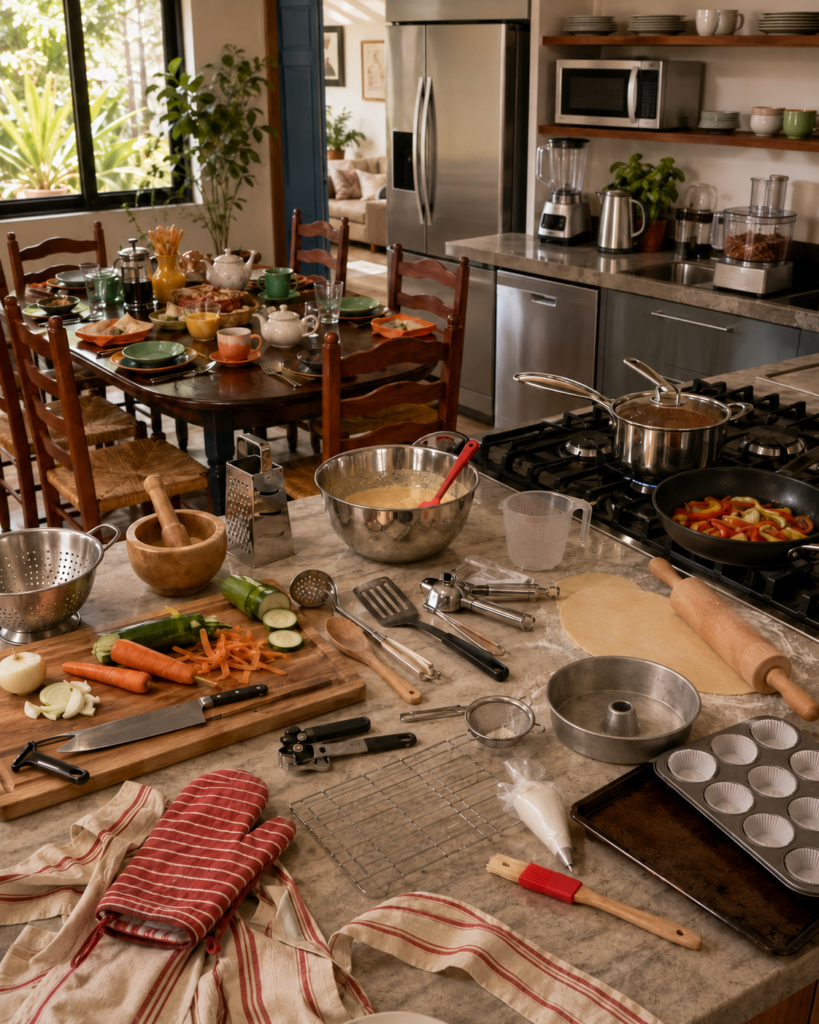

Brazilian Portuguese kitchen vocabulary is essential for anyone who wants to cook, shop, eat with others, follow recipes, or talk naturally about daily life in Brazil. This guide teaches common words for the kitchen, appliances, utensils, tableware, baking tools, dining room items, cooking verbs, and useful meal phrases. Also, some words from European Portuguese were adapted to the Brazilian Portuguese used in everyday conversation.
Why Learn Brazilian Portuguese Kitchen Vocabulary?
The kitchen is one of the most practical places to learn Portuguese because the words appear in daily routines. You may hear them while cooking, watching recipes, visiting a Brazilian home, buying products, or eating with friends.
In addition, this vocabulary helps you understand Brazilian recipes more easily. For example, words like panela, frigideira, colher, faca, forno, and geladeira are very common in Brazil.
Another advantage is that many kitchen words connect with useful verbs. As a result, you do not only learn objects, but also actions such as cortar, misturar, assar, ferver, and fritar.
Kitchen Vocabulary in Brazilian Portuguese
The word kitchen in Portuguese is a cozinha. In Brazil, this is the normal word for the room where people cook, store food, and prepare meals.
Parts of the Kitchen
| Brazilian Portuguese | English |
|---|---|
| a cozinha | kitchen |
| a prateleira | shelf |
| a torneira | faucet |
| a pia | sink |
| a gaveta | drawer |
| a bancada | countertop |
| o armário | cabinet |
| o forno | oven |
| o exaustor | ventilation hood |
| o cooktop | cooktop |
| o revestimento antirespingos | backsplash |
In Brazilian Portuguese, a pia is more natural than o lava-loiça, which is common in Portugal. Also, many Brazilians say cooktop for a modern stovetop, although fogão is still very common for a full stove.
Appliances in Brazilian Portuguese
Appliances are important for everyday communication, especially when you are renting a place, buying something for the house, or following a recipe.
Common Kitchen Appliances
| Brazilian Portuguese | English |
|---|---|
| o micro-ondas | microwave oven |
| a chaleira elétrica | electric kettle |
| a torradeira | toaster |
| o processador de alimentos | food processor |
| o liquidificador | blender |
| a máquina de lavar louça | dishwasher |
| a geladeira | refrigerator |
| o congelador | freezer |
| a máquina de gelo | ice maker |
| a gaveta de legumes | crisper |
| o fogão | stove |
| a boca do fogão | burner |
In Brazil, people usually say geladeira, not frigorífico. Likewise, máquina de lavar louça sounds more Brazilian than máquina de lavar loiça.
Dining Room Vocabulary in Brazilian Portuguese
The dining room is a sala de jantar. Although many homes in Brazil combine the kitchen and dining area, these words are still useful for describing meals and furniture.
Dining Room Objects
| Brazilian Portuguese | English |
|---|---|
| a sala de jantar | dining room |
| a mesa | table |
| a cadeira | chair |
| o encosto | back of a chair |
| o assento | seat |
| a perna | leg |
| a louça | crockery |
| os talheres | cutlery |
| o sal | salt |
| a pimenta | pepper |
The word louça is used in Brazil for dishes, plates, cups, and similar table items. However, talheres refers specifically to forks, knives, and spoons.
Useful Meal Vocabulary
Meals are part of daily conversation, so these words are very useful for beginners and intermediate learners.
| Brazilian Portuguese | English |
|---|---|
| pôr a mesa | set the table |
| servir | serve |
| comer | eat |
| a toalha de mesa | tablecloth |
| o jogo americano | placemat |
| a refeição | meal |
| o café da manhã | breakfast |
| o almoço | lunch |
| o jantar | dinner |
| o anfitrião | host |
| a anfitriã | hostess |
| o convidado | male guest |
| a convidada | female guest |
| com fome | hungry |
| satisfeito / satisfeita | full, satisfied |
In Brazil, café da manhã is the standard expression for breakfast. By contrast, pequeno-almoço is used in Portugal.
Crockery and Cutlery in Brazilian Portuguese
When you eat at a table, you need words for plates, bowls, cups, glasses, and utensils. Therefore, this section is especially useful for restaurants, homes, and cooking videos.
Cups, Glasses, and Serving Items
| Brazilian Portuguese | English |
|---|---|
| a caneca | mug |
| a xícara de café | coffee cup |
| a xícara de chá | teacup |
| o bule | teapot |
| a cafeteira francesa | French press |
| a jarra | pitcher |
| o copo de água | tumbler |
| a taça de vinho | wine glass |
| os copos | glassware |
| a tigela | bowl |
| o porta-guardanapo | napkin ring |
| o guardanapo | napkin |
In Brazilian Portuguese, xícara is more common than chávena. Also, copo is used for regular drinking glasses, while taça is used for wine, champagne, and some desserts.
Plates and Cutlery
| Brazilian Portuguese | English |
|---|---|
| o prato | plate |
| o prato de pão | side plate |
| o prato raso | dinner plate |
| o prato de sopa | soup bowl |
| o lugar à mesa | place setting |
| o garfo | fork |
| a faca | knife |
| a colher | spoon |
| a colher de chá | teaspoon |
| a colher de sopa | soup spoon |
Although colher de sopa can mean “tablespoon” in recipes, it may also describe a soup spoon at the table. Context matters, so recipes and table settings may use the phrase differently.
Cookware in Brazilian Portuguese
Cookware includes pots, pans, and dishes used to prepare food. These words are very useful when buying kitchen items or explaining a recipe.
| Brazilian Portuguese | English |
|---|---|
| a frigideira | frying pan |
| a panela | saucepan, pot |
| a panela antiaderente | nonstick pan |
| a panela wok | wok |
| a panela de barro | clay pot |
| a tampa | lid |
| a tigela de vidro | glass bowl |
| a travessa refratária | ovenproof dish |
| o ramequim | ramekin |
| a panela caçarola | casserole dish |
| o grill | grill pan |
In Brazil, panela is the general word for pot or saucepan. Meanwhile, tacho is less common in everyday Brazilian Portuguese, although some people may understand it depending on the region.
Brazilian Portuguese Kitchen Utensils
Kitchen utensils help you prepare, cut, mix, serve, and measure food. Since these words appear in many recipes, they are a strong part of Brazilian Portuguese kitchen vocabulary.
Cutting and Preparing
| Brazilian Portuguese | English |
|---|---|
| a tábua de cortar | cutting board |
| a faca de pão | bread knife |
| a faca de cozinha | kitchen knife |
| o cutelo | cleaver |
| o afiador de facas | knife sharpener |
| o martelo de carne | meat tenderizer |
| o espeto | skewer |
| o descascador | peeler |
| o descaroçador de maçãs | apple corer |
| o ralador | grater |
| o pilão | pestle |
| o almofariz | mortar |
| o espremedor de batata | masher |
The expression tábua de cortar is clear and natural in Brazil. However, many Brazilians also say tábua de carne, even when they use it for vegetables.
Opening, Pressing, and Serving
| Brazilian Portuguese | English |
|---|---|
| o abridor de latas | can opener |
| o abridor de garrafas | bottle opener |
| o espremedor de alho | garlic press |
| a colher de servir | serving spoon |
| a espátula vazada | slotted spatula |
| o escorredor | colander |
| a espátula de silicone | silicone spatula |
| a colher de pau | wooden spoon |
| a escumadeira | slotted spoon |
| a concha | ladle |
| o garfo de trinchar | carving fork |
| a colher de sorvete | ice-cream scoop |
| o fouet / batedor de arame | whisk |
| a peneira | sieve |
In Brazil, fouet is common in cooking videos and baking contexts. Nevertheless, batedor de arame or batedor de claras may sound more familiar to some learners.
Baking Vocabulary in Brazilian Portuguese
Baking vocabulary is useful for cakes, bread, pies, cookies, and desserts. In Portuguese, baking is often connected with the word confeitaria, but pastelaria can also appear in some contexts.
Baking Tools
| Brazilian Portuguese | English |
|---|---|
| a balança | scale |
| o copo medidor | measuring cup |
| a forma de bolo | cake pan |
| a forma redonda | round pan |
| a forma de torta | pie pan |
| a forma de quiche | quiche pan |
| o pincel culinário | pastry brush |
| o rolo de massa | rolling pin |
| o saco de confeitar | piping bag |
| a forma de cupcake | muffin pan |
| a assadeira | cookie sheet, baking sheet |
| a grade de resfriamento | cooling rack |
| a luva de forno | oven mitt |
| o avental | apron |
In Brazilian Portuguese, assadeira is more natural than tabuleiro de forno in many regions. Also, saco de confeitar is more common in Brazil than saco de pasteleiro.
Cooking Verbs in Brazilian Portuguese
Cooking verbs make your vocabulary more active. Instead of only naming objects, you can describe what you are doing in the kitchen.
| Brazilian Portuguese | English |
|---|---|
| descascar | peel |
| cortar | cut, slice |
| ralar | grate |
| despejar / colocar | pour |
| misturar | mix |
| bater | whisk, beat |
| ferver | boil |
| fritar | fry |
| abrir a massa | roll out dough |
| mexer | stir |
| cozinhar em fogo baixo | simmer |
| escalfar | poach |
| assar | bake, roast |
| grelhar | grill, broil |
| congelar | freeze |
| descongelar | defrost |
| cozinhar no vapor | steam |
| refogar / saltear | sauté |
In Brazil, people often say cozinhar em fogo baixo for “simmer.” Also, assar can mean both “bake” and “roast,” depending on the food and context.
Useful Portuguese Phrases for Meals
These phrases are helpful when eating with Brazilians or speaking politely during a meal.
| Brazilian Portuguese | English |
|---|---|
| Posso repetir, por favor? | Can I have some more, please? |
| Estou satisfeito, obrigado. | I’ve had enough, thank you. |
| Estou satisfeita, obrigada. | I’ve had enough, thank you. |
| Estava delicioso. | That was delicious. |
| Você pode passar o sal? | Can you pass the salt? |
| Onde estão os talheres? | Where is the cutlery? |
| Vou pôr a mesa. | I’m going to set the table. |
| Preciso lavar a louça. | I need to wash the dishes. |
Use obrigado if the speaker is male and obrigada if the speaker is female. Besides that, estou satisfeito or estou satisfeita sounds polite when you do not want more food.
European Portuguese Words Adapted to Brazilian Portuguese
Some words in the pictures are more common in Portugal. For a Brazilian Portuguese vocabulary article, the following versions sound more natural in Brazil.
| European Portuguese | Brazilian Portuguese | English |
|---|---|---|
| o frigorífico | a geladeira | refrigerator |
| o lava-loiça | a pia | sink |
| a máquina de lavar loiça | a máquina de lavar louça | dishwasher |
| a chávena | a xícara | cup |
| o pequeno-almoço | o café da manhã | breakfast |
| o caixote do lixo | a lixeira | garbage can |
| o saco de pasteleiro | o saco de confeitar | piping bag |
| o tabuleiro de forno | a assadeira | baking sheet |
| o tacho | a panela | pot, saucepan |
| a taça misturadora | a tigela | mixing bowl |
| o bico do fogão | a boca do fogão | burner |
These changes make the article more natural for learners who want to speak Brazilian Portuguese. However, understanding the European Portuguese versions can still be useful because books, apps, and dictionaries sometimes include them.
Example Sentences with Brazilian Portuguese Kitchen Vocabulary
Here are simple examples to help you use the words naturally.
Eu vou cortar os legumes na tábua de cortar.
I’m going to cut the vegetables on the cutting board.
A panela está no fogão.
The pot is on the stove.
Coloquei a comida na geladeira.
I put the food in the refrigerator.
Ela usou o liquidificador para fazer suco.
She used the blender to make juice.
Nós precisamos lavar a louça depois do jantar.
We need to wash the dishes after dinner.
O bolo está assando no forno.
The cake is baking in the oven.
Você pode pegar uma colher de sopa?
Can you get a soup spoon?
Vou pôr a mesa antes do almoço.
I’m going to set the table before lunch.
How to Memorize Kitchen Vocabulary in Portuguese
Start with the words you use every day. For example, label your geladeira, fogão, pia, armário, and micro-ondas with sticky notes.
Next, learn vocabulary by category. Utensils, appliances, tableware, and cooking verbs are easier to remember when they are grouped together.
After that, create simple sentences. Instead of memorizing only faca, say a faca está na gaveta. This method helps your brain remember the word in context.
Finally, practice while cooking. You can say the Portuguese words out loud as you use each object, which makes the vocabulary more practical and easier to recall.
Conclusion
Brazilian Portuguese kitchen vocabulary gives you practical language for cooking, eating, shopping, and speaking about daily life. With words like cozinha, geladeira, pia, panela, faca, colher, prato, assar, and misturar, you can understand recipes and communicate more naturally in Brazilian Portuguese.
To improve faster, review the vocabulary by category and use the words in real situations. Over time, these kitchen and dining words will become part of your everyday Portuguese.