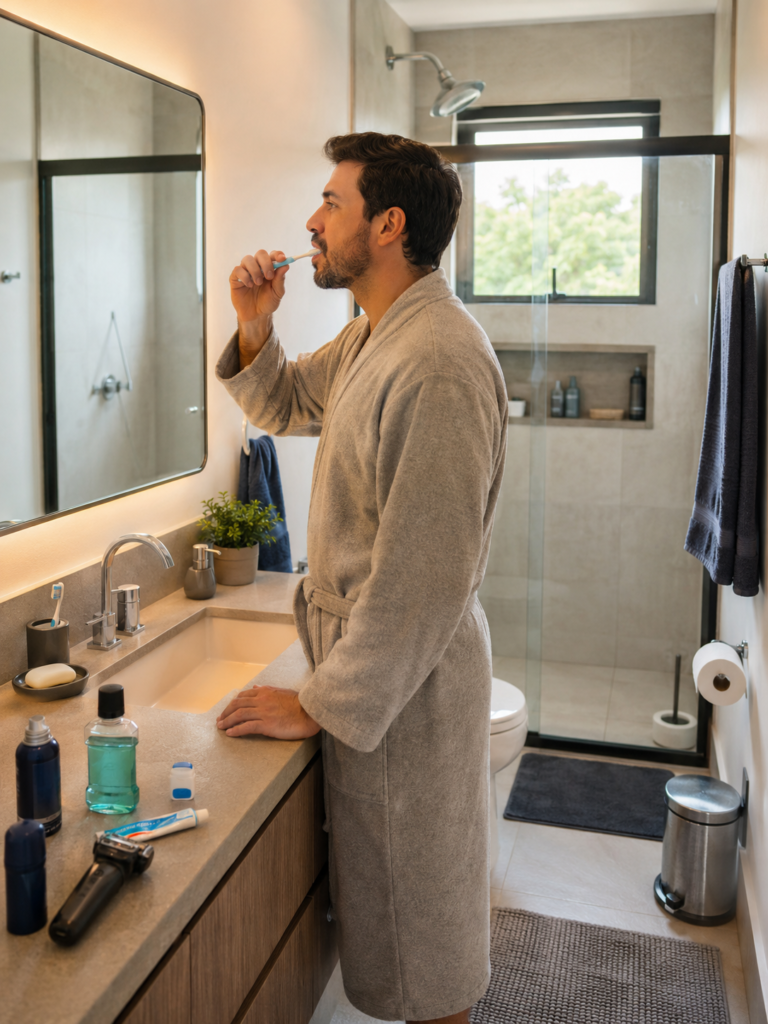

Brazilian Portuguese bathroom vocabulary helps you talk about daily routines, personal hygiene, and common household objects with confidence. Although some textbooks teach European Portuguese terms such as casa de banho, sanita, and duche, Brazilians normally say banheiro, vaso sanitário, and banho. Therefore, learning the Brazilian forms will make your conversations sound clearer and more natural.
This guide covers bathroom fixtures, dental care, bath products, towels, shaving items, useful verbs, and everyday phrases. In addition, it explains which words from Portugal you should replace when your goal is to speak Portuguese as people speak it in Brazil.
Why Bathroom Vocabulary Differs in Brazil
Portuguese varies across countries, just as English does. However, several bathroom words differ noticeably between Brazil and Portugal.
Most Brazilians say banheiro for both a bathroom at home and a public restroom. For example, you can ask “Onde fica o banheiro?” in a restaurant, store, hotel, or private home. As a result, this single question works in many everyday situations.
The following list shows the most important adaptations for learners of Brazilian Portuguese:
- A casa de banho: o banheiro (bathroom or restroom)
- O lavatório: a pia (sink)
- A porta do chuveiro: a porta do box (shower door)
- A cabeça do chuveiro: o chuveiro or a ducha (showerhead)
- O duche: o chuveiro or a ducha (shower)
- Tomar um duche: tomar banho or tomar uma ducha (to take a shower)
- A sanita: o vaso sanitário (toilet)
- A tampa da sanita: o assento or a tampa do vaso sanitário (toilet seat or lid)
- O piaçaba: a escova sanitária (toilet brush)
- O elixir bucal: o enxaguante bucal (mouthwash)
- O gel de duche: o sabonete líquido or o gel de banho (shower gel)
- O creme de rosto: o creme facial or o creme para o rosto (face cream)
- A loção de corpo: a loção corporal or o hidratante corporal (body lotion)
- A máquina de barbear: o barbeador elétrico (electric razor)
- O aftershave: a loção pós-barba (aftershave)
Some original terms remain understandable in Brazil, but they may sound formal, uncommon, or distinctly European. Nevertheless, the Brazilian alternatives above offer the safest choices for natural conversation.
Essential Brazilian Portuguese Bathroom Vocabulary
The Sink and Nearby Objects
Begin with the objects that you normally see around the sink. The articles o and a show each noun’s grammatical gender.
- O banheiro: bathroom or restroom
- A pia: sink
- A torneira: faucet or tap
- A torneira de água fria: cold-water faucet
- A torneira de água quente: hot-water faucet
- O ralo: drain
- O tampão da pia: sink plug or stopper
- O espelho: mirror
- O armário de remédios: medicine cabinet
- O porta-toalhas: towel rack or towel holder
Pia sounds more natural than lavatório when Brazilians talk about the sink in a home bathroom. However, lavatório may appear in technical descriptions or formal settings.
For example, “A torneira está pingando” means “The faucet is dripping.” Meanwhile, “O ralo está entupido” means “The drain is clogged.”
The Shower and Bathtub
Start with chuveiro, one of the most useful words in this topic. In Brazil, the noun can name the shower fixture, while tomar banho describes the action of showering or bathing.
- O chuveiro: shower or showerhead
- A ducha: shower or showerhead
- O box: shower enclosure
- A porta do box: shower door
- A cortina de banheiro: shower curtain
- A cortina para box: shower curtain
- A banheira: bathtub
- O tapete de banheiro: bath mat
- O tapete de banho: bath mat
- O tapete antiderrapante: non-slip bath mat
Although tomar uma ducha sounds natural in Brazil, tomar banho appears more often in everyday speech. Speakers also say tomar um banho, especially when they want to emphasize having a quick or refreshing bath.
Likewise, duche strongly suggests European Portuguese. Therefore, Brazilian Portuguese learners should prefer ducha or banho.
Here are some examples:
- Vou tomar banho. = I am going to take a shower.
- O chuveiro não está esquentando. = The shower is not heating up.
- Feche a porta do box, por favor. = Please close the shower door.
- A banheira está cheia. = The bathtub is full.
- A água do chuveiro está fria. = The shower water is cold.
- Preciso limpar o box. = I need to clean the shower enclosure.
The Toilet Area
Brazilian speakers usually choose vaso sanitário as the neutral term for “toilet.” For instance, privada also means toilet, but it sounds informal and may feel impolite in some settings. By contrast, sanita belongs mainly to European Portuguese.
- O vaso sanitário: toilet
- O assento do vaso sanitário: toilet seat
- A tampa do vaso sanitário: toilet lid
- A descarga: flush or flushing mechanism
- O papel higiênico: toilet paper
- O rolo de papel higiênico: toilet paper roll
- A escova sanitária: toilet brush
- A escova para vaso sanitário: toilet brush
- O bidê: bidet
- A ducha higiênica: handheld bidet sprayer
- A lixeira: trash can
Use dar descarga when you want to say “to flush the toilet.” For example, “Não se esqueça de dar descarga” means “Do not forget to flush.”
A traditional bidê still appears in some homes, especially older ones. Instead, many modern Brazilian bathrooms have a ducha higiênica beside the toilet.
Personal Hygiene Vocabulary in Portuguese
Dental and Oral Hygiene
For oral care, Brazilians normally say enxaguante bucal rather than elixir bucal. Moreover, everyday speech favors pasta de dente, although product labels and advertisements often use creme dental.
- A escova de dentes: toothbrush
- A pasta de dente: toothpaste
- O creme dental: toothpaste
- O fio dental: dental floss
- O enxaguante bucal: mouthwash
- A higiene bucal: oral hygiene
First, you can say escovar os dentes for “to brush your teeth.” Then, use passar fio dental for “to floss.” Finally, usar enxaguante bucal means “to use mouthwash.”
Here are some useful examples:
- Preciso escovar os dentes. = I need to brush my teeth.
- A pasta de dente acabou. = The toothpaste ran out.
- Você tem fio dental? = Do you have dental floss?
- Eu uso enxaguante bucal todos os dias. = I use mouthwash every day.
- Comprei uma escova de dentes nova. = I bought a new toothbrush.
Bath, Skin, and Body-Care Products
Bath products provide another practical group of Brazilian Portuguese bathroom vocabulary. Although people understand gel de banho, most Brazilians use sabonete líquido when they mean liquid body soap or shower gel.
- A esponja: sponge
- A pedra-pomes: pumice stone
- A escova para as costas: back brush
- O sabonete: soap or bar of soap
- A saboneteira: soap dish
- O sabonete líquido: liquid soap or shower gel
- O gel de banho: shower gel
- A espuma de banho: bubble-bath foam
- O banho de espuma: bubble bath
- O creme facial: face cream
- O creme para o rosto: face cream
- A loção corporal: body lotion
- O hidratante corporal: body moisturizer
- O talco: talcum powder
- O desodorante: deodorant
Sabonete normally refers to a solid bar of soap unless the speaker adds another description. Therefore, sabonete líquido specifies that the product comes in liquid form.
For example, “Passei hidratante corporal depois do banho” means “I applied body lotion after my shower.” Meanwhile, “O sabonete acabou” means “The soap ran out.”
Additional examples include:
- Coloque o sabonete na saboneteira. = Put the soap in the soap dish.
- Preciso comprar desodorante. = I need to buy deodorant.
- Ela usa creme facial antes de dormir. = She uses face cream before sleeping.
- O gel de banho está no box. = The shower gel is in the shower enclosure.
- Passei loção corporal nos braços. = I applied body lotion to my arms.
Towels, Mats, and a Bathrobe
Towels have specific names according to their purpose. In Brazil, toalha de mão uses the singular form mão, while toalha de banho refers to the larger towel that you use after bathing.
However, as toalhas simply means “the towels” as a group.
- A toalha de mão: hand towel
- A toalha de banho: bath towel
- As toalhas: towels
- O roupão: bathrobe or robe
- O roupão de banho: bathrobe
- O tapete de banheiro: bath mat
- O porta-toalhas: towel rack
Consider these examples:
- Preciso de uma toalha de banho. = I need a bath towel.
- A toalha de mão está molhada. = The hand towel is wet.
- Coloque as toalhas no porta-toalhas. = Put the towels on the towel rack.
- Ele vestiu o roupão depois do banho. = He put on the bathrobe after showering.
- O tapete de banheiro precisa ser lavado. = The bath mat needs to be washed.
Shaving Vocabulary in Brazilian Portuguese
Shaving vocabulary becomes especially useful when you shop for personal-care products or describe your morning routine. To sound natural, choose barbeador elétrico instead of the more European-sounding máquina de barbear.
- Fazer a barba: to shave
- O barbeador elétrico: electric razor
- A espuma de barbear: shaving foam
- O aparelho de barbear: razor
- O barbeador descartável: disposable razor
- A lâmina de barbear: razor blade
- A loção pós-barba: aftershave
For example, “Preciso fazer a barba antes de sair” means “I need to shave before leaving.” Afterward, someone might say “Vou passar loção pós-barba,” which means “I am going to apply aftershave.”
More useful examples include:
- Meu barbeador elétrico está sem bateria. = My electric razor has no battery.
- Preciso trocar a lâmina de barbear. = I need to change the razor blade.
- Onde está a espuma de barbear? = Where is the shaving foam?
- Comprei um aparelho de barbear novo. = I bought a new razor.
- Ele faz a barba todas as manhãs. = He shaves every morning.
Everyday Bathroom Actions and Verbs
Daily routines become easier to describe when you learn verbs together with nouns. First, notice that Brazilians usually omit the article in tomar banho. Next, remember that tomar um banho also sounds natural when the speaker emphasizes one bath or a refreshing break.
- Usar o banheiro: to use the bathroom
- Tomar banho: to take a shower or bath
- Tomar uma ducha: to take a shower
- Lavar as mãos: to wash your hands
- Lavar o rosto: to wash your face
- Escovar os dentes: to brush your teeth
- Passar fio dental: to floss
- Usar enxaguante bucal: to use mouthwash
- Se enxugar: to dry yourself
- Passar desodorante: to apply deodorant
- Passar hidratante: to apply moisturizer
- Fazer a barba: to shave
- Dar descarga: to flush the toilet
- Abrir a torneira: to turn on the faucet
- Fechar a torneira: to turn off the faucet
- Limpar o banheiro: to clean the bathroom
Afterward, combine the expressions into a short routine:
“Primeiro, eu tomo banho. Depois, escovo os dentes. Em seguida, passo fio dental. Por fim, passo desodorante.”
This method helps you remember the vocabulary as connected actions rather than isolated words.
Useful Bathroom Phrases in Brazilian Portuguese
Because vocabulary works best in context, practice complete phrases that you can use at home, in a hotel, or while traveling. Moreover, these examples connect common nouns with natural Brazilian verbs.
- Onde fica o banheiro? = Where is the bathroom?
- Posso usar o banheiro? = May I use the bathroom?
- Tem papel higiênico? = Is there toilet paper?
- Preciso de uma toalha de banho. = I need a bath towel.
- A água do chuveiro está fria. = The shower water is cold.
- O ralo está entupido. = The drain is clogged.
- A torneira está pingando. = The faucet is dripping.
- A pasta de dente acabou. = The toothpaste ran out.
- Você tem fio dental? = Do you have dental floss?
- Não se esqueça de dar descarga. = Do not forget to flush.
- Pode me passar o sabonete? = Can you hand me the soap?
- Vou fazer a barba. = I am going to shave.
- Onde estão as toalhas? = Where are the towels?
- O banheiro está ocupado. = The bathroom is occupied.
- O banheiro está livre. = The bathroom is available.
- Preciso lavar as mãos. = I need to wash my hands.
- O chuveiro tem água quente? = Does the shower have hot water?
- Você pode limpar o banheiro? = Can you clean the bathroom?
Pronunciation Tips for Important Bathroom Words
Brazilian pronunciation varies by region, but a few spelling patterns will help you speak more clearly. However, you do not need perfect pronunciation before using these words in conversation.
- In banheiro, the letters nh sound similar to the “ny” in “canyon.”
- In toalha, the letters lh create a sound similar to “lli” in “million.”
- In chuveiro, the letters ch sound like “sh” in English.
- In roupão, the ending ão has a nasal sound that does not have an exact English equivalent.
- The letter h stays silent in higiênico.
For example, break banheiro into small sound groups before saying the whole word. Meanwhile, listen for nh, lh, and ão in other Brazilian Portuguese words to recognize the same patterns.
A Short Bathroom Dialogue in Portuguese
The following dialogue shows how the vocabulary works in a natural situation:
A: Com licença, onde fica o banheiro?
B: Fica no fim do corredor, à direita.
A: Obrigado. Tem uma toalha de banho lá?
B: Tem, sim. Ela está no porta-toalhas.
A: Ótimo. O chuveiro tem água quente?
B: Tem. Gire a torneira para a esquerda.
English translation:
A: Excuse me, where is the bathroom?
B: It is at the end of the hallway, on the right.
A: Thank you. Is there a bath towel there?
B: Yes. It is on the towel rack.
A: Great. Does the shower have hot water?
B: Yes. Turn the faucet to the left.
Common Mistakes to Avoid
Common mistakes often happen when learners transfer vocabulary directly from European Portuguese. Therefore, make these substitutions when you want to sound Brazilian:
- Casa de banho: use banheiro
- Tomar um duche: use tomar banho or tomar uma ducha
- Sanita: use vaso sanitário
- Elixir bucal: use enxaguante bucal
- Piaçaba: use escova sanitária
- Máquina de barbear: use barbeador elétrico
- Porta do chuveiro: use porta do box
- Pasta de dentes: use pasta de dente or creme dental
- Creme de rosto: use creme facial or creme para o rosto
- Loção de corpo: use loção corporal or hidratante corporal
A second common mistake involves assento and tampa. The assento is the toilet seat, whereas the tampa is the lid that covers it.
Additionally, do not translate “to take a shower” word for word with pegar. Brazilians use tomar banho, not pegar um banho.
How to Memorize Brazilian Portuguese Bathroom Vocabulary
First, group words by location, such as the sink, shower, toilet, or medicine cabinet. Next, connect each noun to an action, such as chuveiro with tomar banho or escova de dentes with escovar os dentes.
Then, describe your own morning routine aloud with three or four short sentences. Finally, review the words through active recall instead of only rereading the list.
Another useful technique involves placing temporary labels on safe, dry objects at home. For example, a label that says espelho can help you remember “mirror,” while porta-toalhas reinforces “towel rack.”
You can also organize the vocabulary into the following groups:
- Bathroom fixtures
- Dental hygiene products
- Bath and skin-care products
- Towels and clothing
- Shaving products
- Daily actions
As a result, your brain creates connections between related words instead of trying to memorize one long, disconnected list.
Frequently Asked Questions
How Do You Say “Bathroom” in Brazilian Portuguese?
The standard word is banheiro. Brazilians use it for a bathroom in a home and for a restroom in a public place.
For example, “Onde fica o banheiro?” means “Where is the bathroom?”
How Do You Say “Shower” in Brazilian Portuguese?
The most common noun is chuveiro, while ducha also appears frequently. To describe the action, say tomar banho or tomar uma ducha.
How Do You Say “Toilet” in Brazilian Portuguese?
Use vaso sanitário in neutral conversation. The word privada also exists, although it sounds more informal.
What Is “Toothpaste” in Brazilian Portuguese?
Say pasta de dente in everyday conversation or creme dental in a more commercial or formal context. Although pasta de dentes makes sense, the singular form sounds more characteristically Brazilian.
What Does “Box” Mean in a Brazilian Bathroom?
In Brazilian Portuguese, box means the enclosed shower area. Therefore, porta do box means “shower door.”
Are Bidets Common in Brazil?
Traditional standalone bidets still exist, particularly in older homes. However, many bathrooms use a ducha higiênica, or handheld bidet sprayer, beside the toilet.
What Is the Difference Between Banheiro and Lavabo?
Banheiro is the general word for a bathroom or restroom. By contrast, lavabo usually refers to a small guest bathroom with a sink and toilet but no shower.
How Do You Ask to Use the Bathroom in Portuguese?
Say “Posso usar o banheiro?” This sentence means “May I use the bathroom?” and works in both formal and informal situations.
Conclusion
Brazilian Portuguese bathroom vocabulary becomes much easier when you organize words by real situations and replace European terms with natural Brazilian alternatives.
Start with essential words such as banheiro, pia, chuveiro, vaso sanitário, and toalha. Then, connect them to useful actions like tomar banho, escovar os dentes, fazer a barba, and dar descarga.
With regular practice, you will describe your routine, ask for what you need, and understand everyday conversations with greater confidence.