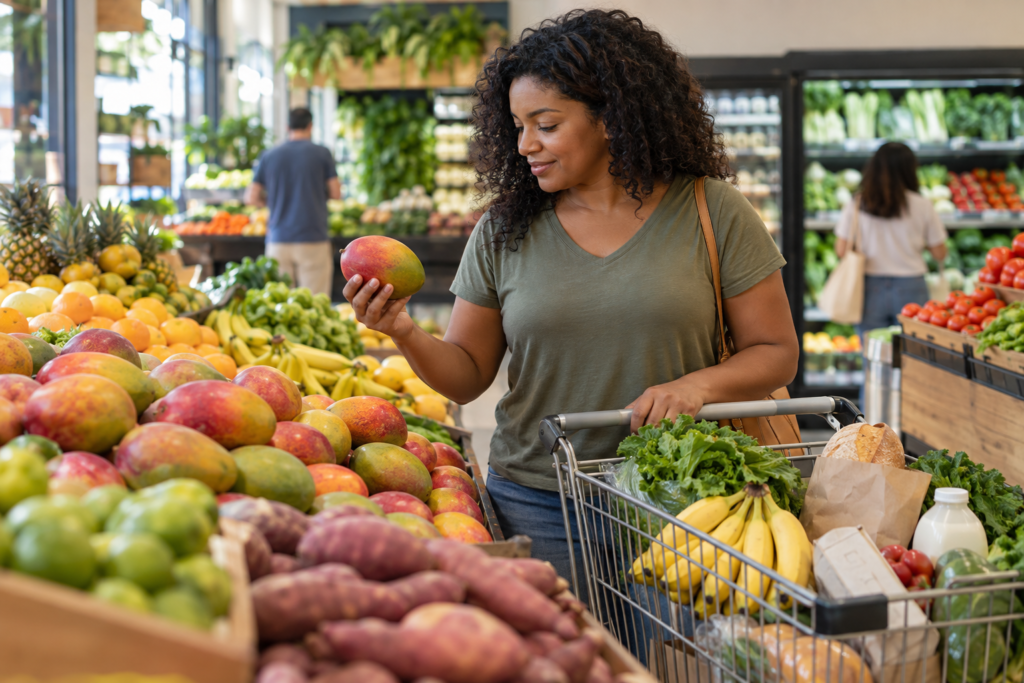

Brazilian Portuguese supermarket vocabulary helps you find groceries, ask for prices, and speak confidently at checkout. Whether you need fresh fruit, cleaning supplies, or a shopping bag, a few practical words can make your shopping trip much easier. In addition, learning these expressions gives you useful language for everyday life in Brazil.
This guide covers the supermarket objects and product categories in the pictures. Along the way, it adapts several terms to common Brazilian usage and adds phrases you can use immediately.
Essential Brazilian Portuguese Supermarket Vocabulary
First, learn the words that describe the store and the people inside it. These terms help you understand directions before you start looking for specific products.
| Brazilian Portuguese | English | Practical note |
|---|---|---|
| o supermercado | supermarket | A general word for a grocery store. |
| o mercado | market; grocery store | Common in everyday conversation. |
| o cliente / a cliente | customer | The article changes according to the person. |
| o funcionário / a funcionária | employee | Useful when asking someone for help. |
| o caixa / a caixa | cashier | Can refer to the person operating the checkout. |
| o caixa | checkout | Also refers to the place where you pay. |
| o corredor | aisle | A passage between product shelves. |
| a prateleira | shelf | The surface that holds products. |
| as compras | groceries; shopping | The items you buy, depending on context. |
| a lista de compras | shopping list | Helps you remember what you need. |
| a promoção | special offer; sale | A temporary deal or promotional offer. |
| a oferta | offer; deal | Another useful word on price signs. |
For example, “Vou ao mercado” means “I’m going to the grocery store.” Meanwhile, “Vou fazer compras no supermercado” means “I’m going grocery shopping at the supermarket.”
Understanding “O Caixa” and “A Caixa”
In Brazil, o caixa commonly means the checkout. However, o caixa or a caixa can also describe a cashier, depending on the person.
- Onde fica o caixa?: Where is the checkout?
- A caixa foi muito simpática.: The cashier was very friendly.
- O caixa está fechado.: The checkout is closed.
The pictures use a caixa for the checkout area. For Brazilian Portuguese learners, o caixa is the more useful everyday choice for that meaning.
Shopping Carts, Baskets, Bags, and Checkout Equipment
Next, learn the objects you handle during a shopping trip. Although some labels in the pictures work in Brazil, others sound more natural with a small adjustment.
| Brazilian Portuguese | English |
|---|---|
| o carrinho de compras | shopping cart |
| a cesta / a cestinha de compras | shopping basket |
| a alça | handle of a basket or bag |
| a sacola de compras | shopping bag |
| a sacola reutilizável | reusable shopping bag |
| a esteira do caixa | checkout conveyor belt |
| a caixa registradora | cash register |
| o código de barras | barcode |
| o leitor de código de barras | barcode scanner |
For a basket handle, use alça instead of the picture’s pega. Similarly, sacola de compras is a natural Brazilian alternative to saco de compras.
At checkout, esteira do caixa works well for the conveyor belt. Meanwhile, leitor de código de barras describes the scanner more specifically than leitor óptico.
Useful Phrases for Shopping Equipment
- Onde ficam os carrinhos?: Where are the shopping carts?
- Tem uma cestinha?: Is there a shopping basket?
- Preciso de uma sacola, por favor.: I need a bag, please.
- Trouxe minha própria sacola.: I brought my own bag.
- Posso colocar as compras na esteira?: Can I put the groceries on the conveyor belt?
If you only need a few items, ask for uma cestinha. Otherwise, choose um carrinho de compras for a larger shopping trip.
Food Sections in a Brazilian Supermarket
Now that you know the store basics, explore the food departments. Learning these categories helps you ask where an item belongs, even when you forget its exact name.
Bakery: Padaria
A padaria means “bakery.” In a supermarket, it usually refers to the section with bread and other baked goods.
| Brazilian Portuguese | English |
|---|---|
| o pão | bread |
| o pão francês | Brazilian bread roll |
| o pão de forma | sliced sandwich bread |
| o pão integral | whole-wheat bread |
| o bolo | cake |
| o pão de queijo | Brazilian cheese bread |
For example, say “Onde fica a padaria?” to ask “Where is the bakery?” Then, you can request “Seis pães franceses, por favor”, meaning “Six bread rolls, please.”
Despite its name, pão francês refers to a familiar Brazilian bread roll rather than simply any bread from France. Also, regional names vary, so you may hear alternatives such as pão de sal.
Dairy Products: Laticínios
Os laticínios are dairy products. This term appears in the pictures and works naturally in Brazilian Portuguese.
| Brazilian Portuguese | English |
|---|---|
| o leite | milk |
| o queijo | cheese |
| o iogurte | yogurt |
| a manteiga | butter |
| o creme de leite | cream |
| o requeijão | Brazilian creamy cheese spread |
| o leite sem lactose | lactose-free milk |
If you need a particular product, ask “Onde fica o leite sem lactose?”: “Where is the lactose-free milk?” In addition, remember that requeijão and American cream cheese are different products, even though both can serve as spreads.
Cereals, Grains, and Everyday Staples
Os cereais means “cereals.” However, the broader staples section may also contain rice, beans, pasta, and flour.
| Brazilian Portuguese | English |
|---|---|
| o cereal matinal | breakfast cereal |
| a aveia | oats |
| a granola | granola |
| o arroz | rice |
| o feijão | beans |
| o macarrão | pasta |
| a farinha de trigo | wheat flour |
| o açúcar | sugar |
For example, “Estou procurando arroz e feijão” means “I’m looking for rice and beans.” Meanwhile, “Vocês têm aveia?” means “Do you have oats?”
Canned Food and Preserved Products
The pictures use as conservas for canned food. In Brazil, os enlatados specifically describes canned products, while conservas also covers preserved foods in jars and other containers.
| Brazilian Portuguese | English |
|---|---|
| os enlatados | canned foods |
| as conservas | preserved foods |
| o milho em lata | canned corn |
| a ervilha em lata | canned peas |
| o atum em lata | canned tuna |
| a sardinha em lata | canned sardines |
| as azeitonas | olives |
| o palmito | hearts of palm |
Therefore, “Onde ficam os enlatados?” is a useful question when you want canned goods. For a specific item, try “Vocês têm atum em lata?”: “Do you have canned tuna?”
Sweets: Doces e Guloseimas
The picture labels candy as a confeitaria. However, confeitaria generally refers to a pastry or confectionery shop, or to that type of production, rather than simply the candy aisle.
For everyday supermarket shopping, use doces, guloseimas, or the product name.
| Brazilian Portuguese | English |
|---|---|
| os doces | sweets |
| as guloseimas | sweet treats |
| as balas | candies |
| o chocolate | chocolate |
| o chiclete | chewing gum |
| o biscoito / a bolacha | cookie; biscuit |
For example, ask “Onde ficam os chocolates?”: “Where are the chocolates?” Also, both biscoito and bolacha occur in Brazil, with preferences that vary by region and product.
Fruit and Vegetables: Frutas, Legumes e Verduras
For the produce department, learn frutas, legumes, and verduras. In addition, hortifruti is a useful term for the section that sells these products.
| Brazilian Portuguese | English |
|---|---|
| as frutas | fruit; fruits |
| os legumes | vegetables, especially non-leafy types |
| as verduras | leafy greens and related vegetables |
| o hortifruti | fruit and vegetable section |
| a maçã | apple |
| a banana | banana |
| a uva | grape |
| a cenoura | carrot |
| a batata | potato |
| a alface | lettuce |
The picture uses a fruta as a general category. For a supermarket section in Brazil, as frutas often sounds more natural.
Also, Portuguese legumes does not mean the same thing as English “legumes.” English “legumes,” such as beans and lentils, correspond to leguminosas.
- Onde fica o hortifruti?: Where is the produce section?
- Quanto custa o quilo da banana?: How much is a kilogram of bananas?
- Preciso pesar as frutas?: Do I need to weigh the fruit?
Before checkout, check whether the store expects you to weigh produce in the department. Procedures vary, so that last question can prevent confusion.
Meat, Poultry, and Fish
As carnes means “meats,” while as aves means “poultry” in this shopping context. Meanwhile, o peixe means “fish.”
| Brazilian Portuguese | English |
|---|---|
| o açougue | butcher shop; meat counter |
| a carne bovina | beef |
| a carne suína | pork |
| o frango | chicken |
| o peito de frango | chicken breast |
| a carne moída | ground meat; commonly ground beef |
| a peixaria | fish shop; fish counter |
| o filé de peixe | fish fillet |
For example, ask “Onde fica o açougue?”: “Where is the meat counter?” Then, say “Quero meio quilo de carne moída, por favor”: “I’d like half a kilogram of ground meat, please.”
Deli Products: Frios e Embutidos
The picture uses charcutaria for the deli. Although Brazilians use that word, frios e embutidos is often a more practical category for everyday supermarket shopping.
Frios includes items such as sliced ham and cheese. Meanwhile, embutidos refers to products such as sausages and salami, with some overlap between the categories.
| Brazilian Portuguese | English |
|---|---|
| os frios | cold cuts and related chilled deli products |
| os embutidos | sausages and similar processed meat products |
| o presunto | ham |
| o salame | salami |
| a mortadela | mortadella |
| a linguiça | sausage |
| o queijo fatiado | sliced cheese |
For a useful request, say “Quero duzentos gramas de presunto fatiado, por favor”: “I’d like 200 grams of sliced ham, please.” Also, remember that grama is masculine when it means the unit of weight: duzentos gramas.
Frozen Foods and Ready Meals
Os congelados means “frozen foods.” For the picture’s comida pré-cozinhada, Brazilian alternatives include comida pronta, refeições prontas, and alimentos pré-cozidos, depending on the product.
| Brazilian Portuguese | English |
|---|---|
| os alimentos congelados | frozen foods |
| a comida pronta | ready-made food |
| as refeições prontas | ready meals |
| os alimentos pré-cozidos | precooked foods |
| a pizza congelada | frozen pizza |
| o sorvete | ice cream |
| os legumes congelados | frozen vegetables |
For example, “Onde ficam os congelados?” means “Where are the frozen foods?” However, remember that a ready meal does not necessarily come frozen.
Drinks: Bebidas
As bebidas means “drinks” or “beverages.” This word covers everything from bottled water to juice and soft drinks.
| Brazilian Portuguese | English |
|---|---|
| a água | water |
| a água com gás | sparkling water |
| a água sem gás | still water |
| o suco | juice |
| o refrigerante | soda; soft drink |
| o café | coffee |
| o chá | tea |
In Brazil, use suco for juice rather than the European Portuguese sumo. For example, ask “Vocês têm suco de laranja?”: “Do you have orange juice?”
Household and Other Supermarket Products
Beyond food, larger supermarkets may offer products for your home, personal care, and pets. However, the exact selection depends on the store.
| Brazilian Portuguese | English |
|---|---|
| os produtos de limpeza | cleaning products |
| os produtos de higiene pessoal | personal care products; toiletries |
| os produtos para bebês | baby products |
| os eletrodomésticos | household appliances |
| a ração | pet food; animal feed |
| as revistas | magazines |
The picture’s artigos de higiene pessoal also works in Brazil. Nevertheless, produtos de higiene pessoal is a natural everyday alternative.
Similarly, use produtos para bebês for baby products. For everyday dog or cat food, ração is more specific than the general expression comida para animais.
Practical Product Names
- o detergente: dishwashing detergent
- o sabão em pó: laundry powder
- a água sanitária: household bleach
- o sabonete: body or hand soap
- a pasta de dente: toothpaste
- o papel higiênico: toilet paper
- a fralda: diaper
- a ração para cachorro: dog food
- a ração para gato: cat food
For example, “Onde ficam os produtos de limpeza?” means “Where are the cleaning products?” Alternatively, ask for the item directly: “Vocês têm ração para gato?”: “Do you have cat food?”
Useful Brazilian Portuguese Phrases for Grocery Shopping
Once you recognize the categories, combine them with simple questions. As a result, you can communicate even with a limited vocabulary.
Asking for Directions and Help
| Portuguese phrase | English meaning |
|---|---|
| Com licença, onde fica a padaria? | Excuse me, where is the bakery? |
| Onde ficam os laticínios? | Where are the dairy products? |
| Você pode me ajudar? | Can you help me? |
| Estou procurando café. | I’m looking for coffee. |
| Vocês têm este produto? | Do you have this product? |
| Pode repetir, por favor? | Could you repeat that, please? |
| Pode falar mais devagar? | Could you speak more slowly? |
Use onde fica with a singular noun, such as a padaria. In contrast, use onde ficam with a plural noun, such as os laticínios.
Asking About Prices and Quantities
| Portuguese phrase | English meaning |
|---|---|
| Quanto custa? | How much does it cost? |
| Qual é o preço? | What is the price? |
| Está em promoção? | Is it on sale? |
| O preço é por quilo ou por unidade? | Is the price per kilogram or per item? |
| Quero um quilo, por favor. | I’d like one kilogram, please. |
| Quero meio quilo. | I’d like half a kilogram. |
| Tem uma embalagem menor? | Is there a smaller package? |
For produce and meat, learn quilo, gramas, and unidade early. In addition, checking the unit helps you understand what the displayed price actually means.
Paying at Checkout
| Portuguese phrase | English meaning |
|---|---|
| Posso pagar com cartão? | Can I pay by card? |
| Vou pagar no débito. | I’ll pay with a debit card. |
| Vou pagar no crédito. | I’ll pay with a credit card. |
| Vou pagar em dinheiro. | I’ll pay in cash. |
| Vocês aceitam Pix? | Do you accept Pix? |
| Preciso de uma sacola. | I need a bag. |
| Pode me dar o cupom fiscal? | Can you give me the receipt? |
| Acho que este preço está errado. | I think this price is incorrect. |
At checkout, you may hear “Débito ou crédito?”, meaning “Debit or credit?” Also, troco means “change,” so “Aqui está o seu troco” means “Here is your change.”
Brazilian Portuguese and European Portuguese Differences
To review the adaptations, compare the picture labels with useful Brazilian alternatives. However, treat these as usage preferences rather than a claim that every original word is incorrect in Brazil.
| Term in the pictures | Useful Brazilian alternative | Meaning |
|---|---|---|
| a caixa, for the checkout | o caixa | checkout |
| o saco de compras | a sacola de compras | shopping bag |
| a pega | a alça, for a basket | handle |
| o cesto | a cesta / a cestinha | shopping basket |
| o tapete rolante | a esteira do caixa | checkout conveyor belt |
| o leitor óptico | o leitor de código de barras | barcode scanner |
| as conservas | os enlatados, for canned products | canned foods |
| a confeitaria, for candy | os doces / as guloseimas | sweets |
| a fruta | as frutas, for the department | fruit |
| a charcutaria | os frios e embutidos | deli products |
| a comida pré-cozinhada | a comida pronta / os alimentos pré-cozidos | ready-made or precooked food |
| os artigos para bebé | os produtos para bebês | baby products |
| a comida para animais | a ração, for standard pet food | pet food |
Notice the spelling bebê in Brazilian Portuguese, compared with bebé in European Portuguese. Meanwhile, terms such as supermercado, corredor, prateleira, and produtos de limpeza need no change.
A Short Supermarket Conversation in Portuguese
Finally, practice the vocabulary in a realistic conversation. Read the Portuguese lines first, then check the English translation.
Customer: Com licença, onde ficam os laticínios?
Excuse me, where are the dairy products?
Employee: No corredor três, perto dos frios.
In aisle three, near the deli products.
Customer: Obrigado! Vocês têm leite sem lactose?
Thank you! Do you have lactose-free milk?
Employee: Sim, fica na prateleira de cima.
Yes, it’s on the top shelf.
Customer: Ótimo. Também estou procurando ração para gato.
Great. I’m also looking for cat food.
Employee: Fica no corredor cinco.
It’s in aisle five.
Cashier: Vai precisar de sacola?
Will you need a bag?
Customer: Não, obrigado. Trouxe a minha.
No, thank you. I brought my own.
Cashier: Débito ou crédito?
Debit or credit?
Customer: Débito, por favor.
Debit, please.
In this example, the customer uses obrigado. A female speaker would normally use obrigada instead.
How to Practice Brazilian Portuguese Supermarket Vocabulary
Start with ten words you will actually use, such as mercado, carrinho, sacola, leite, and arroz. Then, write your next shopping list in Portuguese.
For example, your list might include pão, leite, arroz, feijão, bananas, sabonete. Next, practice saying “Onde fica…?” or “Onde ficam…?” with each item.
After that, describe a simple shopping trip aloud: “Vou ao mercado. Preciso comprar pão e frutas. Depois, vou pagar no débito.” This means “I’m going to the grocery store. I need to buy bread and fruit. After that, I’ll pay with a debit card.”
Finally, review the differences that could cause confusion, especially caixa, confeitaria, legumes, and ração. As a result, you will learn meanings in context rather than memorize isolated translations.
Frequently Asked Questions
How Do You Say “Grocery Store” in Brazilian Portuguese?
Use supermercado or, in everyday conversation, mercado. For example, “Vou ao mercado” means “I’m going to the grocery store.”
How Do You Say “Grocery Shopping” in Portuguese?
Say fazer compras no supermercado or fazer compras no mercado. Meanwhile, as compras can refer to the groceries themselves, as in “Vou guardar as compras”: “I’m going to put away the groceries.”
What Is a Shopping Bag Called in Brazil?
Sacola is the everyday word you need. For greater precision, say sacola de compras or sacola reutilizável.
What Does “Hortifruti” Mean?
Hortifruti refers to fruit and vegetables, and commonly to the section or shop that sells them. Therefore, “Onde fica o hortifruti?” helps you locate the produce department.
What Does “Frios” Mean in a Supermarket?
In this context, frios refers to chilled deli products such as ham and cheese. However, the word also has other meanings outside food shopping, depending on the sentence.
Put Your Supermarket Vocabulary Into Practice
Brazilian Portuguese supermarket vocabulary becomes more useful when you connect each word to a real task. Start by finding a department, asking for a product, and choosing a payment method. Then, add new words as your shopping needs grow.
With expressions such as “Onde fica o caixa?”, “Quanto custa?”, and “Preciso de uma sacola”, you already have a practical foundation. Most importantly, regular practice will help everyday grocery shopping feel more familiar and manageable.