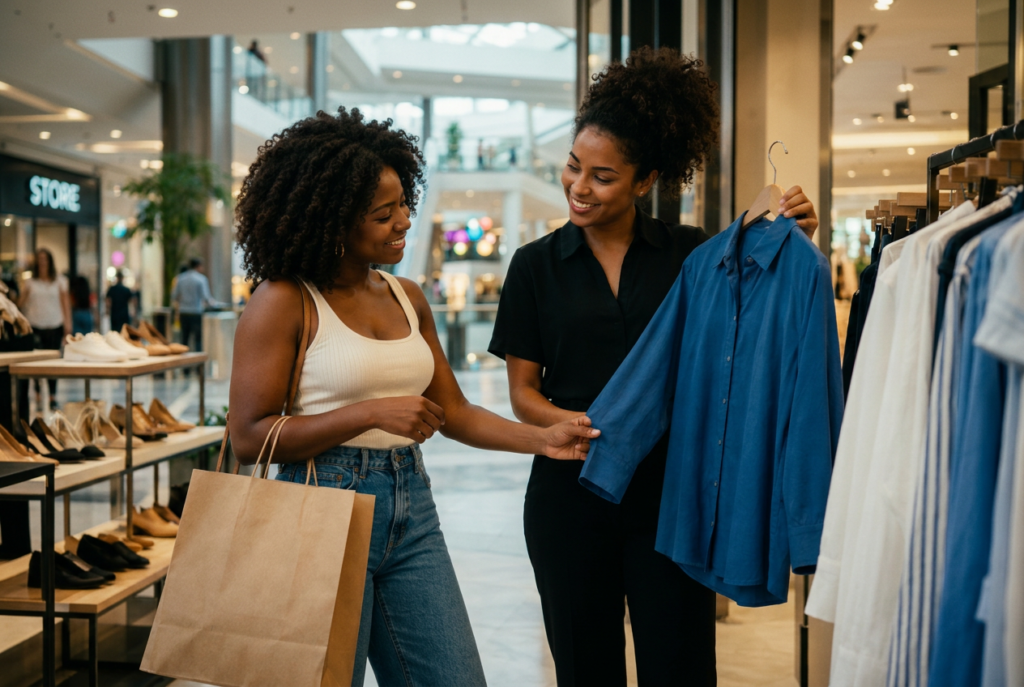

Brazilian Portuguese shopping vocabulary helps you find stores, ask about prices, try on clothes, and explain what you need. Whether you visit a mall or browse a department store, a few useful words make the experience easier. In this guide, you will learn the vocabulary from the pictured shopping scenes, adapted to everyday Brazilian Portuguese, plus practical phrases for real conversations.
Shopping involves more than knowing the names of products. For example, you may need to find a restroom, ask for another size, or locate the customer service desk. Therefore, this guide combines store departments, mall facilities, and short dialogues you can practice before shopping in Brazil.
Essential Brazilian Portuguese Shopping Vocabulary
Start with the words that describe the shopping experience itself. Then, add the names of places and people you might encounter.
| Brazilian Portuguese | English | Practical note |
|---|---|---|
| as compras | shopping; purchases | The meaning depends on the sentence. |
| fazer compras | to shop; to go shopping | Use this for the activity. |
| comprar | to buy | Use this when purchasing something. |
| a loja | store; shop | A general word for a retail business. |
| o shopping / o shopping center | shopping mall | In Brazilian Portuguese, shopping commonly means a mall. |
| o centro comercial | shopping center; commercial complex | This can describe a group of shops and businesses. |
| a loja de departamentos | department store | A store with several product departments. |
| o departamento / a seção | department; section | Both help you describe areas within a store. |
| o produto | product | A general term for an item on sale. |
| o cliente / a cliente | customer | The noun keeps the same form; the article changes. |
| o vendedor / a vendedora | salesperson | Useful when asking who can help you. |
| o atendente / a atendente | sales assistant; service attendant | A broader term for someone serving customers. |
| o caixa | checkout; cashier | Context identifies the counter or the person. |
| a sacola | shopping bag | A bag for carrying your purchases. |
| a vitrine | shop window; display window | Usually the display at the front of a store. |
For example, “Vou ao shopping” means “I’m going to the mall.” By contrast, “Vou fazer compras” means “I’m going shopping.” Although the English word shopping describes an activity, the borrowed word often names a place in Brazil.
Useful First Phrases
These short sentences work in many stores. In addition, they help you start a conversation without complicated grammar.
| Portuguese phrase | English meaning |
|---|---|
| Com licença. | Excuse me. |
| Você pode me ajudar, por favor? | Can you help me, please? |
| Estou procurando uma camiseta. | I’m looking for a T-shirt. |
| Onde fica essa loja? | Where is that store? |
| Estou só olhando, obrigado/obrigada. | I’m just looking, thank you. |
Use obrigado if you are male and obrigada if you are female. Meanwhile, por favor works for everyone and makes a request more polite.
Finding Your Way Around a Brazilian Mall
Malls contain shops, shared facilities, and several levels. Therefore, learning location words helps you understand directions as well as store maps.
| Brazilian Portuguese | English |
|---|---|
| a entrada | entrance |
| a saída | exit |
| o átrio / o espaço central | atrium; central space |
| o térreo | ground floor |
| o primeiro andar | first level above the ground floor |
| o segundo andar | second level above the ground floor |
| o piso | level; floor |
| a escada rolante | escalator |
| o elevador | elevator |
| o mapa do shopping | mall map |
| o diretório de lojas | store directory |
| o banheiro | restroom; bathroom |
| o fraldário | baby changing room |
| o estacionamento | parking area |
| a praça de alimentação | food court |
| o balcão de informações | information desk |
| o atendimento ao cliente | customer service |
Átrio describes the architectural space, but espaço central may feel easier in an everyday conversation. Likewise, mapa do shopping offers a straightforward way to ask for a directory.
Understanding Floors and Levels
The vocabulary in the photos distinguishes the ground floor from the levels above it. In Brazil, térreo commonly names the ground floor, while primeiro andar usually names the level directly above it. However, malls may use their own labels, such as Piso 1, Piso 2, or named levels.
Consequently, check the mall’s signs instead of assuming that every building follows the same numbering system. The phrase “Em qual piso fica a loja?” avoids confusion and means “On which level is the store?”
Asking for Directions
Use onde fica to ask where a place is. Then, listen for words such as perto (near), ao lado (next to), and em frente (opposite; in front of).
| Portuguese phrase | English meaning |
|---|---|
| Onde fica o banheiro? | Where is the restroom? |
| Tem um fraldário aqui? | Is there a baby changing room here? |
| Onde fica a escada rolante? | Where is the escalator? |
| A loja fica no térreo? | Is the store on the ground floor? |
| Em qual piso fica a praça de alimentação? | On which level is the food court? |
| Fica ao lado do elevador. | It’s next to the elevator. |
| Fica em frente à papelaria. | It’s opposite the stationery store. |
For example, an employee might say “A perfumaria fica no segundo andar, perto do elevador.” This means “The perfume store is on the second level above the ground floor, near the elevator.”
Department Store Vocabulary in Brazilian Portuguese
A department store brings several product categories together. As a result, department names help you reach the right area quickly.
Clothing, Lingerie, Shoes, and Sports
The photos use expressions such as roupa de homem and roupa de senhora. In Brazilian stores, however, roupas masculinas and roupas femininas are more natural department labels.
| Brazilian Portuguese | English |
|---|---|
| as roupas masculinas / a moda masculina | menswear; men’s fashion |
| as roupas femininas / a moda feminina | womenswear; women’s fashion |
| as roupas infantis / a moda infantil | children’s clothing; children’s fashion |
| a seção infantil | children’s department |
| a lingerie | lingerie |
| as roupas íntimas | underwear |
| os calçados | footwear |
| a seção de calçados | shoe department |
| as roupas esportivas | sportswear |
| os artigos esportivos | sporting goods |
Roupas esportivas refers specifically to clothing. By comparison, artigos esportivos can include balls, exercise accessories, and other equipment.
Perfumes and Beauty Products
For beauty shopping, begin with broad categories. After that, name the specific product you want.
| Brazilian Portuguese | English |
|---|---|
| a perfumaria | perfume store; fragrance department |
| o perfume | perfume |
| os produtos de beleza | beauty products |
| os cosméticos | cosmetics |
| a maquiagem | makeup |
| o hidratante | moisturizer |
| o protetor solar | sunscreen |
| o batom | lipstick |
| o xampu / o shampoo | shampoo |
For instance, “Onde fica a seção de cosméticos?” means “Where is the cosmetics section?” Alternatively, ask “Vocês têm esse perfume?” when looking for a particular fragrance.
Home Textiles, Furniture, and Decoration
The pictured expression têxteis para o lar describes household textiles. In Brazil, cama, mesa e banho is a familiar retail label for bedding, table linens, and bathroom textiles.
| Brazilian Portuguese | English |
|---|---|
| a seção de cama, mesa e banho | bedding, table linen, and bath linen department |
| o lençol | bedsheet |
| a fronha | pillowcase |
| a toalha de banho | bath towel |
| a toalha de mesa | tablecloth |
| os móveis | furniture |
| a decoração | decoration; home decor |
| os artigos de decoração | decorative items |
| a cortina | curtain |
| o tapete | rug |
| a iluminação | lighting |
| a luminária | light fixture; lamp |
Móveis works naturally when discussing furniture in everyday Brazilian Portuguese. Meanwhile, mobiliário also means furniture, but often sounds more formal or technical.
Kitchenware, Tableware, Appliances, and Electronics
These categories can sit near each other, yet they describe different products. Therefore, choose the word that matches the item you need.
| Brazilian Portuguese | English |
|---|---|
| os utensílios de cozinha | kitchen utensils; kitchenware |
| as utilidades domésticas | household goods |
| a louça | tableware; crockery |
| o prato | plate |
| a xícara | cup |
| os talheres | cutlery; silverware |
| a panela | cooking pot; pan |
| os eletrodomésticos | household appliances |
| a geladeira | refrigerator |
| a máquina de lavar roupa | washing machine |
| o micro-ondas | microwave |
| os eletrônicos | electronics |
| a televisão / a TV | television |
| o celular | cell phone |
In Brazilian Portuguese, write louça, rather than the loiça shown in the photos. Also, louça covers everyday dishes and does not necessarily mean fine china.
The pictured television section carries the label eletrodomésticos. For clarity, however, use eletrônicos for electronics and eletrodomésticos for household appliances such as refrigerators and washing machines.
Haberdashery, Toys, Stationery, Groceries, and Luggage
Some departments require vocabulary you may not encounter in beginner lessons. Nevertheless, these words help you describe common shopping needs.
| Brazilian Portuguese | English |
|---|---|
| o armarinho / a seção de armarinho | haberdashery; sewing notions store or section |
| a linha | thread |
| a agulha | needle |
| o botão | button |
| o zíper | zipper |
| os brinquedos | toys |
| a seção de brinquedos | toy department |
| a papelaria | stationery store; stationery department |
| o caderno | notebook |
| a caneta | pen |
| o supermercado | supermarket |
| os alimentos | food items |
| os mantimentos | groceries; food supplies |
| as malas | suitcases |
| a seção de malas | luggage department |
| a mochila | backpack |
In Brazil, armarinho commonly describes a shop or department selling thread, buttons, and sewing supplies. Similarly, seção de malas sounds more natural for retail luggage than a literal translation using bagagens.
Portuguese From Portugal vs. Brazilian Portuguese
The photos include several expressions associated with European Portuguese. Although Brazilians may understand many of them, the alternatives below better match everyday shopping in Brazil.
| Wording in the photos | Natural Brazilian alternative | English meaning |
|---|---|---|
| centro comercial | shopping / shopping center | shopping mall |
| grandes armazéns | loja de departamentos | department store |
| rés do chão | térreo | ground floor |
| escadas rolantes | escadas rolantes | escalators; the term is the same |
| casas de banho | banheiros | restrooms |
| roupa de homem | roupas masculinas | menswear |
| roupa de senhora | roupas femininas | womenswear |
| seção de criança | seção infantil | children’s department |
| seção de bagagens | seção de malas | luggage department |
| seção de sapataria | seção de calçados | shoe department |
| planta do centro | mapa do shopping | mall map |
| empregado / empregada | vendedor/vendedora or atendente | sales assistant |
| têxteis para o lar | cama, mesa e banho | household linens |
| mobiliário e decoração | móveis e decoração | furniture and home decor |
| retrosaria | armarinho | sewing notions; haberdashery |
| equipamento de cozinha | utensílios de cozinha | kitchenware |
| loiça | louça | tableware |
| artigos desportivos | artigos esportivos | sporting goods |
| Quanto custa isto? | Quanto custa isso? | How much is this? |
These alternatives reflect common usage, rather than a rule that every original expression is incorrect in Brazil. For example, centro comercial and mobiliário also occur in Brazilian Portuguese, but their meaning or register may differ from the simplest shopping vocabulary.
Both isto and isso belong to Brazilian Portuguese. In everyday speech, however, shoppers often use “Quanto custa isso?”, including when pointing to an item nearby.
Trying On Clothes and Asking for Another Size
Once you find the clothing department, you may want to check the fit. First, learn provador, which means “fitting room.” Then, practice asking about size and color.
| Brazilian Portuguese | English |
|---|---|
| o provador | fitting room |
| o tamanho | size |
| a cor | color |
| pequeno / P | small |
| médio / M | medium |
| grande / G | large |
| extra grande / GG | extra large |
| experimentar | to try on; to try |
| vestir | to wear; to put on clothing |
| apertado | tight |
| largo | loose |
Size labels vary across brands. Therefore, use these letters as vocabulary cues and check the fit before buying.
Practical Fitting Room Phrases
| Portuguese phrase | English meaning |
|---|---|
| Onde ficam os provadores? | Where are the fitting rooms? |
| Posso experimentar esta camisa? | Can I try on this shirt? |
| Você tem um tamanho maior? | Do you have a larger size? |
| Tem um tamanho menor? | Is there a smaller size? |
| Vocês têm essa camiseta em azul? | Do you have this T-shirt in blue? |
| Ficou apertado. | It’s too tight. |
| Ficou largo. | It’s too loose. |
| Serviu bem. | It fits well. |
| Vou levar esta. | I’ll take this one. |
Notice that adjectives agree with the clothing item. For example, “A camisa ficou apertada” describes a feminine noun, while “O vestido ficou apertado” describes a masculine noun.
Asking About Prices, Paying, and Exchanging Items
Price questions form an essential part of Brazilian Portuguese shopping vocabulary. In addition, a few payment words help you understand the checkout conversation.
| Brazilian Portuguese | English |
|---|---|
| o preço | price |
| o desconto | discount |
| a promoção | special offer; sale |
| pagar | to pay |
| o dinheiro | cash; money |
| o cartão de crédito | credit card |
| o cartão de débito | debit card |
| o troco | change |
| a nota fiscal | fiscal receipt; sales document |
| o comprovante | proof of payment; transaction receipt |
| trocar | to exchange |
| devolver | to return |
| a troca | exchange |
| a devolução | return |
Nota fiscal and comprovante do not always name the same document. For example, a card transaction receipt may show the payment without providing the full sales details of a nota fiscal.
Useful Checkout Questions
| Portuguese phrase | English meaning |
|---|---|
| Quanto custa isso? | How much is this? |
| Qual é o preço? | What’s the price? |
| Está em promoção? | Is it on sale? |
| Tem desconto? | Is there a discount? |
| Vocês aceitam cartão? | Do you accept cards? |
| Posso pagar no débito? | Can I pay by debit card? |
| Vou pagar em dinheiro. | I’ll pay in cash. |
| Pode me dar a nota fiscal, por favor? | Can you give me the receipt, please? |
| Posso trocar isso? | Can I exchange this? |
| Qual é o prazo para troca? | What’s the time limit for an exchange? |
| Posso devolver este produto? | Can I return this product? |
Trocar means to exchange an item, whereas devolver means to return it. Before buying, ask about the store’s policy so you understand its conditions.
Short Shopping Dialogues to Practice
These examples combine directions, clothing sizes, and payment vocabulary. First, read each dialogue aloud; afterward, replace the product or department with something you need.
Finding a Department
Customer: Com licença. Onde fica a seção de calçados?
Excuse me. Where is the shoe department?
Employee: Fica no primeiro andar, ao lado da seção de roupas femininas.
It’s on the first level above the ground floor, next to the womenswear section.
Customer: E onde fica a escada rolante?
And where is the escalator?
Employee: Ali, perto do elevador.
Over there, near the elevator.
Asking for a Different Size
Customer: Posso experimentar esta camiseta?
Can I try on this T-shirt?
Employee: Claro. Os provadores ficam ali.
Of course. The fitting rooms are over there.
Customer: Ficou apertada. Você tem tamanho G?
It’s too tight. Do you have size large?
Employee: Tenho, sim. Vou buscar para você.
Yes, I do. I’ll get it for you.
Paying at the Checkout
Customer: Quanto custa esta bolsa?
How much is this bag?
Employee: Custa cento e vinte reais.
It costs 120 reais.
Customer: Posso pagar no débito?
Can I pay by debit card?
Employee: Pode, sim.
Yes, you can.
Customer: Ótimo. Vou levar.
Great. I’ll take it.
How to Practice Brazilian Portuguese Shopping Vocabulary
Learning words in groups makes them easier to use. For example, connect camiseta, tamanho, and provador with one shopping situation rather than memorizing them separately.
- Choose five departments. Start with clothing, shoes, cosmetics, kitchenware, and stationery.
- Build a question for each one. For instance, say “Onde fica a papelaria?”
- Add a product. Next, practice “Estou procurando um caderno.”
- Ask about the price. Then, use “Quanto custa isso?”
- Finish the purchase. Finally, say “Vou levar” and choose a payment phrase.
For additional practice, describe an imaginary mall. You might say “A papelaria fica no térreo, e a seção de brinquedos fica no primeiro andar.” This exercise links product vocabulary with useful location words.
Quick Shopping Vocabulary Exercises
Try these questions before checking the answers. Afterward, read the completed phrases aloud to reinforce the vocabulary.
Exercise 1: Choose the Natural Brazilian Term
- What is the common Brazilian word for casas de banho?
- Which retail label commonly describes household linens in Brazil?
- What does loja de departamentos mean in English?
- Which word names a fitting room?
- What is a natural Brazilian alternative to retrosaria?
Answers:
- Banheiros.
- Cama, mesa e banho.
- Department store.
- Provador.
- Armarinho.
Exercise 2: Translate These Shopping Phrases
- Where is the escalator?
- Can I try on this shirt?
- Do you have a larger size?
- How much is this?
- Can I exchange this?
Suggested answers:
- Onde fica a escada rolante?
- Posso experimentar esta camisa?
- Você tem um tamanho maior?
- Quanto custa isso?
- Posso trocar isso?
Frequently Asked Questions
How Do You Say “Shopping Mall” in Brazilian Portuguese?
Use shopping or shopping center. For example, “Vamos ao shopping?” means “Shall we go to the mall?”
What Is the Difference Between “Shopping” and “Compras”?
In Brazil, shopping usually names the mall, while compras refers to shopping or purchases. Therefore, “fazer compras no shopping” means “to go shopping at the mall.”
How Do You Ask “How Much Is This?” in Brazil?
Say “Quanto custa isso?” Alternatively, “Qual é o preço?” means “What’s the price?”
What Is the Brazilian Word for “Restroom”?
The everyday word is banheiro. Consequently, “Onde fica o banheiro?” works well when asking for directions in a mall or store.
How Do You Say “Department Store” in Brazilian Portuguese?
Say loja de departamentos. Within the store, you can ask for a specific seção, such as seção de calçados or seção de brinquedos.
Put Your Shopping Vocabulary Into Practice
Brazilian Portuguese shopping vocabulary gives you the tools to navigate malls, find departments, and speak with store employees. Start with “Onde fica…?”, “Quanto custa isso?”, and “Posso experimentar?” Then, add the product names that match your interests.
With regular practice, these small conversations become easier. On your next shopping trip, try asking one question in Portuguese and build from there.