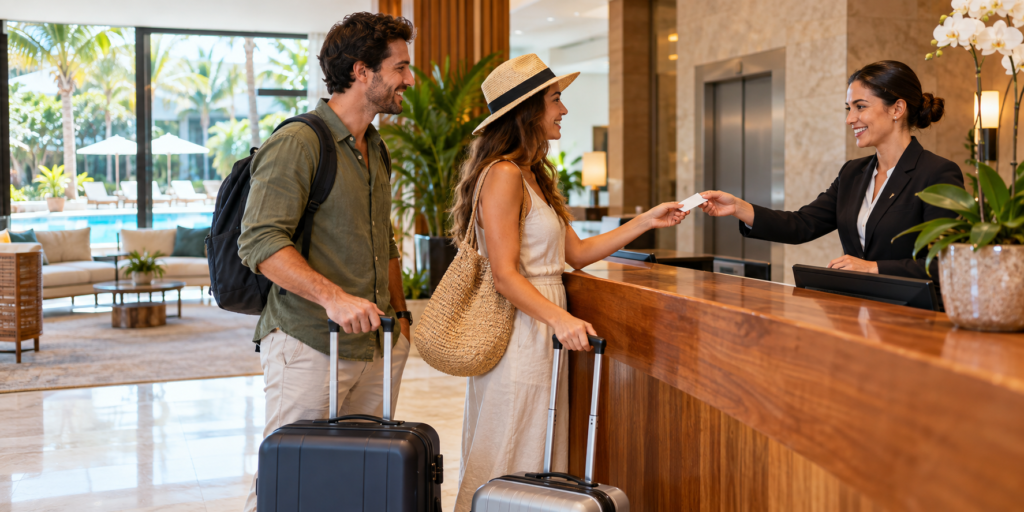

Brazilian Portuguese hotel vocabulary helps you book a room, speak with reception staff, and ask for the services you need. Whether you want breakfast, a private bathroom, or help with your luggage, a few practical expressions make communication easier. In addition, learning the Brazilian terms helps you avoid confusion with vocabulary from Portugal.
This guide covers hotel spaces, room types, meals, and everyday requests. Along the way, you will find English translations and short conversations you can practice before your trip.
Essential Brazilian Portuguese Hotel Vocabulary
Start with the words you will use when you arrive. Then, combine them with simple phrases such as “Onde fica…?” (Where is…?) and “Preciso de…” (I need…).
| Brazilian Portuguese | English |
|---|---|
| o hotel | hotel |
| a recepção | reception; front desk |
| o lobby / o saguão | lobby |
| o balcão da recepção | reception counter |
| o hóspede / a hóspede | guest |
| o recepcionista / a recepcionista | receptionist |
| a reserva | reservation |
| a hospedagem | accommodation; lodging |
| a estadia | stay |
| a diária | nightly rate; one night’s accommodation charge |
| o quarto | room |
| o número do quarto | room number |
| a chave | key |
| o cartão de acesso / o cartão-chave | key card |
| o elevador | elevator |
| a bagagem | luggage |
| a mala | suitcase |
| o carrinho de bagagem | luggage cart |
| o mensageiro / a mensageira | bell attendant; bellhop |
| o porteiro / a porteira | door attendant; doorman / doorwoman |
How to Use Articles with Hotel Words
Portuguese nouns have grammatical gender. For example, say “o hotel” but “a recepção.” Learning the article together with the noun helps you form sentences correctly.
Some words keep the same form for different genders. However, the article changes: “o hóspede” and “a hóspede,” or “o recepcionista” and “a recepcionista.”
Try these examples:
| Portuguese | English |
|---|---|
| Onde fica a recepção? | Where is the front desk? |
| Preciso da chave do quarto. | I need the room key. |
| Pode me ajudar com a bagagem? | Can you help me with my luggage? |
| Qual é o número do meu quarto? | What is my room number? |
Porteiro and Mensageiro: Different Roles
The word “porteiro” usually refers to someone who works at the entrance. Meanwhile, a “mensageiro” may help guests carry luggage and reach their rooms.
Therefore, “mensageiro” is often a better match for “bellhop” than “porteiro.” Staff duties can overlap, so you can simply ask reception for help with your bags.
Booking a Hotel Room in Portuguese
Before you arrive, you may need to ask about availability and prices. For this reason, learn “reserva,” “disponível,” and “diária” first.
| Portuguese phrase | English meaning |
|---|---|
| Vocês têm quartos disponíveis? | Do you have any rooms available? |
| Gostaria de fazer uma reserva. | I would like to make a reservation. |
| Preciso de um quarto para uma pessoa. | I need a room for one person. |
| Gostaria de um quarto para três noites. | I would like a room for three nights. |
| Qual é o valor da diária? | What is the nightly rate? |
| O café da manhã está incluído? | Is breakfast included? |
| Vocês cobram alguma taxa adicional? | Do you charge any additional fees? |
| Qual é a política de cancelamento? | What is the cancellation policy? |
Diária, Noite, and Estadia
“Diária” refers to the accommodation charge for a night within the hotel’s arrival and departure schedule. However, it does not automatically mean you can stay for 24 hours after arriving.
“Noite” means “night,” so “três noites” describes the length of a three-night booking. Meanwhile, “estadia” refers to the whole stay.
For example, ask “Qual é o valor total da estadia?” to learn the total price. Then, confirm whether the hotel includes breakfast and any additional charges in that amount.
Polite Ways to Make a Request
“Gostaria de…” means “I would like…” and works well for reservations. Alternatively, “Queria…” is a common, polite way to request something in conversation.
You can say “Queria um quarto individual, por favor.” However, “Quero um quarto individual” sounds more direct.
For an easy beginner pattern, use “Gostaria de” + a noun or verb. For instance, “Gostaria de reservar um quarto” means “I would like to book a room.”
Hotel Room Types in Brazilian Portuguese
Room names help you describe your needs. However, the name alone may not tell you exactly which beds the hotel provides.
| Brazilian Portuguese | English meaning |
|---|---|
| o quarto individual / o quarto de solteiro | single room |
| o quarto de casal | room with a double bed |
| o quarto com duas camas de solteiro | twin room; room with two single beds |
| o quarto duplo | double-occupancy room; confirm the beds |
| o quarto triplo | triple room |
| a suíte | suite; a room with a private bathroom in some accommodation listings |
| o banheiro privativo | private bathroom |
| o banheiro compartilhado | shared bathroom |
| a cama de solteiro | single bed |
| a cama de casal | double bed |
Quarto de Casal vs. Quarto com Duas Camas
A “quarto de casal” usually has a bed for two people. Nevertheless, you do not need to be a couple to book one.
If you want separate beds, ask for “um quarto com duas camas de solteiro.” This description makes the arrangement clear.
By contrast, hotels may use “quarto duplo” for different bed configurations. Therefore, ask “O quarto tem uma cama de casal ou duas camas de solteiro?”
That question means: “Does the room have one double bed or two single beds?”
Asking About a Private Bathroom
In Brazil, use “banheiro privativo” for “private bathroom.” For example, ask “O quarto tem banheiro privativo?”
You may also see “suíte” in accommodation descriptions. However, do not assume it always means a large room with a separate living area.
Instead, check the description or ask “A suíte tem uma sala separada?” This means “Does the suite have a separate living room?”
Checking In and Speaking with Reception
Brazilian hotels commonly use the English terms “check-in” and “check-out.” Consequently, you can use those words inside a Portuguese sentence.
| Portuguese phrase | English meaning |
|---|---|
| Tenho uma reserva. | I have a reservation. |
| A reserva está no nome de Ramon. | The reservation is under the name Ramon. |
| Gostaria de fazer o check-in. | I would like to check in. |
| Aqui está meu documento. | Here is my ID. |
| A que horas posso entrar no quarto? | What time can I enter the room? |
| Onde fica o elevador? | Where is the elevator? |
| Qual é a senha do Wi-Fi? | What is the Wi-Fi password? |
| O cartão do quarto não está funcionando. | The room key card is not working. |
Example Check-In Conversation
Receptionist: Boa tarde! Como posso ajudar?
Good afternoon! How can I help?
Guest: Boa tarde! Tenho uma reserva no nome de Ramon.
Good afternoon! I have a reservation under the name Ramon.
Receptionist: Pode me mostrar seu documento, por favor?
Can you show me your ID, please?
Guest: Claro. O café da manhã está incluído?
Of course. Is breakfast included?
Receptionist: Sim. Aqui está o cartão do seu quarto.
Yes. Here is your room key card.
Guest: Obrigado! Onde fica o elevador?
Thank you! Where is the elevator?
Use “obrigado” if you are a male speaker and “obrigada” if you are a female speaker. In either case, the word refers to the person giving thanks.
Brazilian Portuguese Hotel Vocabulary for Services
Once you settle in, you may want food, clean clothes, or fresh towels. In addition, knowing the names of hotel facilities helps you ask where they are.
| Brazilian Portuguese | English |
|---|---|
| o serviço de limpeza / a limpeza do quarto | housekeeping; room cleaning |
| o camareiro / a camareira | room attendant |
| o serviço de lavanderia / a lavanderia | laundry service; laundry |
| o serviço de quarto | room service |
| a bandeja de café da manhã | breakfast tray |
| o frigobar | minibar; small refrigerator |
| o restaurante | restaurant |
| a academia | gym; fitness center |
| a piscina | swimming pool |
| a toalha | towel |
| o lençol | bedsheet |
| o travesseiro | pillow |
| o cobertor | blanket |
| o ar-condicionado | air conditioning; air conditioner |
Room Service and Housekeeping
“Serviço de quarto” usually refers to food or drinks delivered to your room. By contrast, “limpeza do quarto” refers to housekeeping.
Therefore, ask “Vocês têm serviço de quarto?” when you want to order food. To request cleaning, say “Gostaria de solicitar a limpeza do quarto.”
Here are additional requests:
| Portuguese phrase | English meaning |
|---|---|
| Preciso de mais uma toalha, por favor. | I need one more towel, please. |
| Poderia trazer outro travesseiro? | Could you bring another pillow? |
| Posso pedir o café da manhã no quarto? | Can I order breakfast in my room? |
| Quanto custa o serviço de lavanderia? | How much does the laundry service cost? |
| O ar-condicionado não está funcionando. | The air conditioner is not working. |
| A que horas a piscina abre? | What time does the pool open? |
| Onde fica a academia? | Where is the gym? |
Understanding Frigobar Charges
“Frigobar” is the usual Brazilian word for the small refrigerator in a hotel room. However, drinks and snacks inside it may cost extra.
Before consuming anything, ask “Os produtos do frigobar estão incluídos na diária?” This means “Are the minibar items included in the nightly rate?”
Alternatively, ask “Onde está a tabela de preços do frigobar?” to find the minibar price list.
Breakfast and Hotel Meal Plans
In Brazil, “café da manhã” means “breakfast.” Although “café” also means “coffee,” the full expression refers to the morning meal.
| Brazilian Portuguese | English meaning |
|---|---|
| a hospedagem com café da manhã | accommodation with breakfast |
| o café da manhã incluído | breakfast included |
| a meia pensão | half board |
| a pensão completa | full board |
| o almoço | lunch |
| o jantar | dinner |
| as bebidas | drinks |
Meia Pensão vs. Pensão Completa
“Meia pensão” generally includes breakfast and one other main meal. However, confirm whether the hotel offers lunch or dinner as that second meal.
“Pensão completa” generally includes breakfast, lunch, and dinner. Nevertheless, drinks, snacks, and room service may involve separate charges.
For clarity, ask “Quais refeições estão incluídas?” That question means “Which meals are included?”
Then, follow up with “As bebidas também estão incluídas?” to ask whether the meal plan includes drinks.
Useful Breakfast Questions
| Portuguese phrase | English meaning |
|---|---|
| A que horas começa o café da manhã? | What time does breakfast start? |
| Até que horas vocês servem o café da manhã? | Until what time do you serve breakfast? |
| Onde vocês servem o café da manhã? | Where do you serve breakfast? |
| Vocês têm leite sem lactose? | Do you have lactose-free milk? |
| Posso levar o café da manhã para o quarto? | Can I take breakfast to my room? |
Portugal Portuguese vs. Brazilian Hotel Terms
The photos include several expressions associated with Portuguese from Portugal. For a trip to Brazil, use the alternatives below.
| Term in the photos | Brazilian alternative | English meaning |
|---|---|---|
| pequeno-almoço | café da manhã | breakfast |
| bandeja do pequeno-almoço | bandeja de café da manhã | breakfast tray |
| alojamento com pequeno-almoço | hospedagem com café da manhã | accommodation with breakfast |
| casa de banho privativa | banheiro privativo | private bathroom |
| ginásio | academia | gym; fitness center |
| minibar | frigobar | minibar |
| cartão de proximidade | cartão de acesso / cartão-chave | hotel key card |
Some words, including “hotel,” “recepção,” “elevador,” and “piscina,” work in both varieties. Meanwhile, Brazilian speakers may understand other terms from context, even when they prefer a different word.
Be especially careful with “ginásio.” In Brazil, this word often refers to a sports hall rather than a hotel fitness center.
Checking Out and Paying the Bill
Before leaving, confirm your departure time and final charges. Then, ask reception about luggage storage if you plan to explore the area afterward.
| Portuguese phrase | English meaning |
|---|---|
| Qual é o horário de check-out? | What is the check-out time? |
| A que horas preciso sair do quarto? | What time do I need to leave the room? |
| Gostaria de fazer o check-out. | I would like to check out. |
| Pode conferir a conta, por favor? | Can you check the bill, please? |
| Posso pagar com cartão? | Can I pay by card? |
| Gostaria de um recibo, por favor. | I would like a receipt, please. |
| Posso deixar minha bagagem aqui por algumas horas? | Can I leave my luggage here for a few hours? |
| É possível sair mais tarde? | Is it possible to check out later? |
If you need more time, ask about availability before assuming you can stay. Also, confirm the cost with “Há alguma cobrança adicional?” (Is there any additional charge?).
How to Practice Hotel Vocabulary
First, learn five words: “reserva,” “quarto,” “diária,” “recepção,” and “chave.” Next, practice one sentence for each word.
For example, imagine arriving at reception and saying “Tenho uma reserva.” After that, request your preferred bed arrangement and ask whether breakfast is included.
To practice services, describe a simple need such as “Preciso de uma toalha.” Finally, rehearse asking “Qual é o horário de check-out?”
You can also change one detail in each sentence. For instance, replace “três noites” with “duas noites,” or change “uma toalha” to “um travesseiro.”
Frequently Asked Questions
How Do You Say “I Have a Reservation” in Portuguese?
Say “Tenho uma reserva.” To add your name, continue with “A reserva está no nome de…”
What Is the Brazilian Portuguese Word for Breakfast?
The Brazilian term is “café da manhã.” Therefore, ask “O café da manhã está incluído?” when checking your booking.
How Do You Ask for a Twin Room?
Say “Gostaria de um quarto com duas camas de solteiro.” This phrase explicitly requests two separate single beds.
What Does Diária Mean at a Hotel?
“Diária” refers to the charge for one night’s accommodation. However, the hotel sets specific check-in and check-out times.
How Do You Ask About the Check-Out Time?
Ask “Qual é o horário de check-out?” Alternatively, say “A que horas preciso sair do quarto?”
Put Your Brazilian Portuguese Hotel Vocabulary into Practice
With this Brazilian Portuguese hotel vocabulary, you can describe your room preferences, ask about meals, and request help during your stay. Start with short phrases, then add details as you gain confidence.
Above all, remember the practical Brazilian terms “café da manhã,” “banheiro,” “academia,” and “frigobar.” By practicing them in complete sentences, you will feel more prepared for your next hotel stay in Brazil.