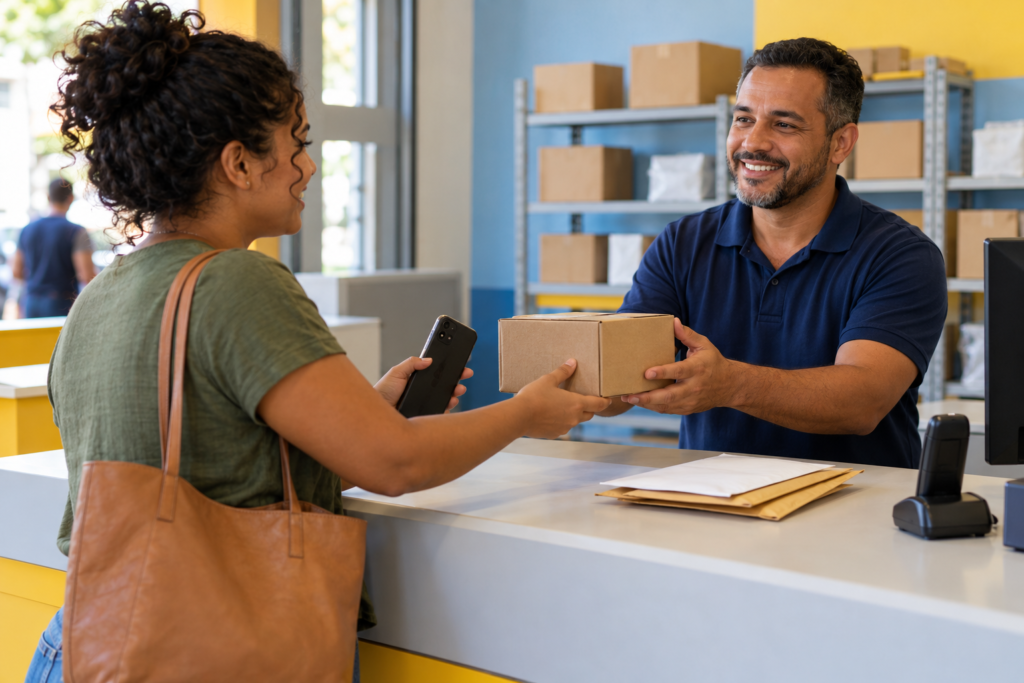

Brazilian Portuguese communication vocabulary helps you send a package, make a phone call, and exchange messages with confidence. For example, knowing endereço (address), celular (cell phone), and senha (password) makes everyday conversations easier. This guide explains essential words for postal services, deliveries, telephones, and digital communication.
Some Portuguese textbooks use vocabulary from Portugal. However, Brazilians often choose different words for the same objects. You will therefore learn the Brazilian equivalents, along with English translations, practical phrases, and short exercises.
Brazilian Portuguese communication vocabulary: key differences
Start with the words that change most noticeably between Portugal and Brazil. Although people may understand a term from another variety of Portuguese, local vocabulary usually sounds more natural.
| Portuguese from Portugal | Brazilian Portuguese | English |
|---|---|---|
| a morada | o endereço | address |
| a morada do remetente | o endereço do remetente | sender’s address / return address |
| o código postal | o CEP / o código postal | postal code / ZIP code |
| o telemóvel | o celular | cell phone / mobile phone |
| a palavra-passe | a senha | password / passcode, depending on context |
| a aplicação | o aplicativo / o app | app |
| o telefone sem fios | o telefone sem fio | cordless phone |
| marcar um número | discar um número | to dial a number |
| o indicativo | o código de área / o DDD | area code |
| o correio registado | a carta registrada / a correspondência registrada | registered mail |
| a recolha | a coleta | pickup / collection |
| o marco de correio | a caixa de coleta dos Correios | public postal collection box |
| o gravador de chamadas, meaning an answering machine | a secretária eletrônica | answering machine |
Aplicação has several meanings in Brazil, but aplicativo is the usual word for a phone app. Similarly, use endereço when you ask where someone lives or where to send a letter.
An important distinction concerns the image’s “gravador de chamadas.” In Brazil, that expression suggests a device or program that records calls. Instead, secretária eletrônica describes an answering machine that takes messages when nobody answers.
Post office vocabulary in Brazilian Portuguese
To talk about the national postal company, Brazilians use os Correios. For a particular branch, say a agência dos Correios or simply a agência when the context is clear.
For example, “Vou aos Correios” means “I’m going to the post office.” Meanwhile, “Onde fica a agência dos Correios?” asks where the branch is.
People and equipment at the post office
| Brazilian Portuguese | English | Practical example |
|---|---|---|
| a agência dos Correios | post office / postal branch | A agência fica perto daqui. |
| o funcionário / a funcionária dos Correios | postal employee | A funcionária pode ajudar. |
| o atendente / a atendente | service clerk | Vou perguntar ao atendente. |
| o carteiro / a carteira | mail carrier | O carteiro trouxe uma carta. |
| o guichê | service window | Vá ao guichê de atendimento. |
| o balcão | counter | Coloque a caixa no balcão. |
| a balança | scale | A atendente colocou a encomenda na balança. |
| o saco de correspondência / a mala postal | mailbag | O funcionário levou a mala postal. |
The feminine form carteira can mean a female mail carrier. However, the same word also means “wallet” in another context. Therefore, a sentence such as “A carteira entregou a correspondência” makes the postal meaning clear.
Also, guichê and balcão describe different things. The first refers to a service window or station, while the second names the counter itself.
Letters, envelopes, and addresses
| Brazilian Portuguese | English |
|---|---|
| a carta | letter |
| o envelope | envelope |
| o selo | postage stamp |
| o carimbo postal | postmark |
| a correspondência | mail / correspondence |
| o endereço | address |
| o remetente / a remetente | sender |
| o destinatário / a destinatária | recipient / addressee |
| o endereço do remetente | return address |
| o CEP | Brazilian postal code |
| a assinatura | signature |
Remetente identifies the person sending the item. In contrast, destinatário identifies the person receiving it. Consequently, you need the recipient’s details when you address a letter.
In Brazil, CEP stands for Código de Endereçamento Postal. It contains eight digits, and the standard written format is 00000-000. For address preparation, consult the official Correios addressing guide.
Here are useful questions:
- Qual é o seu endereço? — What is your address?
- Qual é o CEP? — What is the postal code?
- Onde escrevo o endereço do remetente? — Where do I write the return address?
- Preciso assinar aqui? — Do I need to sign here?
Shipping services and package instructions
| Brazilian Portuguese | English |
|---|---|
| a encomenda / o pacote | package / parcel |
| a entrega | delivery |
| a coleta | pickup / collection |
| o envio | sending / shipping |
| a postagem | posting / mailing |
| o valor do envio / o custo da postagem | shipping cost / postage cost |
| a carta registrada | registered letter |
| o envio por via aérea | airmail / air shipment |
| o código de rastreamento | tracking number / tracking code |
| frágil | fragile |
| não dobrar | do not bend |
| este lado para cima | this way up |
The textbook uses franquia for postage. For everyday Brazilian conversations, however, valor do envio or custo da postagem communicates the meaning more clearly. You can ask, “Quanto custa enviar esta carta?” rather than memorize a technical postal term.
Likewise, por avião means “by plane,” but por via aérea sounds more natural when describing a shipping method. For package handling, the instructions frágil, não dobrar, and este lado para cima work in Brazilian Portuguese too.
Mailboxes and delivery workers
Caixa de correio usually refers to a mailbox at a house or building. However, a public box for posting letters can be called caixa de coleta dos Correios. If you mean the narrow opening in a door, use abertura para correspondência or fenda para correspondência.
The word caixa postal has a different meaning: a post office box. In telephone contexts, meanwhile, it can also mean voicemail.
For a courier, entregador or entregadora is often the most useful everyday choice. Mensageiro and mensageira also exist, although the best translation depends on the job. Similarly, motoboy commonly describes a worker who makes deliveries by motorcycle.
Telephone vocabulary in Brazilian Portuguese
Telephone conversations use a small group of recurring words. Therefore, learning the device names and common verbs gives you a practical foundation.
Phones and their parts
| Brazilian Portuguese | English |
|---|---|
| o telefone | telephone |
| o telefone fixo | landline phone |
| o telefone sem fio | cordless phone |
| o celular | cell phone |
| o smartphone | smartphone |
| o fone / o monofone | telephone handset |
| a base | base station |
| o teclado | keypad |
| a secretária eletrônica | answering machine |
| o gravador de chamadas | call recorder |
| a caixa postal | voicemail, in a telephone context |
For the handheld part of a landline phone, fone is a common choice. Monofone is more technical, while auscultador, as shown in the image, is characteristic of European Portuguese in this context.
Be careful with fone de ouvido, which means an earphone or headphones. By contrast, “Tire o fone do gancho” means “Pick up the receiver.”
Verbs for making and answering calls
| Brazilian Portuguese | English | Example |
|---|---|---|
| ligar | to call | Vou ligar para você. |
| fazer uma ligação | to make a call | Preciso fazer uma ligação. |
| discar | to dial | Disque o número novamente. |
| atender | to answer | Você pode atender o telefone? |
| desligar | to hang up / turn off | Ela desligou o telefone. |
| retornar a ligação | to return a call | Vou retornar a ligação mais tarde. |
| deixar um recado | to leave a message | Posso deixar um recado? |
| falar com alguém | to speak to someone | Gostaria de falar com a Ana. |
Ligar can mean either “to call” or “to turn on.” For example, “Vou ligar para a Ana” means you will call Ana. In contrast, “Vou ligar o celular” means you will turn the phone on.
Similarly, desligar changes meaning with context. “Ele desligou a ligação” means he ended the call, while “O celular está desligado” means the phone is off.
Phone status and connection problems
- A linha está ocupada. — The line is busy.
- O celular está desligado. — The cell phone is off.
- A ligação caiu. — The call dropped.
- Estou sem sinal. — I have no signal.
- Não consigo ouvir você. — I can’t hear you.
- Pode repetir, por favor? — Could you repeat that, please?
The English word “disconnected” does not always translate as desligado. For example, an inactive telephone line might be desativada. A dropped call, on the other hand, usually leads to the phrase a ligação caiu.
Messages, apps, and internet vocabulary
Brazilian Portuguese communication vocabulary also includes everyday digital terms. In particular, these words help you ask for internet access and exchange messages.
| Brazilian Portuguese | English |
|---|---|
| o aplicativo / o app | app |
| o Wi-Fi | Wi-Fi |
| a senha | password |
| a senha de desbloqueio / o PIN | unlock passcode / PIN |
| os dados móveis | mobile data |
| o roaming de dados | data roaming |
| a mensagem de texto / o SMS | text message / SMS |
| a mensagem de voz / o áudio | voice message |
| a notificação | notification |
| o contato | contact |
For example, “Qual é a senha do Wi-Fi?” means “What is the Wi-Fi password?” To request a voice message, you can say, “Pode me mandar um áudio?”
Mensagem is a broad term and does not specify the platform. Therefore, “Me manda uma mensagem” could refer to a messaging app or another channel. If you specifically want a text message by SMS, say me manda um SMS.
In casual conversation, mandar is a natural alternative to enviar. Both mean “to send,” although enviar often suits more formal writing.
Useful phrases for everyday communication
These expressions turn individual words into complete requests. Moreover, adding por favor helps you sound polite.
| Brazilian Portuguese | English |
|---|---|
| Gostaria de enviar esta encomenda. | I’d like to send this package. |
| Quanto custa o envio? | How much does shipping cost? |
| Qual é o prazo de entrega? | What is the delivery timeframe? |
| Como posso rastrear a encomenda? | How can I track the package? |
| Você pode me passar o número da agência? | Can you give me the branch’s phone number? |
| Qual é o DDD? | What is the area code? |
| Pode me mandar uma mensagem? | Can you send me a message? |
| Me manda uma mensagem, por favor. | Send me a message, please. |
| Pode me ligar mais tarde? | Can you call me later? |
| Gostaria de falar com a Ana, por favor. | I’d like to speak to Ana, please. |
In Brazil, DDD is the everyday term for the telephone area code. Anatel also uses Código Nacional for this numbering concept. For an official reference, see Anatel’s information on telephone numbering areas.
The textbook phrase “Poderia dar-me o número de…?” is grammatical. However, “Você poderia me passar o número de…?” usually sounds more natural in Brazilian conversation. Similarly, replace “Envia-me uma mensagem!” with “Me manda uma mensagem!” for a casual Brazilian request.
Short dialogues to practice
Sending a package at the post office
Cliente: Bom dia! Gostaria de enviar esta encomenda.
Customer: Good morning! I’d like to send this package.
Atendente: Bom dia! Qual é o CEP do destinatário?
Clerk: Good morning! What is the recipient’s postal code?
Cliente: Está aqui no endereço. Quanto custa o envio?
Customer: It’s here in the address. How much does shipping cost?
Atendente: Primeiro, vou pesar a encomenda. Depois, verifico as opções de envio.
Clerk: First, I’ll weigh the package. Then, I’ll check the shipping options.
Cliente: Certo. Também gostaria de saber o prazo de entrega.
Customer: Okay. I’d also like to know the delivery timeframe.
Returning a phone call
Ana: Alô?
Ana: Hello?
Lucas: Oi, Ana! Aqui é o Lucas. Você me ligou?
Lucas: Hi, Ana! This is Lucas. Did you call me?
Ana: Sim, mas a ligação caiu. Você pode falar agora?
Ana: Yes, but the call dropped. Can you talk now?
Lucas: Agora não posso. Por isso, vou te ligar mais tarde.
Lucas: I can’t right now. That’s why I’ll call you later.
Ana: Tudo bem. Enquanto isso, vou te mandar uma mensagem.
Ana: Okay. In the meantime, I’ll send you a message.
Common mistakes to avoid
Using “morada” for an everyday Brazilian address request. Prefer endereço. For example, ask “Qual é o seu endereço?”
Calling a cell phone “telemóvel.” Instead, use celular when speaking Brazilian Portuguese.
Confusing a stamp with a postmark. A selo is the postage stamp; a carimbo postal is the postal marking. Consequently, the two words do not describe the same thing.
Treating every mailbox as “caixa postal.” Use caixa de correio for a home mailbox. Meanwhile, reserve caixa postal for a post office box or telephone voicemail, depending on context.
Translating “answering machine” as “gravador de chamadas.” Choose secretária eletrônica for the machine that takes messages. However, gravador de chamadas fits a call recorder.
Using “marcar” when you mean to dial. Prefer discar um número. In Brazil, marcar commonly means to schedule or mark something, as in “marcar uma reunião.”
Practice Brazilian Portuguese communication vocabulary
Exercise one: choose the Brazilian equivalent
Replace each term with the most useful Brazilian Portuguese equivalent:
- Morada
- Telemóvel
- Palavra-passe
- Aplicação, meaning a phone app
- Recolha, meaning package pickup
- Telefone sem fios
Exercise two: complete the sentences
Use these words: CEP, remetente, atender, senha, rastreamento, áudio.
- Qual é a ______ do Wi-Fi?
- Você pode ______ o telefone?
- Preciso do ______ para preencher o endereço.
- Quem envia a carta é o ______.
- Pode me mandar um ______ em vez de ligar?
- Qual é o código de ______ da encomenda?
Exercise three: translate into Brazilian Portuguese
- I’d like to send this package.
- What is your address?
- Can you call me later?
- The call dropped.
- What is the area code?
Answer key
Exercise one: 1. Endereço; 2. Celular; 3. Senha; 4. Aplicativo or app; 5. Coleta; 6. Telefone sem fio.
Exercise two: 1. Senha; 2. Atender; 3. CEP; 4. Remetente; 5. Áudio; 6. Rastreamento.
Exercise three:
- Gostaria de enviar esta encomenda.
- Qual é o seu endereço?
- Pode me ligar mais tarde?
- A ligação caiu.
- Qual é o DDD?
Other translations can also work. For example, pacote can replace encomenda in the first sentence.
Frequently asked questions
How do you say “post office” in Brazilian Portuguese?
Use agência dos Correios for a postal branch. In everyday conversation, however, “Vou aos Correios” is a natural way to say “I’m going to the post office.”
Do Brazilians say “celular” or “telemóvel”?
Brazilians normally say celular. In contrast, telemóvel is the usual European Portuguese term.
What does “CEP” mean?
CEP means Código de Endereçamento Postal, Brazil’s postal code. Therefore, you will see this abbreviation in mailing addresses and delivery forms.
How do you ask someone to text you in Brazilian Portuguese?
Say “Me manda uma mensagem, por favor.” For a specific channel, add “pelo WhatsApp” or ask “Pode me mandar um SMS?”
What is the difference between “recado” and “mensagem”?
Recado often means a message you leave for someone, especially through another person. Mensagem, meanwhile, is a broader word for written, recorded, or digital communication. For example, you can deixar um recado at reception or mandar uma mensagem on your phone.
Put your new vocabulary into practice
Brazilian Portuguese communication vocabulary becomes easier to remember when you connect it to daily tasks. First, practice asking for an endereço and a CEP. Then, rehearse sending an encomenda, making a ligação, and requesting a mensagem.
Finally, use the dialogues as starting points for your own conversations. By combining local vocabulary with short, polite requests, you can communicate more confidently at the post office, on the phone, and online.
Publishing note, remove before publication: The draft uses an English focus keyphrase and English explanatory text. Set the page and Yoast analysis language to English. It includes short paragraphs, mostly active constructions, transition words, and one H1. The title and description meet the requested character limits. Actual green indicators require checking the published draft in your Yoast installation, including its assessment of bilingual examples and tables. Add a relevant internal link and a suitable image when publishing; use accurate descriptive alt text.