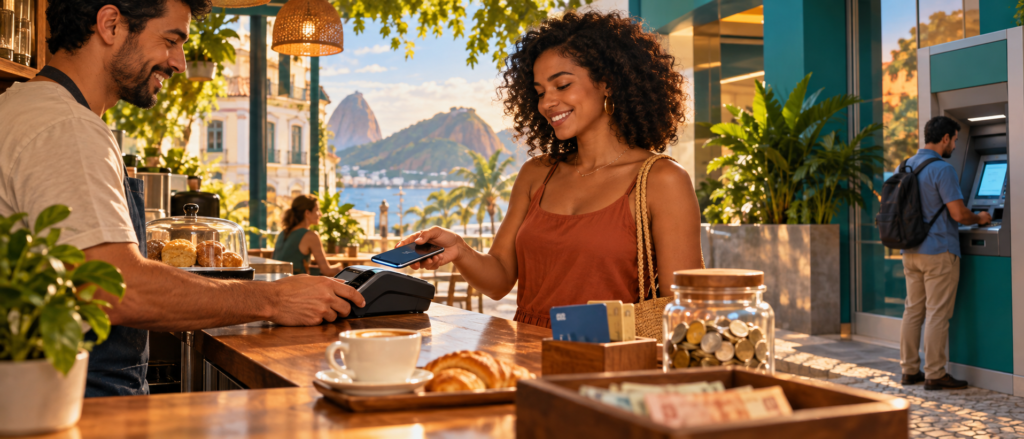

Brazilian Portuguese banking vocabulary helps you do more than recognize words on a screen. It helps you open an account, use an ATM, pay a bill, and ask for help when something goes wrong. In this guide, you will learn the words from the illustrated vocabulary pages, updated where necessary for everyday use in Brazil. You will also see examples you can use at a bank, on an app, or while discussing money.
Brazilian Portuguese banking vocabulary at a glance
The word banco means bank. A cliente is a customer, and an atendente is a staff member who helps customers. Meanwhile, a caixa may be a bank teller or the counter where the teller works. The table below gives you a quick starting point.
| Brazilian Portuguese | English | Useful note |
|---|---|---|
| o banco | bank | Also used for the bank as a company. |
| a agência bancária | bank branch | Often shortened to agência. |
| o cliente / a cliente | customer | The article changes; the noun does not. |
| o caixa / a caixa | teller | Caixa can also mean cash desk or checkout. |
| o guichê | service window | A numbered station for in-person service. |
| o balcão | counter | Used in banks and many other businesses. |
| o atendimento | customer service | Preciso de atendimento means “I need assistance.” |
| a fila | line, queue | A common word when visiting a branch. |
For example, you can say Onde fica o caixa? (“Where is the teller?”). If you need a specific service, say Preciso falar com um atendente (“I need to speak with a staff member”).
Bank counters and service windows
The photo labels guichê as a window and balcão as a counter. In Brazil, a guichê is usually the service station, while balcão describes the physical counter more generally. Therefore, Vá ao guichê três means “Go to window three,” even if no literal window separates you from the employee.
Accounts, cards, and payments in Brazil
Many banking tasks now happen on a phone. Still, you will see the same account and payment terms in apps, at stores, and on bank statements.
| Brazilian Portuguese | English | Example or clarification |
|---|---|---|
| a conta bancária | bank account | Abrir uma conta means “to open an account.” |
| o número da conta | account number | Different from the número da agência (branch number). |
| a conta corrente | checking account | Used for day-to-day transactions. |
| a conta poupança | savings account | Often shortened to poupança. |
| o saldo | balance | Consultar o saldo means “to check the balance.” |
| o extrato bancário | bank statement | Usually a transaction history in an app or document. |
| o cartão de débito | debit card | Money generally comes from your account. |
| o cartão de crédito | credit card | Purchases appear on a fatura (bill or statement). |
| a senha | PIN or password | Context determines the meaning. |
| a maquininha de cartão | card payment terminal | Common everyday term in shops. |
| o pagamento | payment | Fazer um pagamento means “to make a payment.” |
| a quantia / o valor | amount | Valor is particularly common in payment screens. |
The illustrated page calls a card reader terminal de pagamento. That phrase is understandable in Brazil; however, people often call the device at a store a maquininha. Likewise, a printed comprovante is proof of a transaction, while an extrato shows account activity over a period.
Essential verbs for banking
Learn a verb with each noun so you can form useful sentences immediately:
| Verb or expression | English | Example |
|---|---|---|
| abrir uma conta | open an account | Quero abrir uma conta. — I want to open an account. |
| depositar | deposit | Preciso depositar dinheiro. — I need to deposit money. |
| sacar / fazer um saque | withdraw / make a withdrawal | Onde posso sacar dinheiro? — Where can I withdraw cash? |
| transferir | transfer | Vou transferir o valor. — I’ll transfer the amount. |
| pagar | pay | Já paguei a fatura. — I already paid the bill. |
| consultar o saldo | check the balance | Posso consultar meu saldo aqui? — Can I check my balance here? |
| digitar a senha | enter the PIN | Digite sua senha na maquininha. — Enter your PIN on the terminal. |
Levantar dinheiro appears in some Portuguese learning materials. In Brazil, sacar dinheiro or fazer um saque sounds more natural for withdrawing cash.
Using an ATM and a banking app
In everyday Brazilian Portuguese, an ATM is a caixa eletrônico. You may also see caixa automático, but caixa eletrônico is the safer choice for a learner. An ATM may display tela (screen), teclado (keypad), and entrada do cartão (card slot).
An aplicativo do banco, often called app do banco, is a banking app. By contrast, banco on-line or internet banking describes banking through the internet, sometimes specifically through a website. To ask for help, try Como faço uma transferência pelo aplicativo? (“How do I make a transfer through the app?”).
Pix, boletos, and automatic payments
To understand banking in Brazil, add these useful terms to the vocabulary in the pictures:
| Brazilian Portuguese | English explanation |
|---|---|
| o Pix | Brazil’s instant payment system; also a common name for a payment made through it. |
| a chave Pix | an identifier used to receive a Pix payment. |
| o QR Code | a scannable code that may contain payment details. |
| o boleto | a payment slip or bill with payment details. |
| o vencimento | the due date of a bill or payment. |
| o débito automático | automatic debit from an account. |
| a transferência bancária | bank transfer. |
| o comprovante | receipt or proof of payment. |
For instance, Posso pagar por Pix? asks “Can I pay with Pix?” After paying, you might say Pode me enviar o comprovante? (“Can you send me the payment receipt?”). Also, Cadastrei a conta em débito automático means “I set up automatic debit for the bill.”
Saving, borrowing, interest, and bank fees
These Brazilian Portuguese banking vocabulary terms help when you compare accounts or discuss a loan. Because financial products vary, read the conditions before agreeing to a fee or rate.
| Brazilian Portuguese | English | Note |
|---|---|---|
| a poupança | savings; savings account | Context tells you which meaning applies. |
| o empréstimo | loan | Pedir um empréstimo means “to apply for a loan.” |
| o financiamento | financing, often for a major purchase | Common with homes and cars. |
| a hipoteca | mortgage, mortgage lien | In Brazil, housing finance commonly uses financiamento imobiliário; legal structures vary. |
| a taxa de juros | interest rate | Ask whether it applies per month or per year. |
| os juros | interest charges or earnings | Juros altos means “high interest.” |
| o imposto | tax | The specific tax depends on the transaction. |
| a tarifa bancária | bank fee | Often clearer than comissão bancária for an account fee. |
| o cheque especial | arranged overdraft facility | It can create interest charges when used. |
| o limite | limit | May refer to card credit or overdraft access. |
The book translates descoberto as overdraft. In Brazil, you are more likely to hear cheque especial for the overdraft facility on a checking account or saldo negativo for a negative balance. Likewise, tarifa bancária is the everyday expression for many bank charges, while comissão often refers to a commission in a specific transaction.
You can ask Qual é a taxa de juros ao mês? (“What is the monthly interest rate?”). To check a charge, say Por que essa tarifa aparece no meu extrato? (“Why does this fee appear on my statement?”).
Cash and foreign exchange vocabulary
If you travel or exchange money, pay attention to the difference between moeda and dinheiro. Dinheiro means money generally, while moeda can mean a coin or a currency. Meanwhile, nota or cédula means a banknote.
| Brazilian Portuguese | English |
|---|---|
| o dinheiro | money; sometimes cash in context |
| o dinheiro em espécie | cash, specifically physical money |
| a moeda | coin; currency |
| a nota / a cédula | banknote, bill |
| o troco | change returned after a purchase |
| a moeda estrangeira | foreign currency |
| a casa de câmbio | currency exchange office |
| a taxa de câmbio | exchange rate |
| a cotação | quoted price or exchange rate |
| a comissão / a tarifa | commission / fee |
At an exchange office, you can say Qual é a cotação do dólar hoje? (“What is today’s dollar exchange rate?”). Then ask Há alguma taxa ou comissão? (“Is there any fee or commission?”). Finally, Posso trocar estes dólares por reais? means “Can I exchange these dollars for reais?”
Investments and finance terms
The second picture introduces investment words. Some of its translations need care: ações are shares of company stock, while títulos can refer to securities or bonds depending on the context. Calling every título a “stock” would be misleading.
| Brazilian Portuguese | English | Note |
|---|---|---|
| o investimento | investment | Investir means “to invest.” |
| a carteira de investimentos | investment portfolio | Carteira alone can also mean wallet. |
| a ação / as ações | share / shares of stock | Comprar ações means “to buy shares.” |
| o título / os títulos | security; often bond or debt instrument | Check the type of título. |
| os dividendos | dividends | Money distributed to shareholders. |
| o capital próprio | equity | Meaning varies with the business context. |
| o valor nominal | face or nominal value | May differ from the market price. |
| a cotação da ação | share price, quoted stock price | Cotação also applies to currencies. |
| a bolsa de valores | stock exchange | The financial market or exchange. |
| o assessor financeiro / a assessora financeira | financial adviser | Professional roles and titles vary. |
| o corretor / a corretora de valores | investment broker or brokerage | Corretora may refer to the firm. |
| o contador / a contadora | accountant | In Brazil, contador is more usual than contabilista in everyday speech. |
| a moeda digital | digital currency | The term alone does not mean cryptocurrency. |
For example, Tenho uma carteira de investimentos means “I have an investment portfolio.” You could also ask Esses títulos pagam juros? (“Do these securities pay interest?”). When discussing a company, Ela distribui dividendos? asks whether it pays dividends.
Useful Brazilian Portuguese phrases at the bank
Practice these short exchanges aloud. Then replace the key noun with another term from the tables.
Opening an account
Cliente: Olá. Quero abrir uma conta corrente. De quais documentos eu preciso?
Hello. I want to open a checking account. Which documents do I need?
Atendente: Vou explicar as opções e as tarifas.
I’ll explain the options and fees.
Using an ATM
Cliente: Onde fica o caixa eletrônico? Preciso sacar dinheiro.
Where is the ATM? I need to withdraw cash.
Atendente: Fica ao lado da entrada.
It’s next to the entrance.
Checking a payment
Cliente: Fiz um Pix, mas não encontro o comprovante.
I made a Pix payment, but I can’t find the receipt.
Atendente: Abra o histórico no aplicativo do banco.
Open the transaction history in the banking app.
Exchanging currency
Cliente: Qual é a taxa de câmbio de hoje? Posso trocar estes dólares por reais?
What is today’s exchange rate? Can I exchange these dollars for reais?
Common mistakes to avoid
First, use caixa eletrônico for an ATM and caixa for a teller when the context is clear. Next, distinguish senha from número da conta: the former is a PIN or password, while the latter identifies an account. Also, use saque for a withdrawal in Brazil; levantamento is more characteristic of Portugal.
Moreover, avoid translating every moeda as “coin”: moeda estrangeira means foreign currency. Finally, remember that comprovante, extrato, and fatura serve different purposes: a receipt confirms a transaction, a bank statement lists account activity, and a credit card bill lists charges and payment details.
Quick practice: can you say it in Portuguese?
- “I need to check my account balance.” → Preciso consultar o saldo da minha conta.
- “Can I pay with Pix?” → Posso pagar por Pix?
- “What is the exchange rate today?” → Qual é a taxa de câmbio hoje?
- “Where is the ATM?” → Onde fica o caixa eletrônico?
- “I want to see my bank statement.” → Quero ver meu extrato bancário.
Final thoughts
You can build Brazilian Portuguese banking vocabulary one real task at a time. Start with conta, saldo, cartão, saque, and pagamento. Next, practice questions you might ask in a branch or banking app. Once those words feel familiar, add Pix, exchange, borrowing, and investment terms as you need them. The goal is simple: understand what you see and speak clearly when money matters.