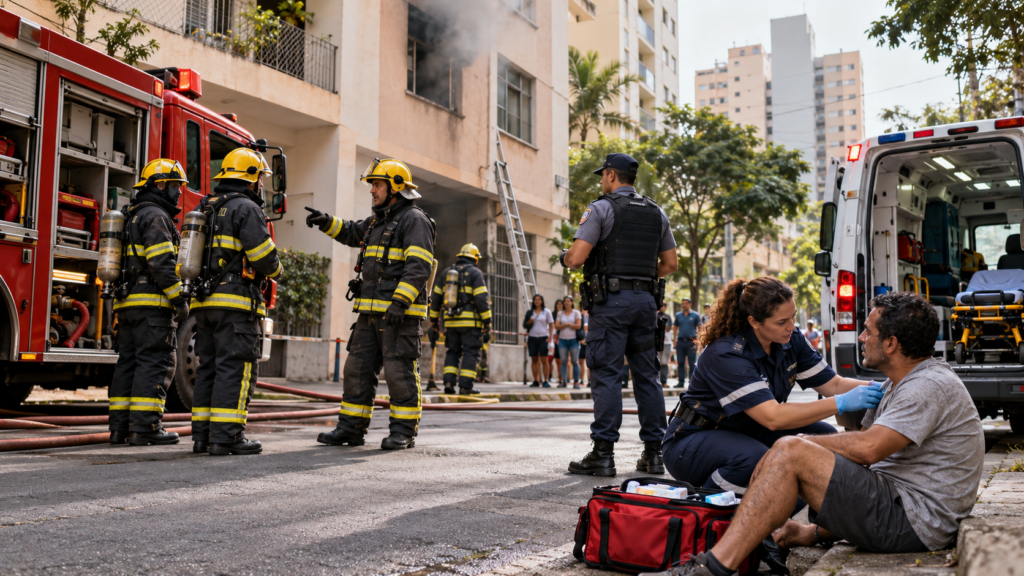

Brazilian Portuguese emergency vocabulary helps you explain a problem, ask for help, and understand the people responding. Whether you are learning Portuguese for travel or daily life, a few clear words can make a difficult situation easier to handle. This guide covers ambulances, police, and firefighters, with natural Brazilian terms and short sentences you can practice aloud.
Emergency services in Brazilian Portuguese
The general expression for emergency services is serviços de emergência. You may also hear serviços de urgência, especially in medical contexts. In everyday conversation, Brazilians often name the service directly: SAMU, polícia, or bombeiros.
| English | Brazilian Portuguese | Example |
|---|---|---|
| emergency | a emergência | É uma emergência. (It’s an emergency.) |
| emergency services | os serviços de emergência | Preciso dos serviços de emergência. (I need emergency services.) |
| help | a ajuda | Preciso de ajuda. (I need help.) |
| accident | o acidente | Houve um acidente. (There was an accident.) |
| address | o endereço | Qual é o endereço? (What is the address?) |
In Brazil, 190 reaches the Military Police, 192 reaches SAMU for medical emergencies, and 193 reaches the Fire Department. These are Brazilian numbers; do not assume that the emergency number from your home country works the same way. For example, you can say “Preciso de uma ambulância. O endereço é…” and then give your location. For official descriptions of the services, see Anatel’s emergency-number list and the Ministry of Health’s SAMU page.
Ambulance and medical emergency vocabulary
The word ambulância is easy for English speakers to recognize. However, learning the related words helps you describe what is happening before an ambulance arrives.
| English | Brazilian Portuguese | Example |
|---|---|---|
| ambulance | a ambulância | Chame uma ambulância! (Call an ambulance!) |
| paramedic | o paramédico / a paramédica | A paramédica está chegando. (The paramedic is arriving.) |
| emergency medical service | o SAMU | Ligue para o SAMU. (Call SAMU.) |
| stretcher | a maca | Precisamos de uma maca. (We need a stretcher.) |
| patient | o paciente / a paciente | O paciente está consciente. (The patient is conscious.) |
| injured person | a pessoa ferida | Há uma pessoa ferida. (There is an injured person.) |
SAMU stands for Serviço de Atendimento Móvel de Urgência. In Brazil, saying “Ligue para o SAMU” sounds more specific than simply saying “call an ambulance.” Also, Brazilian teams may use different professional titles, such as socorrista, enfermeiro/enfermeira, or médico/médica, depending on the person’s role. Paramédico/paramédica is understandable, but it does not describe every responder.
Useful medical emergency phrases
- Preciso de uma ambulância. — I need an ambulance.
- Uma pessoa desmaiou. — Someone fainted.
- Ele não está respirando. — He is not breathing.
- Ela está com dificuldade para respirar. — She is having trouble breathing.
- Houve um acidente aqui. — There was an accident here.
- Estamos na Rua [nome], número [número]. — We are at [street name], number [number].
When you call, give your location clearly and answer the dispatcher’s questions. Next, describe what happened in simple language. If you do not know a medical term, “Preciso de ajuda” and a clear description are still useful.
Police vocabulary in Brazilian Portuguese
The book pictured for this lesson uses a few terms that sound more natural in Portugal than in Brazil. In Brazil, delegacia de polícia is the everyday term for a police station where people report incidents. Similarly, viatura da polícia is a common term for a police vehicle.
| English | Brazilian Portuguese | Usage note |
|---|---|---|
| police | a polícia | Chame a polícia. means “Call the police.” |
| police officer | o policial / a policial | Agente da polícia is understandable, but policial is more natural. |
| police car | a viatura da polícia | Carro da polícia also works in casual speech. |
| police station | a delegacia de polícia | Prefer this to esquadra da polícia in Brazil. |
| badge | o distintivo | The officer’s identification badge. |
| uniform | o uniforme | Same word for men and women. |
| siren | a sirene | Ouvi a sirene. (I heard the siren.) |
| flashing lights | as luzes da viatura / o giroflex | Giroflex is a familiar informal word for the flashing light bar. |
| handcuffs | as algemas | Usually used in the plural. |
| gun | a arma / a pistola | Arma is broader; pistola is a pistol. |
| baton | o cassetete / o bastão | Both terms are understood. |
In addition, delegacia refers to a Civil Police station in common usage. A Military Police facility may be called a batalhão or posto policial. If you need to report a theft, “Onde fica a delegacia mais próxima?” is a useful question.
Words for reporting a crime
| English | Brazilian Portuguese | Example or distinction |
|---|---|---|
| crime | o crime | Foi um crime. (It was a crime.) |
| robbery / mugging | o assalto | An assalto usually involves force or threat. |
| theft | o furto | Furto generally does not involve force or threat against a person. |
| assault / physical attack | a agressão | Houve uma agressão. (There was an assault.) |
| complaint / report | a queixa / a denúncia | The correct term depends on the situation. |
| police report | o boletim de ocorrência (BO) | Quero registrar um BO. (I want to file a police report.) |
| arrest | a prisão | Detenção also exists, but the terms have different legal uses. |
| cell | a cela | A cell in a police station or prison. |
| investigation | a investigação | A investigação continua. (The investigation continues.) |
| accusation | a acusação | The English legal word charge needs context. |
| fingerprint | a impressão digital | Also refers to a biometric fingerprint. |
| suspect | o suspeito / a suspeita | A person suspected of involvement. |
| detective | o detetive / a detetive | Investigador/investigadora may fit a police role better. |
One translation deserves special attention: assalto commonly means robbery or mugging in Brazilian Portuguese. By contrast, English burglary describes unlawful entry into a building to commit a crime. Depending on the facts, you might describe that as arrombamento, invasão, or furto em residência. Therefore, do not automatically translate every burglary as assalto.
Useful police phrases
- Chame a polícia, por favor. — Please call the police.
- Fui assaltado. / Fui assaltada. — I was robbed. Choose the ending that matches the speaker.
- Roubaram meu celular. — They stole my phone.
- Preciso registrar um boletim de ocorrência. — I need to file a police report.
- Onde fica a delegacia mais próxima? — Where is the nearest police station?
- Eu vi o que aconteceu. — I saw what happened.
Firefighter and fire safety vocabulary
In Brazil, os bombeiros can mean firefighters or the fire department, depending on the sentence. Meanwhile, o Corpo de Bombeiros names the institution. Use “Chame os bombeiros!” when you need to call for help.
| English | Brazilian Portuguese | Example or note |
|---|---|---|
| firefighter | o bombeiro / a bombeira | Os bombeiros chegaram. (The firefighters arrived.) |
| fire department | o Corpo de Bombeiros | Name of the service. |
| fire station | o quartel dos bombeiros | The station or headquarters. |
| fire | o incêndio | A building fire is um incêndio. |
| smoke | a fumaça | Tem muita fumaça. (There is a lot of smoke.) |
| hose | a mangueira | A firefighter’s hose. |
| water jet / stream | o jato de água | Water coming from a hose. |
| helmet | o capacete | Protective helmet. |
| ladder | a escada | A fire truck may carry one. |
| aerial ladder / boom | a escada extensível / o braço articulado | The exact name depends on the equipment. |
| rescue basket | o cesto de resgate | The platform at the end of some aerial equipment. |
| fire truck | o caminhão de bombeiros | More natural in Brazil than carro de bombeiros. |
| truck cab | a cabine | Where the crew rides. |
| fire escape | a escada de incêndio | A protected escape stairway. |
| emergency exit | a saída de emergência | An exit, not the same thing as a fire escape. |
| smoke detector | o detector de fumaça | A device that detects smoke. |
| fire alarm | o alarme de incêndio | An alarm that warns of fire. |
| ax | o machado | A tool firefighters may use. |
| fire extinguisher | o extintor de incêndio | Often shortened to extintor. |
| fire hydrant | o hidrante | Hidrante is the common Brazilian term. |
Notice the difference between saída de emergência and escada de incêndio. A sign marked SAÍDA DE EMERGÊNCIA points to an emergency exit; a fire escape is a stairway or route that people can use to leave a building. Similarly, a detector de fumaça detects smoke, while an alarme de incêndio warns people about a possible fire.
Useful fire emergency phrases
- Há um incêndio no prédio. — There is a fire in the building.
- Está saindo fumaça do apartamento. — Smoke is coming out of the apartment.
- Chame os bombeiros! — Call the firefighters!
- Onde fica a saída de emergência? — Where is the emergency exit?
- Tem alguém dentro do prédio. — Someone is inside the building.
- O incêndio é na Rua [nome], número [número]. — The fire is at [street name], number [number].
During an emergency, prioritize getting to safety and following the instructions of local responders. Then, when you call, share the location and the clearest description you can give.
Portugal and Brazil: vocabulary differences to remember
The photos contain useful Portuguese words, but some choices are more natural in European Portuguese or need a more precise English translation. The following pairs will help you sound clearer in Brazil.
| In the pictures | Prefer in Brazil | Why |
|---|---|---|
| a esquadra da polícia | a delegacia de polícia | Delegacia is the familiar Brazilian word for a police station. |
| o agente da polícia | o policial / a policial | Policial is the everyday word for a police officer. |
| o carro da polícia | a viatura da polícia | Both work, but viatura is the standard vehicle term. |
| o carro de bombeiros | o caminhão de bombeiros | Caminhão describes the large fire vehicle naturally. |
| a boca de incêndio | o hidrante | Hidrante is the common word for a fire hydrant. |
| a saída de emergência = “fire escape” | a escada de incêndio = “fire escape” | Saída de emergência means “emergency exit.” |
| o assalto = “burglary” | o assalto = “robbery” | Burglary requires a different translation based on what happened. |
These alternatives do not mean that Brazilians will fail to understand every term in the pictures. Rather, they give you words you are more likely to hear and use in Brazil.
How to practice Brazilian Portuguese emergency vocabulary
First, read each short phrase aloud until you can say it without looking. Next, replace the example street with your own address or a familiar place. Finally, practice three situations: asking for an ambulance, reporting a robbery, and describing a fire. You can keep your sentences short; clear information matters more than perfect grammar.
Try this mini practice:
- How do you say “I need an ambulance”? Preciso de uma ambulância.
- What would you ask if you needed the nearest police station? Onde fica a delegacia mais próxima?
- How would you say “There is smoke in the building”? Tem fumaça no prédio.
- Which term means “fire hydrant” in Brazil? O hidrante.
As you build confidence, combine the vocabulary with a location: “Há um incêndio no prédio da Rua…” or “Houve um acidente perto de…”. This makes your Portuguese more useful in a real conversation.
Frequently asked questions
What is “call an ambulance” in Brazilian Portuguese?
Say “Chame uma ambulância!” or “Ligue para o SAMU!” The first expression asks someone to call an ambulance; the second names Brazil’s mobile emergency medical service.
How do Brazilians say “police station”?
The common expression is delegacia de polícia, often shortened to delegacia. For example, “Preciso ir à delegacia” means “I need to go to the police station.”
What is the difference between “assalto” and “furto”?
In everyday Brazilian Portuguese, assalto suggests robbery involving force or threat. Furto refers to theft without that kind of force or threat against a person. If you are reporting an incident, explain what happened rather than worrying about choosing a legal label.
How do you say “fire truck” in Brazil?
Say caminhão de bombeiros. You may also hear viatura dos bombeiros as a broader term for a fire service vehicle.
Conclusion
Brazilian Portuguese emergency vocabulary becomes easier when you learn words in groups: ambulância and SAMU for medical help, polícia and delegacia for police matters, and bombeiros and incêndio for fires. Start with “Preciso de ajuda”, add your location, and describe what happened in short sentences. Then practice the phrases above so they come to mind when you need them.