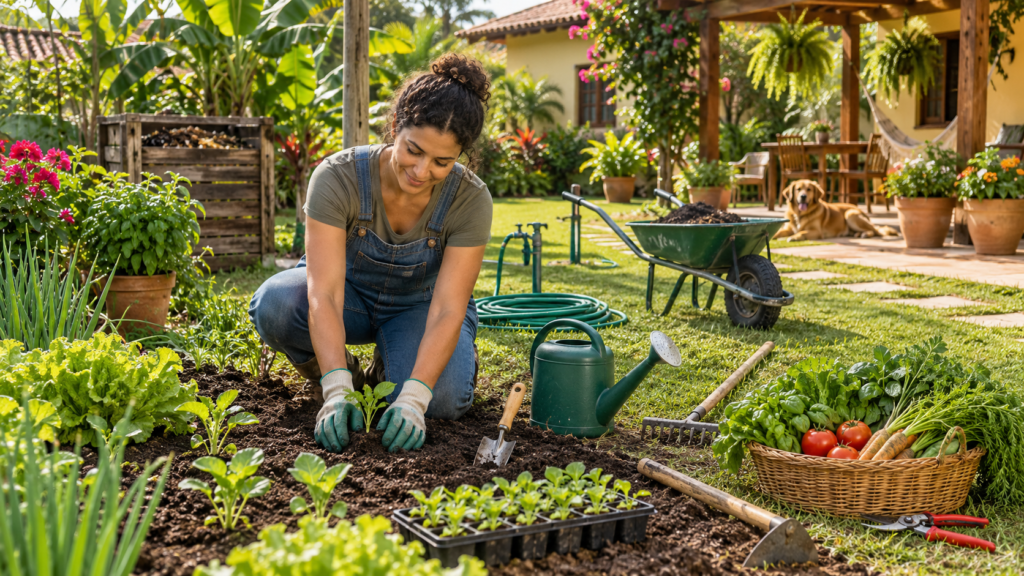

Brazilian Portuguese gardening vocabulary helps you talk about plants, tools, soil, and everyday work in the garden. Whether you grow herbs, visit a nursery, hire a gardener, or simply describe your yard, the right words make conversations much easier. This guide teaches natural terms used in Brazil, with English meanings, practical examples, and important differences from European Portuguese.
Why learn garden vocabulary in Brazilian Portuguese?
Gardening brings together several useful parts of the language. For example, you can practice names of objects, action verbs, colors, locations, and instructions. You will also hear many of these words when Brazilians discuss homes, parks, farms, and outdoor projects.
Moreover, garden vocabulary helps in real situations. You may need to ask where the fertilizer is, explain that a plant needs shade, or buy a hose. Therefore, learning complete phrases can be more valuable than memorizing isolated nouns.
Some gardening books use vocabulary from Portugal. Those words are not necessarily wrong. However, Brazilians often choose different terms in daily speech. In Brazil, people usually say gramado instead of relvado and cortador de grama instead of máquina de cortar relva.
Basic Brazilian Portuguese gardening vocabulary
Start with the words that describe the garden as a whole. You can use them to talk about an outdoor space before discussing individual plants or tools.
| English | Brazilian Portuguese | Useful note |
|---|---|---|
| garden | o jardim | General ornamental garden |
| gardening | a jardinagem | The activity of caring for a garden |
| yard | o quintal | Outdoor area around a house |
| lawn | o gramado | Relvado is more common in Portugal |
| vegetable garden | a horta | Place for vegetables and herbs |
| flower bed | o canteiro de flores | A defined area for flowers |
| herb garden | o canteiro de ervas | Also horta de ervas |
| path | o caminho | A route through the garden |
| paving | a pavimentação | O piso works for the finished surface |
| courtyard | o pátio | An open area beside or inside a building |
| patio garden | o pátio ajardinado | A patio designed with plants |
| rooftop garden | o jardim no terraço | Also jardim no telhado in some contexts |
| rock garden | o jardim de pedras | Garden arranged with rocks and plants |
| water garden | o jardim aquático | Garden centered on aquatic plants |
| formal garden | o jardim clássico | Jardim formal is also natural |
| cottage garden | o jardim campestre | An informal, densely planted style |
In Brazilian Portuguese, jardim usually suggests an ornamental space. By contrast, horta focuses on edible plants. A home can have both: um jardim na frente e uma horta no quintal.
Garden structures and decorative features
Next, learn the fixed elements that shape the space. These nouns appear often in landscaping, home improvement, and nursery conversations.
| English | Brazilian Portuguese | Useful note |
|---|---|---|
| fence | a cerca | More natural in Brazil than vedação for a garden fence |
| gate | o portão | Entrance in a wall or fence |
| hedge | a cerca-viva | Sebe is understood but uncommon in Brazil |
| arch | o arco | A curved garden structure |
| arbor | a pérgola | Pergolado may describe the complete structure |
| trellis | a treliça | Support for climbing plants |
| hanging basket | o vaso suspenso | More common than the literal cesto suspenso |
| greenhouse | a estufa | Covered space for growing plants |
| shed | o galpão | Barracão also exists, depending on region and size |
| wooden deck | o deck de madeira | Common Brazilian expression |
| pond | o lago | A small artificial pond may be laguinho |
| fountain | a fonte | Decorative water feature |
| topiary | a topiaria | Plants shaped by careful pruning |
For instance, you might say: A trepadeira está crescendo na treliça ao lado da pérgola. This means, “The climbing plant is growing on the trellis beside the arbor.”
Soil and planting materials in Portuguese
Healthy plants begin below the surface. Consequently, this section of Brazilian Portuguese gardening vocabulary is helpful at nurseries and garden centers.
| English | Brazilian Portuguese | Useful note |
|---|---|---|
| soil | o solo | Technical or general word for soil |
| earth/dirt | a terra | Very common in everyday speech |
| topsoil | a terra vegetal | Common retail term in Brazil |
| subsoil | o subsolo | Soil layer below the surface |
| sand | a areia | Used to improve some soil mixtures |
| clay | a argila | Fine mineral material that retains water |
| silt | o silte | Mostly a technical term |
| gravel | o cascalho | Pedrisco or brita may fit specific materials |
| compost | o composto orgânico | Also simply composto |
| compost pile | a pilha de compostagem | Place where organic matter decomposes |
| fertilizer | o fertilizante | Adubo is extremely common |
| organic fertilizer | o adubo orgânico | Fertilizer from organic sources |
| bone meal | a farinha de ossos | Soil amendment rich in minerals |
| seed | a semente | The plural is as sementes |
| pesticide | o pesticida | Defensivo agrícola appears in formal contexts |
| herbicide | o herbicida | Product used against unwanted plants |
| mulch | a cobertura morta | Straw, bark, leaves, or similar material |
| drainage | a drenagem | Movement of excess water through soil |
Although solo and terra can both mean “soil,” they do not always sound identical. Gardeners commonly buy terra vegetal and place it in a pot. Meanwhile, specialists may analyze the composition of the solo.
Useful phrases about soil
Instead of learning only the nouns, practice short combinations:
- solo argiloso — clay soil
- solo arenoso — sandy soil
- terra úmida — moist soil
- terra seca — dry soil
- solo bem drenado — well-drained soil
- adubo orgânico — organic fertilizer
- matéria orgânica — organic matter
- camada de cobertura morta — layer of mulch
For example, a nursery employee may recommend: Use terra vegetal e mantenha o solo úmido. In English, the advice means, “Use topsoil and keep the soil moist.”
Types of garden plants in Brazilian Portuguese
Plants can be grouped by their life cycle, structure, habitat, or use. Therefore, knowing these categories makes plant labels and care instructions easier to understand.
| English | Brazilian Portuguese | Useful note |
|---|---|---|
| annual plant | a planta anual | Completes its cycle within one growing season |
| biennial plant | a planta bienal | Usually completes its cycle in two seasons |
| perennial plant | a planta perene | Lives for more than two years |
| bulb | o bulbo | Underground storage structure |
| fern | a samambaia | More common in Brazil than the broad term feto |
| cattail | a taboa | Aquatic plant; not normally called junco in Brazil |
| bamboo | o bambu | Tall plant with woody stems |
| weed | a erva daninha | An unwanted plant |
| herb | a erva aromática | Used for flavorful or fragrant herbs |
| aquatic plant | a planta aquática | Plant adapted to water |
| tree | a árvore | A woody plant with a main trunk |
| palm | a palmeira | Plant in the palm family |
| conifer | a conífera | Cone-bearing plant |
| evergreen | a planta perenifólia | Planta sempre-verde is easier in casual speech |
| deciduous plant | a planta caducifólia | A plant that loses its leaves seasonally |
The Portuguese word perene may describe a plant’s life cycle. However, perenifólia describes foliage that remains throughout the year. As a result, the two terms should not be treated as exact synonyms.
Plants by growing habit and location
This group describes how or where a plant grows. In addition, several terms help you choose the right plant for a specific part of the yard.
| English | Brazilian Portuguese | Useful note |
|---|---|---|
| alpine plant | a planta alpina | Adapted to mountain conditions |
| succulent | a planta suculenta | Stores water in leaves or stems |
| cactus | o cacto | Standard Brazilian spelling |
| potted plant | a planta em vaso | Natural everyday phrase |
| shade plant | a planta de sombra | Grows well with limited direct sun |
| climbing plant | a trepadeira | Climbs a support or nearby structure |
| flowering shrub | o arbusto florífero | Arbusto com flores sounds more conversational |
| ground cover | a forração | Also planta de cobertura do solo |
| creeping plant | a planta rasteira | Grows close to the ground |
| ornamental plant | a planta ornamental | Grown mainly for appearance |
| grass | a grama | The plant or lawn material |
Notice the difference between grama and gramado. The first word names the grass itself, while the second refers to the lawn as an area. Thus, a Brazilian may say: Precisamos plantar grama para formar um gramado.
Garden tools in Brazilian Portuguese
The following Brazilian Portuguese gardening vocabulary covers large tools, hand tools, and useful supplies. Some names vary by region, so common alternatives appear in the notes.
Large garden tools and equipment
| English | Brazilian Portuguese | Useful note |
|---|---|---|
| shovel | a pá | General digging or moving tool |
| garden fork | o garfo de jardim | Large fork for turning soil |
| long-handled shears | o tesourão de poda | Also corta-galhos for some models |
| leaf rake | o rastelo de folhas | Much more natural than vassoura para relva |
| rake | o rastelo | Ancinho is also widely used |
| hoe | a enxada | Common tool for digging and weeding |
| hand hoe | o sacho | Smaller tool for light cultivation |
| grass trimmer | a roçadeira | Aparador de grama fits lighter equipment |
| lawn mower | o cortador de grama | Brazilian equivalent of máquina de cortar relva |
| wheelbarrow | o carrinho de mão | Used for soil, plants, and tools |
| grass catcher | o saco coletor | Bag attached to a mower |
| handle | o cabo | Pega is more characteristic of Portugal |
| guard | o protetor | Protective part of a machine |
| motor | o motor | Same core term in both varieties |
In Brazil, enxada is far more common than sacho for many routine jobs. Nevertheless, stores may use sacho for a smaller hand tool or a narrow hoe.
Hand tools and gardening supplies
| English | Brazilian Portuguese | Useful note |
|---|---|---|
| hand fork | o garfo de mão | Also garfo para jardinagem |
| pruning shears | a tesoura de poda | Used for stems and small branches |
| trowel | a pá de jardinagem | Also pazinha in casual speech |
| garden shears | a tesoura de jardim | Used for trimming plants |
| blade | a lâmina | Cutting part of a tool |
| handsaw | o serrote | More natural in Brazil than serra manual |
| sieve | a peneira | Used to separate materials |
| seed tray | a bandeja de germinação | Also sementeira in some contexts |
| gardening gloves | as luvas de jardinagem | Protective gloves |
| bamboo stakes | as estacas de bambu | Supports for growing plants |
| twine | o barbante | More Brazilian than guita |
| plant label | a etiqueta para plantas | Identifies seeds or varieties |
| twist tie | o arame plastificado | Fitilho may refer to another kind of tie |
| ring tie | a abraçadeira em anel | Used to attach a plant to a support |
| plant pot | o vaso | Container for a plant |
| rubber boots | as botas de borracha | Also called galochas |
| gardening basket | o cesto de jardinagem | A basket for tools or harvested plants |
When shopping, you can ask: Onde ficam as tesouras de poda e as luvas de jardinagem? That sentence means, “Where are the pruning shears and gardening gloves?”
Watering vocabulary in Brazilian Portuguese
Watering is part of nearly every gardening routine. For that reason, these terms deserve a separate section.
| English | Brazilian Portuguese | Useful note |
|---|---|---|
| watering | a rega | The act or process of watering |
| watering can | o regador | Container used for watering by hand |
| watering-can rose | o bico do regador | Also chuveirinho do regador |
| hose | a mangueira | Flexible tube for water |
| nozzle | o esguicho | Bico da mangueira is also common |
| hose reel | o enrolador de mangueira | Device that stores the hose |
| sprinkler | o aspersor | Distributes water over an area |
| spray bottle | o borrifador | More common in Brazil than pulverizador for a small bottle |
| sprayer | o pulverizador | Equipment used to spray water or products |
Although regar and molhar may both involve water, gardeners usually choose regar for giving water to plants. For example: Vou regar as plantas antes que fique muito quente.
The verb borrifar means to apply a fine spray. Therefore, you can borrifar água nas folhas but regar a terra do vaso.
Essential gardening verbs in Brazilian Portuguese
Verbs turn a word list into usable language. Consequently, this part of the Brazilian Portuguese gardening vocabulary will help you describe what you actually do.
| English | Brazilian Portuguese | Example in Portuguese |
|---|---|---|
| to garden | fazer jardinagem | Gosto de fazer jardinagem aos sábados. |
| to cultivate | cultivar | Ela cultiva ervas no quintal. |
| to care for | cuidar de | Precisamos cuidar das mudas. |
| to design a garden | projetar um jardim | Eles projetaram um jardim pequeno. |
| to fertilize | adubar | Vou adubar o solo na primavera. |
| to aerate | aerar | É importante aerar o gramado. |
| to sift | peneirar | Peneire o composto antes de usar. |
| to pot | plantar em vaso | Vamos plantar a muda em um vaso maior. |
| to mow | cortar a grama | Ele corta a grama toda semana. |
| to rake | rastelar | Rastele as folhas secas. |
| to trim | aparar | Preciso aparar a cerca-viva. |
| to prune | podar | Pode os galhos danificados. |
| to dig | cavar | Cave um buraco para a muda. |
| to sow | semear | Vamos semear manjericão. |
| to water | regar | Regue a planta pela manhã. |
| to spray | borrifar | Borrife água nas folhas. |
| to transplant | transplantar | Transplante a muda com cuidado. |
| to weed | capinar | Ela capinou o canteiro. |
| to harvest | colher | Já podemos colher os tomates. |
Several literal translations from European Portuguese sound unusual in Brazil. Brazilians generally say cortar a grama, not cortar a relva. Likewise, colher sounds more natural than apanhar when you harvest vegetables.
Verbs for plant care and propagation
More specific work requires a second group of verbs:
| English | Brazilian Portuguese | Example in Portuguese |
|---|---|---|
| to train a plant | conduzir a planta | Conduza a trepadeira pela treliça. |
| to deadhead | retirar as flores secas | Retire as flores secas para estimular a floração. |
| to graft | enxertar | O produtor enxertou a muda. |
| to propagate | propagar | Você pode propagar a planta por estacas. |
| to stake | tutorar | Vamos tutorar o tomateiro. |
| to add mulch | cobrir o solo | Cubra o solo com palha. |
| to add top dressing | fazer uma cobertura superficial | Faça uma cobertura superficial com composto. |
| to lay sod | colocar grama | A equipe colocou grama no quintal. |
In everyday Brazilian Portuguese, estaquear can describe propagation by cuttings. However, tutorar means supporting a growing plant with a stake. Context matters because English uses “stake” in a different way.
Practical sentences for the garden
Now combine the vocabulary into complete thoughts. These examples model natural word order and common garden situations.
Describing a garden
- O quintal tem um gramado, uma horta e dois canteiros de flores. — The yard has a lawn, a vegetable garden, and two flower beds.
- A pérgola fica ao lado do lago e da fonte. — The arbor is beside the pond and the fountain.
- Plantei uma trepadeira perto da cerca. — I planted a climbing plant near the fence.
- As plantas de sombra ficam embaixo da árvore. — The shade plants are under the tree.
- Há vasos suspensos no deck de madeira. — There are hanging pots on the wooden deck.
Asking for products and advice
- Você tem terra vegetal para plantas em vaso? — Do you have topsoil for potted plants?
- Qual adubo você recomenda para esta planta? — Which fertilizer do you recommend for this plant?
- Onde posso encontrar sementes e bandejas de germinação? — Where can I find seeds and seed trays?
- Esta planta precisa de sol ou sombra? — Does this plant need sun or shade?
- Com que frequência devo regar esta muda? — How often should I water this seedling?
Giving gardening instructions
- Cave um buraco e coloque a muda no centro. — Dig a hole and place the seedling in the center.
- Depois, complete com terra e pressione levemente. — Then, fill it with soil and press gently.
- Regue bem, mas não deixe o solo encharcado. — Water thoroughly, but do not leave the soil waterlogged.
- Por fim, cubra a terra com palha. — Finally, cover the soil with straw.
These sentences include connectors such as depois, mas, and por fim. As a result, they also help you explain a process clearly.
Brazilian Portuguese and European Portuguese differences
Learners can understand both varieties while choosing the vocabulary that matches their audience. The table below summarizes the most noticeable adaptations from the pictured material.
| English | Common in Portugal | More natural in Brazil |
|---|---|---|
| lawn | relvado | gramado |
| grass | relva | grama |
| lawn mower | máquina de cortar relva | cortador de grama |
| hedge | sebe | cerca-viva |
| shed | barracão | galpão |
| fence | vedação | cerca |
| hanging basket | cesto suspenso | vaso suspenso |
| topsoil | camada superior do solo | terra vegetal |
| fern | feto | samambaia |
| evergreen | de folha perene | perenifólia / sempre-verde |
| deciduous | de folha caduca | caducifólia |
| leaf rake | vassoura para relva | rastelo de folhas |
| lawn mower handle | pega | cabo |
| grass trimmer | roçadora | roçadeira / aparador de grama |
| trowel | colher de transplantar | pá de jardinagem / pazinha |
| twine | guita | barbante |
| spray bottle | pulverizador | borrifador |
| to harvest | apanhar | colher |
Vocabulary varies inside Brazil as well. For instance, one person may say rastelo, while another prefers ancinho. Both words can be correct, although a store may use one name for a particular design.
Regional variation also affects roçadeira and aparador de grama. Usually, a roçadeira handles thicker vegetation. An aparador, on the other hand, finishes lawn edges and lighter growth.
Common mistakes to avoid
First, do not translate every English phrase word for word. “To water a plant,” for example, is regar uma planta, not usually aguar uma planta in neutral Brazilian Portuguese.
Second, distinguish grama from gramado. You buy or plant grama, but you walk across a gramado. This difference makes descriptions sound more precise.
Third, remember the gender of frequent nouns. Say a árvore, a pá, a mangueira, and a cerca. By contrast, use o jardim, o vaso, o solo, and o regador.
Finally, learn verbs together with their complements. Brazilians cuidam das plantas, regam as flores, podam os galhos, and adubam o solo. This approach will improve both vocabulary and grammar.
How to memorize Brazilian Portuguese gardening vocabulary
Begin by labeling five objects in your garden or home. For example, place temporary labels near a vaso, planta, mangueira, pá, and regador. Then, say each word aloud while touching the object.
Next, connect every noun to an action. Pair tesoura de poda with podar, regador with regar, and sementes with semear. Because the words form meaningful groups, recall becomes easier.
Afterward, describe one short routine in Portuguese. You might say: Primeiro, retiro as folhas secas. Depois, rego as plantas. Por fim, guardo as ferramentas. Repeating a real sequence creates practical memory cues.
Additionally, take pictures of plants and record a voice note about them. You can mention their colors, location, size, and care needs. Over time, add less common terms from this guide.
Quick review of the most useful words
If you only memorize a small starter set, choose these terms:
- o jardim — garden
- o quintal — yard
- o gramado — lawn
- a horta — vegetable garden
- a planta — plant
- a árvore — tree
- a flor — flower
- a terra — soil
- o adubo — fertilizer
- a semente — seed
- a pá — shovel
- a enxada — hoe
- o rastelo — rake
- a mangueira — hose
- o regador — watering can
- plantar — to plant
- regar — to water
- podar — to prune
- cavar — to dig
- colher — to harvest
Together, these words cover many basic conversations. Moreover, they provide a foundation for the more specialized terms above.
Conclusion
Learning Brazilian Portuguese gardening vocabulary becomes easier when you organize words by place, plant, tool, and action. More importantly, natural Brazilian choices such as gramado, cerca-viva, terra vegetal, and cortador de grama will help you communicate clearly.
Start with the quick-review list, then practice the example sentences in a real or imaginary garden. Finally, connect each new noun to a verb. With regular practice, you will be ready to visit a Brazilian nursery, discuss plant care, and describe an outdoor space with confidence.