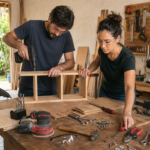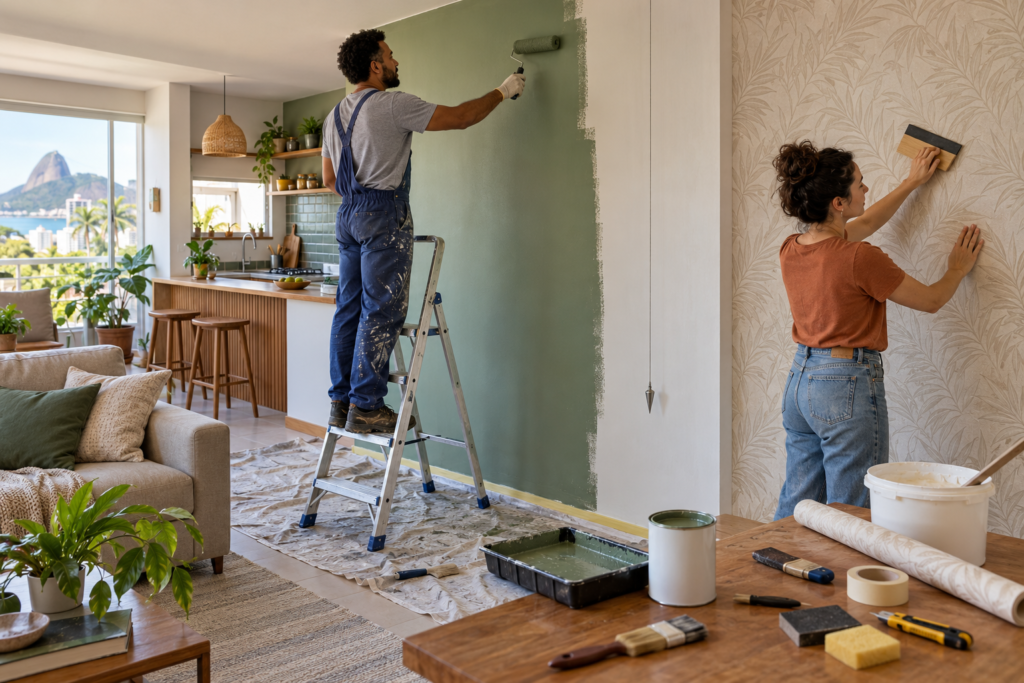

Brazilian Portuguese vocabulary for home decorating helps you shop for paint, follow a renovation tutorial, and talk to a professional in Brazil. Yet many bilingual textbooks use terms that sound more natural in Portugal. This guide turns the words in the reference photos into everyday Brazilian Portuguese and adds practical examples you can use right away.
For example, a Brazilian usually asks for an estilete, not an x-ato. Likewise, stores sell a bandeja de pintura, rather than a tabuleiro de pintura. Small changes like these make your Portuguese clearer and more natural.
You will learn tools, materials, finishes, wallpaper terms, tile vocabulary, and action verbs. In addition, short dialogues will show you how the words work in real conversations. Therefore, you can use this lesson both as a reference and as a speaking exercise.
<!– Replace the relative image path with the WordPress Media Library URL after uploading the selected photo. –>
Brazilian Portuguese vocabulary: the quick answer
If you only need the most important corrections, start here. The textbook words remain understandable in many cases. However, the alternatives below sound more natural in present-day Brazil.
Everyday tools and supplies
| Textbook term | Natural Brazilian Portuguese | English |
|---|---|---|
| o x-ato | o estilete | For example: utility knife or craft knife |
| o escadote | a escada de mão or a escada | Specifically: stepladder |
| o tabuleiro de pintura | a bandeja de pintura or a bandeja para tinta | For instance: paint tray |
| a fita protetora | a fita-crepe or a fita para pintura | In this case: masking tape or painter’s tape |
| o papel de lixa | a lixa | To clarify: sandpaper |
| o protetor | a lona de proteção | In particular: drop cloth |
| o fato-macaco | o macacão | Generally: coveralls |
| a trincha da cola | o pincel para cola | Likewise: pasting brush |
| a trincha de afixar o papel | a escova or a espátula para papel de parede | Similarly: wallpaper brush or smoother |
| a mesa de colar | a mesa para aplicar cola | Moreover: pasting table |
Consequently, these replacements will help when you search Brazilian stores online. They will also make conversations with local workers much easier.
Materials, finishes, and repair words
| Textbook term | Natural Brazilian Portuguese | English |
|---|---|---|
| o betume | a massa corrida or a massa para reparo | For example: filler |
| betumar | aplicar massa, emassar, or preencher | Specifically: to fill |
| estucar | aplicar massa, aplicar gesso, or rebocar | For instance: to plaster |
| a tinta de água | a tinta à base de água or a tinta látex | In this case: water-based or latex paint |
| mate | fosco | To clarify: matte |
| o primário | o fundo preparador, o primer, or sometimes o selador | In particular: primer |
| o vedante | o selante | Generally: sealant |
| o dissolvente | o solvente | Likewise: solvent |
| a mistura para juntas | o rejunte | Similarly: grout |
| a última demão | a demão final or o acabamento final | Moreover: topcoat or final coat |
Still, a few choices depend on the surface and the product. Fundo preparador, primer, and selador do not always perform the same job. For that reason, read the label or ask a store employee which product suits your wall.
Why Brazilian Portuguese vocabulary differs from Portugal
Portuguese speakers share one language, but everyday vocabulary varies by country. For instance, people in Portugal commonly say escadote for a small ladder. Brazilians normally shorten the idea to escada or specify escada de mão.
The difference does not make one version incorrect. Instead, it reflects local habits, product labels, and trade language. Therefore, a learner should match the vocabulary to the country where the conversation happens.
Brazilian Portuguese words that textbooks may miss
Some terms in the photos follow European Portuguese closely. Dissolvente offers a good example because a Brazilian will understand it. Nevertheless, solvente appears far more often on Brazilian labels and in stores.
Other translations sound too literal. A protetor could describe many protective objects, while a painter places a lona de proteção on the floor. Similarly, Brazilian tile workers call grout rejunte, not mistura para juntas.
Professional vocabulary can differ from casual speech
Brazilians often say pincel for almost any paintbrush. However, professionals use trincha for a flat brush that handles corners, edges, and detailed areas. Both words belong in your Brazilian Portuguese vocabulary, although the exact tool decides which one fits best.
Likewise, someone may say colocar azulejo in casual conversation. A tile installer will probably prefer assentar azulejo. The professional phrase sounds more precise because assentar describes fixing the piece with mortar.
Brazilian Portuguese vocabulary for painting tools
This section covers the objects you will see before the first can of paint opens. First, learn each noun with its article. That habit will help you remember grammatical gender.
Brazilian Portuguese tools for surface preparation
| Brazilian Portuguese | English | Practical example |
|---|---|---|
| a tesoura | scissors | For example: Corte o papel com a tesoura. |
| o estilete | utility knife | Specifically: Use o estilete para cortar a sobra. |
| o prumo or o fio de prumo | plumb line or plumb bob | For instance: Confira o alinhamento com o prumo. |
| o raspador | scraper | In this case: O raspador ajuda a remover a tinta velha. |
| a espátula | putty knife or smoothing tool | To clarify: Espalhe a massa com a espátula. |
| a lixa | sandpaper | In particular: Passe a lixa depois que a massa secar. |
| a esponja | sponge | Generally: Limpe a parede com uma esponja úmida. |
| a escada de mão | stepladder | Likewise: Pegue a escada de mão para alcançar o teto. |
Notice the difference between raspador and espátula. A scraper removes material, whereas a putty knife spreads filler or smooths wallpaper. In practice, one multipurpose tool may perform both tasks, so Brazilian stores sometimes use both labels.
Tools for applying paint
| Brazilian Portuguese | English | Practical example |
|---|---|---|
| o rolo de pintura or o rolo | paint roller | Similarly: Passe o rolo em movimentos uniformes. |
| a bandeja de pintura | paint tray | Moreover: Despeje um pouco de tinta na bandeja. |
| a trincha | flat paintbrush | For example: Pinte os cantos com a trincha. |
| o pincel | brush | Specifically: Use um pincel pequeno nos detalhes. |
| a lata de tinta | paint can | For instance: Feche bem a lata de tinta. |
| o balde | bucket | In this case: Misture o produto no balde. |
| a fita-crepe | masking tape | To clarify: Cole fita-crepe ao redor do rodapé. |
| a lona de proteção | drop cloth | In particular: Cubra o chão com uma lona de proteção. |
| o macacão | coveralls | Generally: Vista o macacão antes de começar. |
Moreover, Brazilians may call painter’s tape fita para pintura. Yet fita-crepe remains the everyday phrase in most stores and homes. A product label may add details such as delicate surfaces or outdoor use.
Brazilian Portuguese vocabulary for paint and finishes
Good Brazilian Portuguese vocabulary should help you choose the correct product, not merely translate a label. Therefore, the next groups separate paint, preparation materials, finishes, and solvents.
Brazilian Portuguese paint and protective coatings
| Brazilian Portuguese | English | Usage note |
|---|---|---|
| a tinta | paint | Likewise: General word for paint |
| a tinta para parede | wall paint | Similarly: Common shopping phrase |
| a tinta à base de água | water-based paint | Moreover: Broad description of the formula |
| a tinta látex | latex paint | For example: Common choice for interior walls |
| a tinta acrílica | acrylic paint | Specifically: Often chosen for washable or humid areas |
| o verniz | varnish | For instance: Common on wood and decorative surfaces |
| o conservante | preservative | In this case: Technical additive, not a common shopping category |
Although the photo translates tinta de água as “latex paint,” Brazilian Portuguese usually says tinta à base de água or tinta látex. The first phrase describes the broad formulation. By contrast, the second names a familiar wall-paint category.
Products that prepare or repair a wall
| Brazilian Portuguese | English | Best context |
|---|---|---|
| a massa corrida | wall putty or interior filler | To clarify: Smooth interior, dry walls |
| a massa acrílica | acrylic wall putty | In particular: Exterior or humid areas, according to the label |
| a massa para reparo | repair filler | Generally: Small holes and cracks |
| o fundo preparador | wall conditioner or primer | Likewise: Weak, chalky, or porous surfaces |
| o selador | sealer | Similarly: Porous new surfaces, depending on the system |
| o primer | primer | Moreover: General or product-specific base coat |
| o gesso | plaster or gypsum | For example: Repairs, molding, and some wall finishes |
| o reboco | plaster or render | Specifically: Masonry wall layer |
| o estuque | stucco or fine plaster | For instance: Decorative or traditional finish |
The word betume exists in Brazil, but it does not serve as the default name for wall filler. Instead, ask for massa corrida, massa acrílica, or massa para reparo. The location and size of the repair will guide your choice.
Similarly, estucar sounds uncommon in a casual Brazilian renovation. People usually say aplicar massa, aplicar gesso, or rebocar. Choose the verb that matches the material and the stage of the work.
Common paint finishes
| Brazilian Portuguese | English | Example phrase |
|---|---|---|
| brilhante | glossy | In this case: acabamento brilhante |
| semibrilho | semi-gloss | To clarify: tinta semibrilho |
| acetinado | satin | In particular: acabamento acetinado |
| fosco | matte | Generally: tinta fosca |
| texturizado | textured | Likewise: papel de parede texturizado |
| com relevo | embossed or raised | Similarly: papel de parede com relevo |
| o estêncil | stencil | Moreover: pintura com estêncil |
In Brazil, use fosco instead of the European Portuguese form mate. Also, remember that adjectives agree with the noun. Thus, you say acabamento fosco, but tinta fosca.
Coats of paint and base layers
The noun demão means one applied coat of paint, varnish, or a similar product. For example, duas demãos de tinta means “two coats of paint.” Its plural is demãos.
The photo pairs a primeira demão with “undercoat.” However, those ideas do not always match. Primeira demão simply means the first coat, while demão de base, fundo, or primer describes a true undercoat more accurately.
Likewise, última demão means the last applied coat. A professional may also say demão final or acabamento final. Therefore, ask about both the product and its order in the paint system.
Solvents and thinners
| Brazilian Portuguese | English | Usage note |
|---|---|---|
| o solvente | solvent | Moreover: General technical term |
| a aguarrás | mineral spirits or paint thinner | For example: Common thinner for compatible products |
| a terebintina | turpentine | Specifically: Specific traditional solvent |
| o diluente | thinner | For instance: Product designed for dilution |
Do not treat these products as interchangeable. Instead, follow the paint manufacturer’s instructions. In addition, use ventilation and the recommended protective equipment whenever you handle a solvent.
Brazilian Portuguese vocabulary for wallpaper
Wallpaper gives learners several useful verbs because the job includes measuring, cutting, aligning, gluing, and smoothing. Moreover, Brazilian stores now sell both traditional and adhesive versions.
Brazilian Portuguese wallpaper and installation items
| Brazilian Portuguese | English | Note |
|---|---|---|
| o papel de parede | wallpaper | In this case: Standard term |
| o papel de parede adesivo | peel-and-stick wallpaper | To clarify: Very common retail phrase |
| o papel de parede autoadesivo | self-adhesive wallpaper | In particular: More formal alternative |
| o papel de parede texturizado | textured wallpaper | Generally: Natural choice for embossed designs |
| o papel de parede com relevo | embossed wallpaper | Likewise: Also natural in Brazil |
| o papel-base | backing or base paper | Similarly: Refers to a product layer in some contexts |
| o papel de forro para parede | lining paper | Moreover: Descriptive specialist phrase |
| a cola para papel de parede | wallpaper paste | For example: Product for non-adhesive paper |
| a espátula para papel de parede | wallpaper smoother | Specifically: Removes small air bubbles |
| a escova para papel de parede | wallpaper brush | For instance: Smooths certain papers |
| a emenda | seam | In this case: Join between two strips |
| a estampa | pattern or print | To clarify: Visible design on the paper |
The textbook’s papel de base needs context. In Brazil, papel-base can name the substrate that manufacturers coat or print. On the other hand, British-style lining paper has a smaller presence in everyday Brazilian DIY language. Consequently, describe the product’s purpose when a store label remains unclear.
Natural verbs for wallpaper work
Brazilians normally say colocar, aplicar, or colar papel de parede. The phrase forrar com papel de parede also makes sense, although it sounds less common in a basic store conversation.
To translate “strip wallpaper,” use retirar or remover o papel de parede. Next, use raspar when you need to scrape old residue. Finally, say alisar o papel when you smooth the surface and remove bubbles.
Brazilian Portuguese vocabulary for tile and walls
The photo includes colocar azulejo and mistura para juntas. Both phrases communicate the general idea. However, Brazilian construction vocabulary offers more precise choices.
Brazilian Portuguese words for tile, mortar, and grout
| Brazilian Portuguese | English | Practical meaning |
|---|---|---|
| o azulejo | wall tile | In particular: Often used in kitchens and bathrooms |
| a cerâmica | ceramic tile | Generally: Can refer to the material or a tile |
| o revestimento | wall or floor covering | Likewise: Broad professional term |
| o piso | flooring or floor tile | Similarly: Depends on context |
| a argamassa colante | tile adhesive or thinset mortar | Moreover: Bonds tile to the surface |
| a desempenadeira | trowel | For example: Spreads and combs mortar |
| o espaçador | tile spacer | Specifically: Maintains even gaps |
| a junta | joint or gap | For instance: Space between tiles |
| o rejunte | grout | In this case: Fills the joints |
Use assentar azulejo when you want the professional verb “to tile” or “to set tile.” Afterward, use rejuntar for the action of applying grout. Therefore, assentar e rejuntar a cerâmica means “to set and grout the ceramic tile.”
Plaster, stucco, and filler are not identical
English uses “plaster” for several materials and actions. Brazilian Portuguese separates them more often. Gesso names gypsum plaster, while reboco describes a masonry coating. Meanwhile, estuque often refers to a finer or decorative plaster finish.
For minor imperfections, say massa corrida or massa para reparo. When you describe a masonry layer, use reboco. As a result, context gives you a better translation than a single permanent equivalent.
Brazilian Portuguese vocabulary for decorating verbs
Verbs turn a vocabulary list into usable speech. Therefore, learn them with a short object or instruction instead of memorizing them alone.
Brazilian Portuguese verbs for preparation and painting
| Verb | English | Example |
|---|---|---|
| decorar | to decorate | To clarify: Vamos decorar a sala. |
| proteger | to protect | In particular: Proteja os móveis antes de pintar. |
| cobrir | to cover | Generally: Cubra o chão com uma lona. |
| remover or retirar | to remove | Likewise: Retire o papel de parede antigo. |
| raspar | to scrape | Similarly: Raspe a tinta solta. |
| preencher | to fill | Moreover: Preencha os buracos pequenos. |
| aplicar massa | to apply filler | For example: Aplique massa nas imperfeições. |
| emassar | to cover or level with putty | Specifically: O pintor vai emassar a parede. |
| lixar | to sand | For instance: Lixe a superfície com cuidado. |
| pintar | to paint | In this case: Pinte primeiro os cantos. |
| diluir | to thin or dilute | To clarify: Dilua a tinta conforme o rótulo. |
| misturar | to mix | In particular: Misture bem antes do uso. |
Although arrancar can mean “to pull off,” it may sound forceful. Use remover or retirar for neutral instructions. Conversely, arrancar works when someone literally tears old material away.
Wallpaper and tile verbs
| Verb | English | Example |
|---|---|---|
| medir | to measure | Generally: Meça a altura da parede. |
| cortar | to cut | Likewise: Corte o papel com o estilete. |
| alinhar | to align | Similarly: Alinhe a primeira faixa com o prumo. |
| colar | to glue | Moreover: Cole o papel de cima para baixo. |
| aplicar | to apply | For example: Aplique a cola de maneira uniforme. |
| alisar | to smooth | Specifically: Alise o papel com a espátula. |
| assentar | to set or install tile | For instance: Vamos assentar os azulejos amanhã. |
| rejuntar | to grout | In this case: Espere antes de rejuntar o revestimento. |
| secar | to dry | To clarify: Deixe a primeira demão secar. |
| limpar | to clean | In particular: Limpe as ferramentas no final. |
Additionally, colocar works as a broad everyday verb. You can say colocar papel de parede or colocar azulejo, and everyone will understand. Still, aplicar papel de parede and assentar azulejo sound more specific.
Use Brazilian Portuguese vocabulary in a hardware store
These phrases make Brazilian Portuguese vocabulary practical. First, read each sentence aloud. Then, replace the product, color, or quantity to create a new version.
Asking for tools and products
- Onde ficam as tintas e os materiais de pintura? Where are the paints and painting supplies?
- Preciso de um rolo e de uma bandeja de pintura. I need a roller and a paint tray.
- Você tem fita-crepe para pintura? Do you have painter’s tape?
- Quero uma massa para corrigir pequenos buracos. I want a filler for small holes.
- Qual fundo preparador você recomenda para esta parede? Which primer do you recommend for this wall?
- Vocês vendem cola para papel de parede? Do you sell wallpaper paste?
- Preciso de uma espátula para tirar as bolhas. I need a smoother to remove the bubbles.
- Onde encontro rejunte branco? Where can I find white grout?
For a polite request, you can begin with por favor. Alternatively, start with você pode me ajudar? Both options sound natural and friendly in Brazil.
Asking about color, finish, and coverage
- Esta tinta é à base de água? Is this paint water-based?
- Você tem esta cor com acabamento fosco? Do you have this color in a matte finish?
- Qual é a diferença entre fosco e acetinado? What is the difference between matte and satin?
- Quantos litros eu preciso para duas demãos? How many liters do I need for two coats?
- Quanto tempo a tinta leva para secar? How long does the paint take to dry?
- Esta aguarrás serve para diluir esta tinta? Does this paint thinner work with this paint?
Whenever you ask about a chemical product, show the exact can or label. Consequently, the employee can check compatibility instead of guessing from a general name.
Use Brazilian Portuguese vocabulary with a painter
A painter in Brazil is um pintor or uma pintora. Meanwhile, an interior decorator is um decorador or uma decoradora. English sometimes groups these professions under “decorator,” but Brazilian Portuguese normally distinguishes them.
Discussing preparation and painting
- Você pode lixar e aplicar massa antes de pintar? Can you sand and apply filler before painting?
- Por favor, proteja o piso e os móveis. Please protect the floor and furniture.
- Vamos usar tinta fosca nesta parede. We are going to use matte paint on this wall.
- Os cantos precisam de mais uma demão. The corners need one more coat.
- Quando você pode aplicar a segunda demão? When can you apply the second coat?
- Quero o acabamento uniforme, sem marcas do rolo. I want an even finish without roller marks.
Discussing wallpaper and tile
- A parede está pronta para receber o papel? Is the wall ready for the wallpaper?
- Vamos alinhar a primeira faixa com o prumo. Let us align the first strip with the plumb line.
- Esta emenda ficou um pouco aberta. This seam remained slightly open.
- Pode cortar as sobras com o estilete? Can you cut the excess with the utility knife?
- Também precisamos assentar os azulejos. We also need to set the tiles.
- O rejunte será branco ou cinza? Will the grout be white or gray?
As a result, you can describe the desired result and ask about the process. You do not need advanced grammar to communicate clearly.
Brazilian Portuguese vocabulary in short dialogues
Dialogues connect nouns, verbs, and polite questions. Moreover, they show the rhythm of a normal exchange.
At a paint store
Cliente: Bom dia. Preciso pintar uma parede interna.
Atendente: Bom dia. A parede já está lisa?
Cliente: Ainda não. Primeiro, preciso corrigir alguns buracos.
Atendente: Nesse caso, leve massa para reparo, uma espátula e uma lixa.
Cliente: Depois, posso usar esta tinta fosca?
Atendente: Pode. Porém, confira se a parede também precisa de fundo preparador.
Customer: Good morning. I need to paint an interior wall.
Employee: Good morning. Is the wall already smooth?
Customer: Not yet. First, I need to repair a few holes.
Employee: In that case, take repair filler, a putty knife, and sandpaper.
Customer: Afterward, can I use this matte paint?
Employee: Yes. However, check whether the wall also needs a preparatory primer.
Planning a wallpaper project
Marina: Você já mediu a parede?
Caio: Já. Agora vou cortar a primeira faixa.
Marina: Use o prumo antes de colar o papel.
Caio: Boa ideia. Em seguida, vou alisar tudo com a espátula.
Marina: Ótimo. Assim, não ficam bolhas.
Marina: Have you measured the wall?
Caio: Yes. Now I will cut the first strip.
Marina: Use the plumb line before you paste the paper.
Caio: Good idea. Next, I will smooth everything with the tool.
Marina: Great. That way, no bubbles remain.
Grammar tips for Brazilian Portuguese vocabulary
You can learn Brazilian Portuguese vocabulary faster when you store each noun with its article. In addition, a few plural forms deserve special attention.
Learn the grammatical gender
Most tools in this lesson follow predictable patterns, but not all of them do. Say o rolo, o pincel, o balde, and o estilete. By contrast, say a tinta, a lixa, a trincha, and a espátula.
The gender also changes adjectives. Therefore, o acabamento fosco uses masculine fosco, while a tinta fosca uses feminine fosca. Similarly, you need rejunte branco but parede branca.
Watch these plural forms
- a demão becomes as demãos;
- o papel de parede becomes os papéis de parede;
- o pincel becomes os pincéis;
- o rolo becomes os rolos;
- a lata de tinta becomes as latas de tinta;
- o azulejo becomes os azulejos.
For example, ask for dois pincéis e três rolos. Meanwhile, describe the job as duas demãos de tinta. These small agreements make your speech sound much more polished.
Use the contraction in “à base de água”
The standard phrase is tinta à base de água. Here, the preposition a joins the feminine article a, so the written form takes a grave accent. Consequently, avoid tinta de água when you mean a water-based formulation.
Pronunciation tips for Brazilian Portuguese vocabulary
Pronunciation varies across Brazil, so these cues only offer a starting point. Nevertheless, they help English speakers notice sounds that spelling may hide.
Sounds worth practicing
- In lixa, the letter x sounds like “sh.”
- The group ch in trincha also sounds like “sh.”
- At the start of rejunte, the j sounds similar to the “s” in “measure.”
- Likewise, the j in azulejo uses that same sound.
- For demão, give the ending ão a nasal sound.
- In many Brazilian accents, the initial r in corrida sounds breathy, like an English “h.”
First, say each word slowly with its article. Next, place it in a short phrase such as a lixa fina or duas demãos. Finally, repeat the complete example sentence at a normal speed.
How to study Brazilian Portuguese vocabulary effectively
A long list becomes useful only when you can retrieve the words during a real task. Therefore, organize your study around actions and situations.
Build small word groups
Start with one project. For painting, learn tinta, rolo, bandeja, trincha, fita-crepe, and lona. Afterward, add the verbs proteger, lixar, pintar, and secar.
Wallpaper needs a different group. Combine papel de parede, cola, estilete, prumo, and espátula with medir, cortar, alinhar, colar, and alisar. As a result, every noun connects to a visible action.
Practice substitutions instead of isolated words
Take the sentence Preciso de um rolo de pintura. Then, replace the object with uma bandeja, uma trincha, or uma lata de tinta. This method practices gender and vocabulary at the same time.
You can also change the finish in Quero uma tinta fosca. For instance, substitute acetinada, semibrilho, or brilhante. Thus, one sentence produces several useful variations.
Use Brazilian sources in context
Real Brazilian instructions confirm how professionals and retailers use these words. For example, Suvinil’s wall-painting guide uses fundo preparador, bandeja, trincha, rolo, and demão. Meanwhile, Leroy Merlin Brasil’s wallpaper guide uses massa corrida, selador, primer, espátula, estilete, and cola para papel de parede.
For tile work, Quartzolit’s installation guide shows assentamento, argamassa colante, and rejunte in context. In addition, you can explore more Brazilian Portuguese lessons and build your vocabulary by topic.
Brazilian Portuguese vocabulary practice
Complete each sentence with the most natural Brazilian word. Afterward, compare your choices with the answer key.
Fill in the blanks
- Preciso cortar o papel de parede com um ________.
- Coloque a tinta na ________ antes de usar o rolo.
- Esta tinta tem acabamento ________, sem brilho.
- Vamos proteger o chão com uma ________.
- O pintor vai corrigir os buracos com ________ para reparo.
- Use o ________ para conferir se a primeira faixa está reta.
- Depois de assentar os azulejos, precisamos aplicar o ________.
- A parede precisa de duas ________ de tinta.
- Passe a ________ para deixar a superfície lisa.
- Vista o ________ para proteger a roupa.
Answer key
- estilete
- bandeja de pintura
- fosco
- lona de proteção
- massa
- prumo
- rejunte
- demãos
- lixa
- macacão
Consequently, one short exercise reviews tools, materials, finishes, and grammar. Repeat it later without looking at the vocabulary tables.
Brazilian Portuguese vocabulary questions
These quick answers target the decorating terms that learners search most often. Moreover, each answer gives the phrase you will probably hear in Brazil.
What do Brazilians call a paint roller?
Brazilians call a paint roller rolo de pintura or simply rolo. For example, say Preciso de um rolo para pintar a parede.
How do you say “paint tray” in Brazilian Portuguese?
Say bandeja de pintura or bandeja para tinta. In contrast, tabuleiro de pintura sounds more European and less natural in Brazil.
How do you say “utility knife” in Brazil?
Use estilete. Although some people recognize the X-Acto brand, x-ato does not function as the normal generic word in Brazilian Portuguese.
What is “wall filler” in Brazilian Portuguese?
For interior wall smoothing, Brazilians commonly say massa corrida. However, a small repair may need massa para reparo, while damp or exterior areas may call for massa acrílica. Always check the product’s intended surface.
What is the Brazilian word for “primer”?
Depending on the surface, you may hear primer, fundo preparador, or selador. These products can have different functions, so ask which one matches the paint system.
How do Brazilians say “matte paint”?
The natural phrase is tinta fosca. Therefore, replace the European Portuguese adjective mate with fosco or fosca in Brazil.
How do you say “wallpaper” in Brazilian Portuguese?
Wallpaper is papel de parede. Additionally, Brazilians say papel de parede adesivo for a peel-and-stick product.
What verb means “to hang wallpaper”?
Use colocar, aplicar, or colar papel de parede. While forrar a parede remains understandable, the other choices sound more direct in everyday Brazilian speech.
What do Brazilians call grout?
Grout is rejunte, and “to grout” is rejuntar. Consequently, a worker may say Vamos rejuntar os azulejos amanhã.
What do painters wear over their clothes?
A painter may wear um macacão. The European Portuguese term fato-macaco sounds unusual in Brazil.
Brazilian Portuguese vocabulary recap from the photos
This recap preserves every central idea shown in the two reference pages. However, it uses a Brazilian term whenever the original wording sounds European, overly literal, or technically imprecise.
People, tools, and actions
A decoração means decorating or decor. The worker is o pintor or a pintora, while decorador and decoradora usually refer to an interior decorator. Key tools include a tesoura, o estilete, o prumo, o raspador, a espátula, o balde, a escada de mão, o rolo, a bandeja, a trincha, o pincel, a esponja, a fita-crepe, and a lixa.
For actions, use pintar, lixar, remover, aplicar massa, rebocar, aplicar papel de parede, and assentar azulejo. In addition, use rejuntar when you fill the joints between tiles.
Paint, wallpaper, and protection
The materials include a tinta, a lata de tinta, a tinta à base de água, o verniz, a massa corrida, o fundo preparador, o selador, o solvente, a terebintina, and a aguarrás. Finishes include brilhante, fosco, texturizado, and com relevo. Meanwhile, painters talk about a primeira demão, a demão de base, and a demão final.
Wallpaper terms include o papel de parede, a cola para papel de parede, o pincel para cola, a escova, a espátula, and a mesa para aplicar cola. Finally, protection items include a lona de proteção and o macacão.
Specialist words
Some photo terms need a precise context rather than a simple swap. Estuque, gesso, and reboco describe different materials or finishes. Similarly, papel-base may describe a manufacturing layer, while lining paper may require a descriptive phrase such as papel de forro para parede.
The word conservante remains possible in technical product language. Yet shoppers rarely need it as a separate decorating category. By contrast, estêncil belongs to everyday craft and decorative-painting vocabulary.
Final thoughts on Brazilian Portuguese vocabulary
The most useful Brazilian Portuguese vocabulary reflects what people actually say in Brazilian homes, stores, and job sites. Therefore, choose estilete, escada de mão, bandeja de pintura, massa corrida, fosco, solvente, rejunte, lona de proteção, and macacão when the context calls for them.
At the same time, remember that renovation words depend on the material and the task. A fundo preparador does not always equal a selador, and gesso does not always equal reboco. Consequently, the strongest language skill is not memorizing one translation. It is learning which word fits the situation.
Start with one project, practice the sample sentences, and repeat the short dialogues aloud. Soon, these terms will feel less like a vocabulary list and more like language you can use.