
Brazilian Portuguese seafood vocabulary helps you buy fish, understand restaurant menus, and explain how you want your food prepared. However, translating a seafood name word for word can lead to confusion. Some names change between Brazil and Portugal, while others describe different species across regions.
This guide covers the fish and seafood in the reference pictures, with practical adaptations for Brazil. In addition, you will learn useful cuts, preparation words, original shopping dialogues, and questions that clarify exactly what you are ordering.
Brazilian Portuguese Seafood Vocabulary: The Basics
Start with these terms before memorizing individual species. Then, combine them with the shopping phrases later in this guide.
| Brazilian Portuguese | English | Practical use |
|---|---|---|
| o peixe | fish | A fish, or fish as food |
| os peixes | fish, fishes | Individual fish or different kinds |
| os frutos do mar | seafood | Common culinary term for shrimp, shellfish, squid, and similar foods |
| o pescado | fish and other harvested aquatic animals | Broader commercial or technical term |
| a peixaria | fish shop, fish counter | Place to buy fish and seafood |
| o peixeiro / a peixeira | fishmonger | Person who sells fish |
| a banca de peixe | fish stall | Useful at a market |
| o gelo | ice | Common at seafood displays |
In everyday Brazilian food language, people often distinguish peixe from frutos do mar. For example, a menu might have separate sections for grilled fish and shrimp dishes.
However, those menu categories do not create a universal biological definition. A useful question is: “Quais frutos do mar vêm nesse prato?” That means “Which seafood items come in this dish?”
Is “marisco” the same as “seafood”?
The seafood picture uses o marisco as its heading. For a general Brazilian vocabulary guide, however, frutos do mar offers a more useful starting point.
You may also hear marisco or mariscos, especially in regional speech. Depending on the location, these words can refer to shellfish generally or particular local shellfish.
Therefore, ask “Que tipo de marisco é esse?” when the exact ingredient matters. The question means “What kind of shellfish is this?”
Fish Names in Brazilian Portuguese
Many fish names in the pictures also work in Brazil. Nevertheless, treat the English equivalents below as learning aids rather than guarantees of an exact species match.
Brazil’s Ministry of Fisheries and Aquaculture explains that common fish names vary across regions. Consequently, scientific names help clarify commercial identification when an exact species matters.
Source: Ministry of Fisheries and Aquaculture: commercial fish names.
| Brazilian Portuguese | English learning equivalent | Important context |
|---|---|---|
| o salmão | salmon | Useful in supermarkets and restaurants |
| o atum | tuna | Also appears on canned products |
| a sardinha | sardine | Learn the feminine article |
| a truta | trout | A general trout term |
| a truta-arco-íris | rainbow trout | More specific than truta |
| o bacalhau | cod; salted cod in many food contexts | Ask about salting and desalting |
| o robalo | snook; some sea bass translations | The exact species may differ internationally |
| a cavala | mackerel and related commercial names | Covers different species depending on context |
| o pargo | fish sold under pargo names | Do not assume an exact match to every English “sea bream” |
| a raia | ray or skate | A broad common-name category |
| o tamboril | monkfish | Species can differ by market |
| o linguado | sole or flounder-type flatfish | Does not identify one universal species |
| o salmonete | red mullet | Less useful for beginners than salmão or sardinha |
| o alabote | halibut | You may also encounter the English name |
| o hadoque / o haddock | haddock | Useful alternatives to the pictured eglefim |
| o badejo | grouper-type fish in Brazilian usage | Do not automatically translate it as whiting |
| o espadarte / o meca | swordfish | More precise for Xiphias gladius |
Why “peixe-espada” needs extra care
The picture translates peixe-espada as “swordfish.” In Brazilian commercial naming, however, peixe-espada can identify Trichiurus lepturus, a long, ribbon-shaped fish.
By contrast, espadarte and meca identify Xiphias gladius, the swordfish with the familiar long bill. Therefore, use espadarte or meca when that is the fish you mean.
A practical question is: “É meca ou peixe-espada?” Ask to see the label if you need greater precision.
Source: IBAMA fisheries statistics, species-name annex.
Why “badejo” is not a universal translation of “whiting”
Another picture entry pairs badejo with “whiting.” However, Brazilian usage includes grouper-type fish under the name badejo.
For instance, an IBAMA regulation identifies badejo as Mycteroperca acutirostris. Consequently, an English learner should avoid assuming that Brazilian badejo matches whiting from a British or American fish counter.
Instead, ask “Qual é a espécie?” That means “What species is it?”
Source: IBAMA regulation with common and scientific fish names.
What about “solha” and “eglefim”?
The reference page also includes solha and eglefim. Although these are Portuguese words, a beginner shopping in Brazil will usually gain more from learning linguado and hadoque/haddock first.
However, solha and linguado do not always identify the same species. Use the package label rather than treating one word as a perfect replacement for the other.
For haddock, the Brazilian dictionary Michaelis records hadoque for Melanogrammus aeglefinus. That provides a useful bridge between the English word and Portuguese vocabulary.
Source: Michaelis: hadoque.
Shellfish and Other Seafood in Portuguese
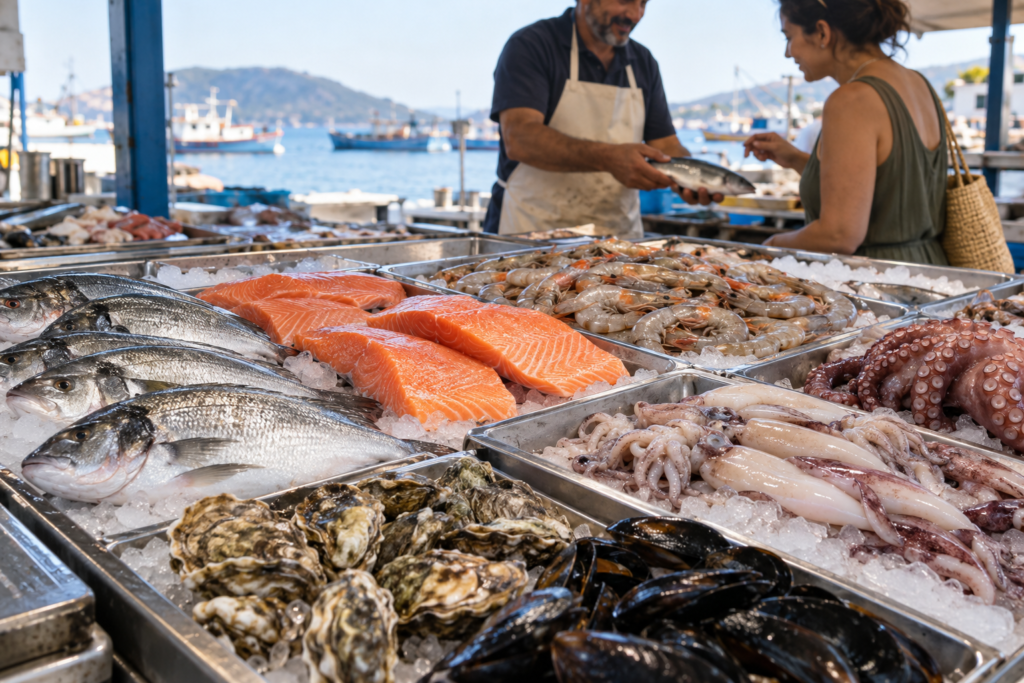
Next, learn the seafood names from the second picture. Keep the articles with each noun because they help you form natural descriptions.
| Brazilian Portuguese | English | Usage note |
|---|---|---|
| o camarão | shrimp, prawn | General everyday term |
| o camarão-tigre | tiger shrimp | A type name, not simply any large shrimp |
| a lagosta | lobster | Common restaurant vocabulary |
| o lagostim | crayfish or langoustine-related names, depending on species | Ask which animal the seller means |
| o lagostim de água doce | freshwater crayfish | Adds useful habitat information |
| o caranguejo | crab | Common general term |
| o siri | swimming crab | A useful Brazilian addition |
| a ostra | oyster | Plural: ostras |
| o mexilhão | mussel | Plural: mexilhões |
| a vieira | scallop | Keep the feminine article |
| a lula | squid | Often appears as anéis de lula |
| o polvo | octopus | Different from lula |
| a sépia / o choco | cuttlefish | Availability and naming vary |
| a amêijoa | clam | Local names may differ |
| o berbigão | cockle | Regional species and usage vary |
| a navalha / a navalheira | razor clam | Less common everyday vocabulary; confirm the species |
“Camarão-tigre” does not simply mean “jumbo shrimp”
The image pairs camarão-tigre with “jumbo shrimp.” However, these expressions communicate different information.
Camarão-tigre refers to a shrimp type, including Penaeus monodon. By contrast, “jumbo” describes a size category in English marketing.
Therefore, ask “Vocês têm camarão grande?” if size is your priority. For more precision, try “Quantos camarões vêm por quilo?”, meaning “How many shrimp are there per kilogram?”
Source: Embrapa: tiger shrimp, Penaeus monodon.
Polvo, lula, and sépia are different animals
English speakers sometimes confuse these names when reading menus. However, the distinction is straightforward:
- Polvo means octopus.
- Lula means squid.
- Sépia or choco means cuttlefish.
For example, polvo grelhado means grilled octopus. Meanwhile, anéis de lula means squid rings.
Although all three belong to the mollusk group, they are separate ingredients. Therefore, avoid using lula as a general translation for every tentacled seafood item.
Fish Cuts, Body Parts, and Preparation Words
Knowing the species is only part of a successful purchase. Next, learn how to describe the cut and the preparation.
| Brazilian Portuguese | English |
|---|---|
| o filé | fillet |
| os filés | fillets |
| em filés | cut into fillets |
| a posta | cross-cut slice; fish steak |
| o lombo | loin; thick portion |
| a espinha | fish bone |
| a escama | scale |
| a nadadeira | fin |
| a cauda / o rabo | tail |
| a pele | skin |
| a cabeça | head |
| a casca do camarão | shrimp shell |
| inteiro / inteira | whole |
| limpo / limpa | cleaned |
| sem espinhas | boneless; without fish bones |
| sem pele | skinless |
| sem escamas | without scales |
| descamado / descamada | with scales removed |
| descascado / descascada | peeled; useful for shrimp |
| fresco / fresca | fresh |
| congelado / congelada | frozen |
| resfriado / resfriada | chilled |
| salgado / salgada | salted |
| dessalgado / dessalgada | desalted |
| defumado / defumada | smoked |
Use “filé” instead of “filete” in Brazil
The picture shows filete and em filetes. In Brazilian shopping language, however, filé and em filés are more natural choices.
For example, say “Quero dois filés de salmão.” This means “I would like two salmon fillets.”
Alternatively, ask “Pode cortar em filés, por favor?” The sentence means “Could you cut it into fillets, please?”
Distinguish “escama” from “espinha”
These similar-looking words describe different parts of a fish. Escama means scale, while espinha means fish bone.
Consequently, sem escamas does not mean boneless. Likewise, limpo does not automatically mean that the seller removed every bone.
A clearer request is: “Quero filé sem pele e sem espinhas.” This means “I would like a skinless, boneless fillet.”
Make adjectives agree with the noun
Portuguese adjectives often change according to gender and number. Therefore, learn complete phrases rather than isolated adjectives.
| Masculine example | Feminine example |
|---|---|
| o peixe fresco | a sardinha fresca |
| o camarão congelado | a lula congelada |
| o salmão defumado | a truta defumada |
| os camarões limpos | as lulas limpas |
However, expressions such as sem pele and sem espinhas stay the same in these combinations. For example, you can order salmão sem pele or truta sem pele.
Useful Phrases at a Brazilian Fish Counter
These phrases turn Brazilian Portuguese seafood vocabulary into something you can use immediately. In addition, they help clarify details that a short label may leave unanswered.
| Portuguese | English |
|---|---|
| Quanto custa o quilo? | How much does a kilogram cost? |
| Tem filé de peixe? | Do you have fish fillets? |
| Quero meio quilo de camarão. | I would like half a kilogram of shrimp. |
| Pode limpar para mim, por favor? | Could you clean it for me, please? |
| Pode tirar as escamas? | Could you remove the scales? |
| Dá para tirar as espinhas? | Is it possible to remove the bones? |
| Pode cortar em postas? | Could you cut it into fish steaks? |
| Esse peixe já foi congelado? | Has this fish been frozen before? |
| O camarão já vem descascado? | Does the shrimp come peeled? |
| Esse bacalhau já está dessalgado? | Is this cod already desalted? |
| O peso é antes ou depois de limpar? | Is the weight before or after cleaning? |
| Qual é a espécie? | What species is it? |
A short shopping dialogue
Customer: Bom dia! Quanto custa o quilo do salmão?
Good morning! How much is a kilogram of salmon?
Seller: Está noventa reais.
It is ninety reais.
Customer: Então, quero meio quilo. Pode tirar a pele, por favor?
Then I would like half a kilogram. Could you remove the skin, please?
Seller: Claro. Quer em filés?
Of course. Would you like fillets?
Customer: Sim, por favor. Também quero duzentos gramas de camarão descascado.
Yes, please. I would also like two hundred grams of peeled shrimp.
The price here serves only as a language example. Actual prices depend on the seller, location, species, and date.
How to Read a Brazilian Seafood Menu
Restaurant menus combine animal names with cooking words. Therefore, learning a few preparation terms helps you understand many dishes.
| Menu expression | English |
|---|---|
| peixe grelhado | grilled fish |
| peixe assado | baked or roasted fish |
| peixe frito | fried fish |
| filé empanado | breaded fillet |
| peixe ao molho | fish served with sauce |
| camarão ao alho e óleo | shrimp with garlic and oil |
| lula à dorê | squid coated in flour and/or egg and fried; recipes vary |
| polvo grelhado | grilled octopus |
| casquinha de siri | prepared crab dish, often served in a shell |
| moqueca de peixe | Brazilian fish stew |
| moqueca de camarão | Brazilian shrimp stew |
| porção de camarão | portion of shrimp; serving size varies |
Ask what comes with the dish
“O que acompanha o peixe?” means “What comes with the fish?” Meanwhile, “Essa porção serve quantas pessoas?” asks how many people a portion serves.
For a mixed dish, try “Além do camarão, vem algum outro fruto do mar?” This means “Besides shrimp, does it contain any other seafood?”
If you need to communicate an allergy, name the specific food clearly. For example, “Tenho alergia a camarão” means “I am allergic to shrimp.”
Also ask “Vocês usam a mesma chapa ou o mesmo óleo para preparar camarão?” This asks whether the kitchen uses the same griddle or oil for shrimp. A vocabulary phrase alone cannot establish whether a meal is safe.
The Three Questions Most Vocabulary Lists Leave Out
A long list of translations cannot answer every real shopping question. Instead, use this three-question method when a seafood name seems unclear.
1. What exactly is it?
Ask “Qual é a espécie?” or “Posso ver o rótulo?” The second question means “May I see the label?”
This step helps when names such as robalo, linguado, and cavala cover different fish in different markets. Moreover, it prevents you from treating an approximate English translation as an exact identification.
2. What preparation does the price include?
Try “Já vem limpo?”, meaning “Does it come cleaned?” Then ask whether the price includes peeling, removing skin, or cutting fillets.
For example, camarão inteiro and camarão descascado describe different purchase formats. Similarly, a whole fish and a boneless fillet involve different amounts of preparation.
3. Which weight determines the bill?
Ask “Vocês pesam antes ou depois de limpar?” This means “Do you weigh it before or after cleaning?”
The question clarifies the transaction before the seller starts preparing the fish. As a result, you can compare offers more meaningfully.
Practice Your Brazilian Portuguese Seafood Vocabulary
Complete the sentences with the most suitable word.
- Quero um _____ de salmão sem pele.
- Pode tirar as _____? Não quero os ossinhos do peixe.
- A lula está _____, mas o peixe está congelado.
- Quero camarão sem casca, ou seja, camarão _____.
- Esse bacalhau já está _____ ou ainda preciso tirar o sal?
Answers: 1. filé; 2. espinhas; 3. fresca; 4. descascado; 5. dessalgado.
Next, create your own order using this pattern:
“Quero [quantity] de [seafood], [preparation], por favor.”
For example: “Quero meio quilo de camarão descascado, por favor.” Then change the ingredient and preparation to practice another purchase.
Frequently Asked Questions
How do you say “seafood” in Brazilian Portuguese?
Frutos do mar is a useful general culinary expression. However, Brazilian menus often list peixe separately from other seafood.
What is the Brazilian Portuguese word for “fish fillet”?
Say filé de peixe. For more than one, use filés de peixe.
Does “camarão” mean shrimp or prawn?
Camarão can cover both English terms in everyday Portuguese. For greater precision, ask about the species and size.
Is “bacalhau” always salted?
No. However, many Brazilian food contexts involve salted cod, so check whether the product is salgado, dessalgado, or sold in another form.
Does “peixe limpo” mean boneless fish?
Not necessarily. Therefore, ask specifically for sem espinhas if you want the seller to remove the bones.
What is the difference between “lula” and “polvo”?
Lula means squid, while polvo means octopus. They name different animals and different menu ingredients.
Put Your Seafood Vocabulary Into Practice
Start with peixe, camarão, salmão, lula, polvo, and filé. Then add preparation words such as grelhado, descascado, sem pele, and sem espinhas.
Most importantly, ask a short follow-up question whenever a name seems ambiguous. With this Brazilian Portuguese seafood vocabulary, you can explain your order, understand the seller’s reply, and make more confident choices.