
Brazilian Portuguese meat vocabulary helps you buy the right cut, understand a menu, and explain exactly what you want at a butcher shop. However, a direct translation does not always work. In Brazil, you usually ask for carne moída, rather than Portugal’s carne picada, when you want ground meat.
This guide covers meat, poultry, cuts, deli products, and useful shopping phrases. Along the way, you will learn why coxa means a chicken drumstick, why bife does not mean beef, and how to describe a cut when its English name has no exact Brazilian equivalent.
Most importantly, you will practice a simple ordering formula: quantity + meat or cut + preparation + preference. As a result, you can turn individual vocabulary words into a request a Brazilian butcher can understand.
Essential Brazilian Portuguese Meat Vocabulary
First, learn the main categories. Although carne translates as “meat,” speakers sometimes use it to mean beef specifically when they contrast it with chicken or fish.
For example, someone might ask, “Você prefere carne ou frango?” That usually means “Do you prefer beef or chicken?” in that conversation. For complete clarity, use carne bovina when you mean beef.
| Brazilian Portuguese | English | Practical note |
|---|---|---|
| a carne | meat | Can mean beef in a particular conversation |
| a carne bovina | beef | A clear term on labels and in orders |
| a carne de boi | beef | Common in everyday speech |
| a carne de vaca | beef; meat from a cow | Understandable, but not the only way Brazilians say beef |
| a carne suína / a carne de porco | pork | Both forms are useful |
| a carne de vitela | veal | Meat from a young bovine animal |
| a carne de cordeiro | lamb | A useful Brazilian equivalent for carne de borrego |
| a carne de carneiro | mutton; sheep meat | Everyday usage may not specify the animal’s exact age |
| a carne de cabra | goat meat | Also learn cabrito for a young goat |
| a carne de cabrito | kid goat meat | Appears on some menus |
| a carne de coelho | rabbit meat | Coelho means rabbit |
| a carne de veado | venison; deer meat | A vocabulary term, not a common everyday purchase |
| a carne de caça | game meat | An umbrella term |
| a carne de aves | poultry meat | Aves means birds |
| a carne branca | white meat | A broad food category |
| a carne vermelha | red meat | A broad food category |
| a carne magra | lean meat | Magra describes low fat, not animal type |
Notice the difference between a species and a description. For instance, carne suína identifies pork, whereas carne magra describes the meat’s fat content.
Also, carne branca is a culinary expression. It does not mean that every pale-looking meat belongs to the same nutritional category.
At the Butcher Shop: Açougue Vocabulary
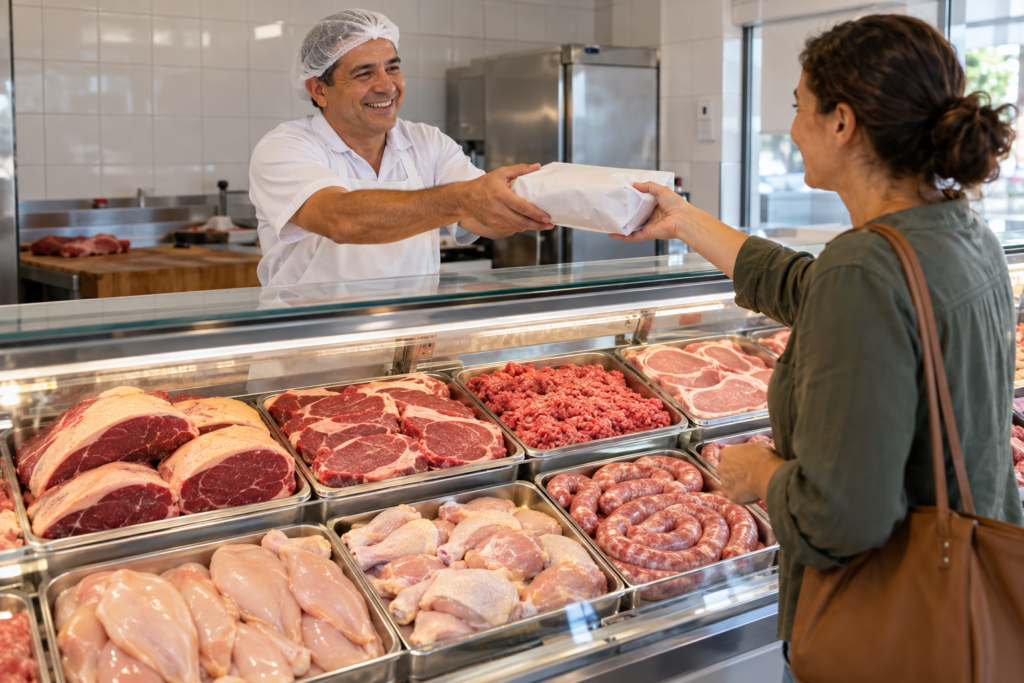
In Brazil, a butcher shop is an açougue. A supermarket may also have a balcão do açougue, meaning its butcher counter.
Similarly, the person who cuts and sells meat is an açougueiro or açougueira. These words will serve you better in Brazil than Portugal’s talhante.
| Brazilian Portuguese | English | Example or explanation |
|---|---|---|
| o açougue | butcher shop | Vou ao açougue: I’m going to the butcher shop |
| o açougueiro / a açougueira | butcher | The person who prepares and sells meat |
| o balcão | counter | The service counter |
| a vitrine refrigerada | refrigerated display case | Where the shop displays chilled products |
| a balança | scale | Used to weigh your order |
| o gancho | hook | Gancho para carne means meat hook |
| a faca | knife | A general cutting tool |
| o amolador de facas | knife sharpener | A broad term for a sharpening tool |
| a chaira | honing steel | A specific tool; not every sharpener is a chaira |
| a tábua de corte | cutting board | Also called tábua de cortar |
| a bandeja | tray | Often refers to a packaged tray of meat |
| a embalagem | packaging / package | Useful for questions about the product |
| a peça | whole piece / unportioned cut | Depends on the product and context |
| o corte | cut | Can refer to the named meat cut |
To start politely, say “Bom dia! Eu queria…”, meaning “Good morning! I’d like…” Although queria literally refers to wanting in the past, Brazilians also use it to soften a request.
Alternatively, “Pode me dar…?” means “Could you give me…?” Both expressions work well at a service counter.
Meat Cuts in Brazilian Portuguese
Meat cuts create more translation problems than animal names. Because countries divide carcasses differently, a Brazilian cut may overlap with several American or British cuts.
Therefore, treat the English descriptions below as shopping guidance. For a specific recipe, confirm the cut’s location, shape, and intended cooking method with the butcher.
Common Beef Cuts
| Brazilian Portuguese | English description | What to remember |
|---|---|---|
| a alcatra | rump/sirloin-region cut | Exact boundaries differ between cutting systems |
| o bife de alcatra | steak cut from alcatra | Bife describes the steak portion |
| o contrafilé | striploin-type cut | A useful term for ordering steaks |
| o filé mignon | beef tenderloin | Refers to the tenderloin cut, not just a small round steak |
| a picanha | rump cap / top sirloin cap | Widely associated with Brazilian barbecue |
| a maminha | tri-tip-type cut | Comes from the lower portion of the alcatra area |
| o patinho | knuckle / round-region cut | You can ask the butcher to grind it |
| o acém | chuck-region cut | Common in ground meat and slow-cooked dishes |
| o peito bovino | beef brisket / breast-region cut | Add bovino to distinguish it from poultry breast |
| a costela bovina | beef ribs | Costela alone does not identify the animal |
| o músculo | shank-type cut | Often appears in slow-cooked dishes |
For authentic examples of Brazilian retail names, see the Friboi cut selection. It lists terms such as alcatra, acém, patinho, picanha, and filé mignon.
However, do not translate every appearance of lombo as “beef fillet.” In Brazil, lombo commonly refers to pork loin when the context concerns pork. For beef tenderloin, ask for filé mignon.
Pork, Chops, and Other Cuts
| Brazilian Portuguese | English | Useful distinction |
|---|---|---|
| o lombo suíno / o lombo de porco | pork loin | State the animal when necessary |
| a bisteca suína | pork chop | A useful everyday shopping term |
| a costeleta | chop / rib chop | Meaning depends on the animal and cut |
| a costela suína | pork ribs | Also called costela de porco |
| o pernil | hind leg; leg cut or roast | Often pork; pernil de cordeiro means leg of lamb |
| a panceta | pork belly | Not automatically the same as cured bacon |
| o toucinho | pork fat / fatback; some belly products | Usage varies with the product and region |
| o bacon | bacon | The clearest everyday term for bacon |
The English word joint, meaning a roasting cut in British English, does not always translate as pernil. Instead, identify the actual cut. For example, a roasting joint could come from the leg, shoulder, or another area.
Likewise, toucinho and bacon are not reliable substitutes in every recipe. If you need breakfast-style bacon strips, ask for bacon em fatias.
Meat Parts and Texture Words
| Brazilian Portuguese | English |
|---|---|
| a gordura | fat |
| o osso | bone |
| a pele | skin |
| o couro | hide; rind in some pork contexts |
| o couro de porco | pork skin / rind |
| a carne macia | tender meat |
| a carne dura | tough meat |
| a carne suculenta | juicy meat |
| a carne com nervo | meat with sinew / tough connective tissue |
For poultry, use pele, as in frango sem pele. By contrast, couro often describes an animal’s hide and can also refer to pork skin in food contexts.
Poultry Vocabulary: Frango, Peru, Pato, and More
Frango is the everyday word for chicken meat. However, galinha refers to a hen and also appears in established food names, such as canja de galinha, or chicken soup.
For an uncooked whole chicken, ask for frango inteiro. Meanwhile, frango limpo describes a cleaned chicken, and frango temperado means seasoned chicken.
| Brazilian Portuguese | English |
|---|---|
| o frango | chicken |
| a galinha | hen; chicken in some food names |
| o peru | turkey |
| o pato | duck |
| o ganso | goose |
| a codorna | quail |
| o faisão | pheasant |
| o peito de frango | chicken breast |
| o filé de peito de frango | chicken breast fillet |
| a coxa de frango | chicken drumstick |
| a sobrecoxa de frango | chicken thigh |
| a coxa com sobrecoxa | connected drumstick and thigh |
| a asa de frango | chicken wing |
| a pele do frango | chicken skin |
| o frango inteiro | whole chicken |
| o frango em pedaços | chicken in pieces |
| o frango desfiado | shredded chicken |
Coxa vs. Sobrecoxa: A Translation Trap
Here is a distinction many basic vocabulary lists miss: coxa means “thigh” in human anatomy, but coxa de frango normally names the drumstick at a Brazilian meat counter.
By comparison, the chicken thigh is the sobrecoxa. Consequently, a learner who translates “thigh” directly as coxa may buy a different piece than intended.
Use these requests:
- Quero quatro coxas de frango. I want four chicken drumsticks.
- Você tem sobrecoxa sem osso? Do you have boneless chicken thighs?
- Pode separar a coxa da sobrecoxa? Could you separate the drumstick from the thigh?
Brazilian packaging also distinguishes these names. For example, Sadia sells coxa e sobrecoxa together and lists sobrecoxa separately.
Why “Frango Preparado” Can Be Unclear
In English, a “dressed chicken” can mean a bird ready for cooking after processing. However, frango preparado does not reliably convey that precise meaning in everyday Brazilian shopping.
Instead, choose a description that matches your needs:
- Frango inteiro e limpo: a whole, cleaned chicken.
- Frango cru: raw chicken.
- Frango temperado: seasoned chicken.
- Frango assado: roasted chicken.
- Frango pronto para cozinhar: chicken ready to cook.
As a result, you avoid leaving the listener to guess whether preparado means cleaned, seasoned, or already cooked.
Ground, Diced, Sliced, and Shredded Meat
Knowing the cut is only part of the order. Next, explain how you want the butcher to prepare it.
| Brazilian Portuguese | English | Example |
|---|---|---|
| moída | ground / minced | carne moída |
| picada | chopped | carne picada na faca |
| em cubos | diced / cubed | carne em cubos |
| em tiras | in strips | frango em tiras |
| em bifes | cut into steaks | alcatra em bifes |
| em fatias | sliced | presunto em fatias |
| desfiada | shredded | carne desfiada |
| com osso | bone-in | bisteca com osso |
| sem osso / desossada | boneless | sobrecoxa desossada |
| com pele | skin-on | peito com pele |
| sem pele | skinless | frango sem pele |
| temperada | seasoned | carne temperada |
| sem tempero | unseasoned | carne sem tempero |
In Brazil, carne moída normally means ground beef unless the label or conversation names another animal. Nevertheless, carne suína moída and frango moído specify ground pork and ground chicken.
Meanwhile, carne picada can mean meat chopped into small pieces. Therefore, use moída when you specifically need the texture of ground meat.
Bife, Fatia, and Filé Are Different Words
Bife means a steak or steak-like slice of meat. It does not mean the animal category “beef.”
For instance, bife de porco means pork steak. Similarly, bife de fígado means a slice of liver prepared as a steak.
Fatia, on the other hand, means a slice in a broader sense. You can order uma fatia de presunto, or a slice of ham.
Finally, filé depends on context. Filé mignon names a specific beef cut, whereas filé de peito de frango describes a chicken breast fillet.
Deli Meats, Sausages, and Offal
At a supermarket, frios often refers to deli products such as ham and sliced cheeses. Consequently, o balcão de frios may include products that are not meat at all.
Do not translate frios simply as “cooked meat.” Instead, think of the deli-counter category and identify the specific product you want.
Ham, Bacon, and Sausages
| Brazilian Portuguese | English | Practical note |
|---|---|---|
| o presunto | ham | Common at the deli counter |
| o presunto fatiado | sliced ham | Useful for sandwiches |
| o bacon em fatias | bacon strips / sliced bacon | Specifies the format |
| o bacon em cubos | diced bacon | A different format for cooking |
| a salsicha | frankfurter / hot dog sausage | Not a general equivalent for every sausage |
| a linguiça | sausage | Includes many styles |
| a linguiça de porco | pork sausage | Names the main meat type |
| a linguiça de frango | chicken sausage | Another common label |
| os frios | deli products / cold cuts | The retail category can include cheese |
| os embutidos | sausages and other casing-based products | Not a perfect synonym for every cold cut |
To order thin ham slices, say “Duzentos gramas de presunto, cortado bem fininho, por favor.” That means “Two hundred grams of ham, sliced very thin, please.”
Also, notice duzentos gramas. When grama means the unit of weight, it takes masculine agreement, even though a grama, meaning grass, is feminine.
Liver, Kidney, Heart, and Other Miúdos
| Brazilian Portuguese | English |
|---|---|
| os miúdos | giblets / offal, depending on context |
| as vísceras | internal organs / viscera |
| o fígado | liver |
| o rim | kidney |
| os rins | kidneys |
| o coração | heart |
| a língua | tongue |
| a moela | gizzard |
| o coração de frango | chicken heart |
For example, miúdos de frango can refer to chicken giblets. However, miúdos is broader than one particular organ, so ask what a package contains.
You may also see coração de frango on a barbecue menu. In that setting, the phrase means chicken hearts, rather than chicken breast or another cut.
Meat Labels and Descriptions
Labels combine animal names, preparation words, and product descriptions. Therefore, reading the whole phrase gives you more information than translating a single word.
| Brazilian Portuguese | English | Interpretation tip |
|---|---|---|
| fresco / fresca | fresh | A description whose precise meaning depends on context |
| resfriado / resfriada | chilled | Refrigerated rather than frozen |
| congelado / congelada | frozen | Refers to storage condition |
| cru / crua | raw | Not cooked |
| cozido / cozida | cooked; boiled in some contexts | Depends on the dish |
| assado / assada | roasted | Common for prepared chicken |
| grelhado / grelhada | grilled | Common on menus |
| curado / curada | cured | Not automatically cooked or ready to eat |
| defumado / defumada | smoked | The usual Brazilian equivalent of fumado on food labels |
| orgânico / orgânica | organic | The usual Brazilian equivalent of biológico in this context |
| criado ao ar livre | free-range / raised outdoors | Does not by itself mean organic |
| caipira | country-style; associated with particular poultry products | Do not assume it means certified organic |
| halal | halal | Describes compliance with Islamic dietary requirements |
| kosher | kosher | Describes compliance with Jewish dietary requirements |
In particular, orgânico, caipira, and criado ao ar livre do not mean exactly the same thing. Likewise, halal and kosher are not synonyms for organic or vegetarian.
For a language learner, the practical lesson is simple: ask about the actual label. “Este produto é orgânico?” means “Is this product organic?”
Portugal vs. Brazil: Important Vocabulary Changes
Both varieties share many words. However, the following choices will usually sound more natural in a Brazilian shopping conversation.
| Portugal-oriented term | Useful Brazilian choice | English meaning |
|---|---|---|
| o talho | o açougue | butcher shop |
| o talhante / a talhante | o açougueiro / a açougueira | butcher |
| a carne picada | a carne moída | ground meat |
| a carne de borrego | a carne de cordeiro | lamb |
| fumado / fumada | defumado / defumada | smoked |
| biológico / biológica | orgânico / orgânica | organic, in food labeling |
| as carnes frias | os frios | cold cuts / deli category, depending on context |
These are practical usage preferences, rather than a claim that Brazilians never understand the other forms. Also, regional vocabulary can vary within Brazil.
How to Order Meat in Brazil
Use this flexible pattern: quantity + cut + preparation + preference. Then add por favor to make the request polite.
For example:
“Quero meio quilo de patinho moído, sem tempero, por favor.”
“I’d like half a kilo of ground patinho, unseasoned, please.”
Here, meio quilo gives the quantity, patinho names the cut, moído requests grinding, and sem tempero specifies your preference.
Quantities and Shopping Questions
| Portuguese phrase | English meaning |
|---|---|
| Quanto está o quilo? | How much is it per kilo? |
| Quero meio quilo. | I’d like half a kilo. |
| Pode ser um quilo. | One kilo will do. |
| Queria duzentos gramas. | I’d like two hundred grams. |
| Pode cortar em bifes finos? | Could you cut it into thin steaks? |
| Você pode moer esta peça? | Can you grind this piece? |
| Pode tirar o excesso de gordura? | Could you remove the excess fat? |
| Tem frango sem tempero? | Do you have unseasoned chicken? |
| Essa carne vem com osso? | Does this meat come with the bone? |
| Pode separar em duas embalagens? | Could you divide it into two packages? |
| Qual corte você recomenda para assar? | Which cut do you recommend for roasting? |
| Essa carne é boa para cozinhar na panela? | Is this meat good for cooking in a pot? |
Brazilian meat counters commonly price meat by the kilogram. For reference, meio quilo equals 500 grams, while um quilo equals 1,000 grams.
A Short Butcher-Shop Conversation
Customer: Bom dia! Quanto está o quilo da alcatra?
Good morning! How much is the alcatra per kilo?
Butcher: Está no preço da etiqueta. Quanto você quer?
It’s the price on the label. How much would you like?
Customer: Quero meio quilo. Pode cortar em bifes finos?
I’d like half a kilo. Could you cut it into thin steaks?
Butcher: Claro. Quer mais alguma coisa?
Of course. Would you like anything else?
Customer: Sim, quatro sobrecoxas sem osso e sem pele, por favor.
Yes, four boneless, skinless chicken thighs, please.
Butcher: Mais alguma coisa?
Anything else?
Customer: Só isso, obrigado.
That’s all, thank you.
Use obrigada if you use feminine agreement when thanking someone. Meanwhile, só isso is a natural way to finish an order.
Restaurant Vocabulary: Ordering Your Steak
After learning the shopping terms, add a few restaurant expressions. In particular, o ponto da carne refers to how well the meat is cooked.
| Brazilian Portuguese | Approximate English equivalent |
|---|---|
| malpassada | rare / on the rare side |
| ao ponto para mal | medium-rare / toward rare |
| ao ponto | medium |
| ao ponto para bem | medium-well / toward well done |
| bem-passada | well done |
Restaurants may interpret these categories somewhat differently. Therefore, add a short description if the result matters to you.
For instance, “Quero ao ponto, com o centro rosado” means “I’d like it medium, with a pink center.” Alternatively, “Prefiro bem-passada” means “I prefer it well done.”
Common Mistakes and How to Fix Them
The most useful Brazilian Portuguese meat vocabulary includes more than translations. It also helps you prevent misunderstandings before the butcher cuts or packages your order.
| Common mistake | Why it causes confusion | Better choice |
|---|---|---|
| Using bife to mean all beef | Bife describes a steak or slice | Use carne bovina or carne de boi |
| Asking for carne picada when you want ground meat | Picada can mean chopped | Ask for carne moída |
| Translating chicken thigh as coxa | Coxa de frango normally means drumstick | Ask for sobrecoxa |
| Translating every fillet as lombo | Lombo does not identify every fillet | Name the animal and cut |
| Calling all sausages salsichas | Salsicha usually suggests a hot dog type | Learn linguiça as well |
| Assuming toucinho always means bacon strips | The products can differ | Ask for bacon em fatias |
| Treating frios as all cooked meat | Frios names a deli category | Name the specific product |
| Translating every roasting joint as pernil | Pernil identifies a leg cut | Identify the actual roasting cut |
When you cannot remember a cut, describe your goal. For example, “Quero uma carne para fazer ensopado” means “I want meat for making a stew.”
Likewise, “Vou fazer na churrasqueira” means “I’m going to cook it on the barbecue.” That gives the butcher useful information without requiring a perfect English-to-Portuguese cut match.
Practice Brazilian Portuguese Meat Vocabulary
Try translating these shopping requests before reading the answers. Next, change the quantities or preferences to create your own orders.
- I’d like half a kilo of ground beef.
- Do you have boneless chicken thighs?
- Could you cut the pork loin into cubes?
- I’d like two hundred grams of sliced ham.
- Which cut do you recommend for a stew?
- Could you remove the excess fat?
Suggested Answers
- Quero meio quilo de carne bovina moída. In a clear beef-shopping context, carne moída is usually enough.
- Você tem sobrecoxa de frango sem osso? Alternatively, say sobrecoxa desossada.
- Pode cortar o lombo de porco em cubos? This names both the animal and the preparation.
- Quero duzentos gramas de presunto fatiado. Add bem fininho for very thin slices.
- Qual corte você recomenda para fazer ensopado? This explains your intended dish.
- Pode tirar o excesso de gordura? You can add por favor for politeness.
Frequently Asked Questions
How Do You Say “Butcher Shop” in Brazilian Portuguese?
Say açougue. The butcher is an açougueiro or açougueira, while the supermarket service area may be the balcão do açougue.
What Is Ground Beef in Brazilian Portuguese?
Carne moída is the usual everyday expression. However, carne bovina moída makes the animal explicit, which helps when a store offers several types of ground meat.
Does “Carne” Always Mean Beef?
No. Carne means meat in general, although speakers may use it for beef when contrasting it with chicken or fish. Therefore, context matters.
What Is the Difference Between Coxa and Sobrecoxa?
At a Brazilian chicken counter, coxa means drumstick and sobrecoxa means thigh. A connected portion can appear as coxa com sobrecoxa.
Is Picanha the Same as Sirloin Steak?
Not exactly. Picanha refers to a particular cap cut, often described in English as rump cap or top sirloin cap. Because cutting systems differ, “sirloin steak” alone does not identify it reliably.
How Do You Ask for Boneless, Skinless Chicken?
Use frango sem osso e sem pele, then name the piece when possible. For example, sobrecoxa sem osso e sem pele means boneless, skinless chicken thigh.
Put Your Vocabulary Into Practice
Start with açougue, carne moída, frango, bife, and meio quilo. Then add preparation words such as em cubos, sem osso, and sem tempero.
Above all, combine the words into complete requests. With “Quero meio quilo de alcatra em bifes finos, por favor,” you communicate the quantity, cut, preparation, and tone in one useful sentence.
As your confidence grows, describe what you plan to cook and ask for recommendations. That habit turns Brazilian Portuguese meat vocabulary into a practical skill for shopping, cooking, and eating out.