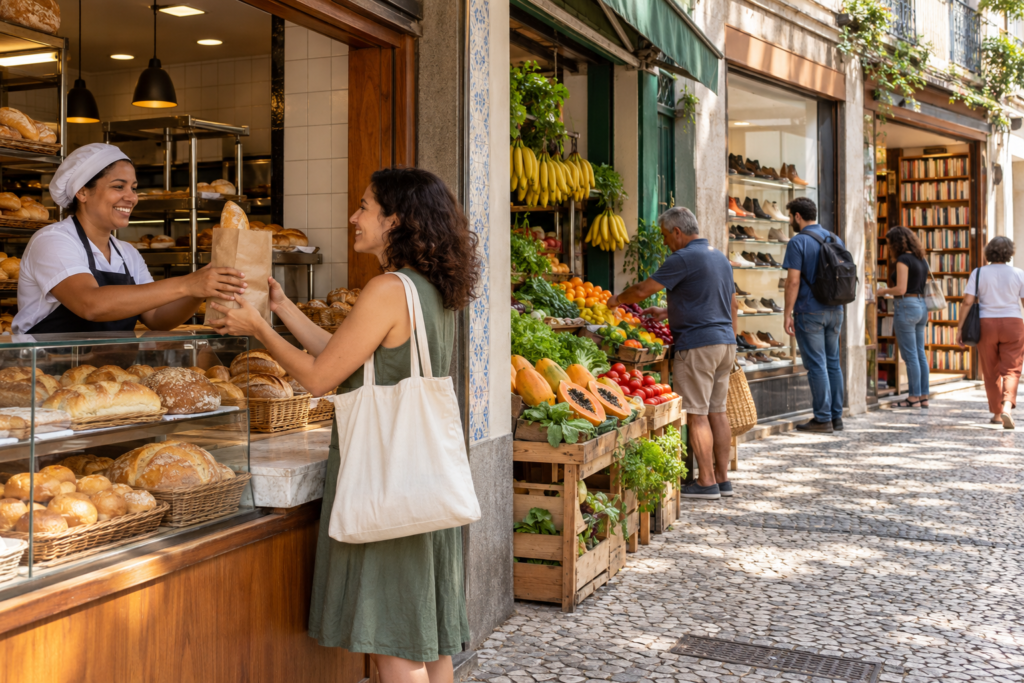

Brazilian Portuguese shopping vocabulary helps you find the right store, ask for everyday items, and understand the answers. For example, you buy bread at a padaria, meat at an açougue, and books at a livraria. However, some words in European Portuguese picture dictionaries can send you to the wrong place in Brazil.
This guide covers food shops, clothing stores, household businesses, and local services. Along the way, you will learn practical requests, useful grammar, and differences between Portuguese from Brazil and Portugal.
Rather than memorize isolated translations, connect each place with a task. As a result, you can move from recognizing a sign to actually buying something.
Essential Brazilian Portuguese Shopping Vocabulary
Start with three everyday words: a loja means “the store,” as compras means “the shopping” or “the purchases,” and comprar means “to buy.” In addition, fazer compras means “to go shopping” or “to do the shopping.”
Learn each noun with its article, o or a. That way, you also learn its grammatical gender and can build phrases more easily.
| Brazilian Portuguese | English | Example |
|---|---|---|
| a loja | store; shop | A loja fica perto. = The store is nearby. |
| o cliente / a cliente | customer | Sou cliente daqui. = I shop here. |
| o vendedor / a vendedora | salesperson | Vou perguntar à vendedora. = I will ask the salesperson. |
| o atendente / a atendente | person assisting customers | O atendente pode ajudar. = The staff member can help. |
| o caixa | checkout; cashier, depending on context | Onde fica o caixa? = Where is the checkout? |
| o balcão | counter | Pode deixar no balcão. = You can leave it on the counter. |
| o preço | price | Qual é o preço? = What is the price? |
| a sacola | shopping bag | Preciso de uma sacola. = I need a bag. |
| a nota fiscal | tax invoice; fiscal receipt | Pode me dar a nota fiscal? = Can I have the fiscal receipt? |
| o comprovante de pagamento | proof of payment | Quero o comprovante. = I would like the payment receipt. |
A compra can mean one purchase. By contrast, as compras can refer to several purchases or the goods you bought: Vou guardar as compras means “I will put the groceries/shopping away.”
Food Stores in Brazilian Portuguese
Food shopping introduces several useful neighborhood words. Moreover, the same product may appear in a specialty shop, a supermarket, or a street market.
Bakeries, Pastry Shops, and Butcher Shops
| Brazilian Portuguese | English | What you might buy |
|---|---|---|
| a padaria | bakery | bread, rolls, and often snacks |
| a confeitaria | cake and pastry shop | cakes, pastries, and sweets |
| o açougue | butcher shop; meat counter | meat and specific cuts |
| a peixaria | fish shop; fish counter | fish and seafood |
| a mercearia | small grocery store | basic groceries and household staples |
| o supermercado | supermarket | groceries and other everyday goods |
| o mercado | market; grocery store, depending on context | food and household items |
| o mercado municipal | municipal market | products from multiple vendors |
Padaria and confeitaria overlap, but they emphasize different products. For example, a padaria may serve breakfast and sandwiches, while a confeitaria may focus on cakes and elaborate sweets.
Use açougue for a butcher shop in Brazil. Although Portuguese speakers in Portugal commonly use talho, that is not the usual Brazilian choice.
Try these requests:
- Na padaria: “Queria quatro pães franceses, por favor.” = I would like four French rolls, please.
- Na confeitaria: “Vocês fazem bolo por encomenda?” = Do you make cakes to order?
- No açougue: “Pode moer essa carne, por favor?” = Could you grind this meat, please?
- Na peixaria: “Você pode limpar o peixe?” = Can you clean the fish?
- Na mercearia: “Vocês têm arroz?” = Do you have rice?
In everyday Brazilian speech, queria often softens a request. Similarly, gostaria de sounds polite, while me vê… sounds informal and suits familiar counter interactions.
Produce Stores, Street Markets, and Regional Names
For fruit and vegetables, learn hortifrúti, sacolão, quitanda, and feira livre. However, these words do not describe exactly the same type of business everywhere.
| Word | Practical meaning | Usage note |
|---|---|---|
| o hortifrúti | produce store or produce department | Useful for fruit, vegetables, and greens |
| o sacolão | produce store | A familiar name in many Brazilian cities |
| a quitanda | small food or produce shop | Can carry a different regional meaning |
| a feira livre | open-air street market | Usually brings together multiple stalls |
| a banca | stall; stand | Useful for an individual vendor at a market |
| a frutaria | fruit shop | Understandable, although local alternatives vary |
Quitanda deserves special attention. Besides a shop, the word can refer to homemade baked goods in some Brazilian regions, as Dicio’s entry for quitanda explains.
Consequently, someone offering quitandas may mean cakes, biscuits, or similar foods rather than several stores. Context matters more than a single dictionary translation.
At a produce stall, say: “Queria meio quilo de tomate.” That means “I would like half a kilogram of tomatoes.”
For a different task, ask: “Posso escolher as frutas?” This means “Can I choose the fruit?”
Delis and Stores Selling Drinks
Charcutaria refers to charcuterie and businesses specializing in products such as cured meats. However, the English word “deli” covers a wider range of businesses.
For sliced ham and cheese, loja de frios or balcão de frios may describe your destination more clearly. Meanwhile, empório often names a store selling specialty groceries, although its range varies.
Use loja de bebidas as a broad translation for a drinks store. In contrast, adega can suggest a wine shop, a drinks business, or a wine-storage space, depending on context.
Garrafeira is a useful word to recognize in Portugal. For Brazilian conversations, however, loja de bebidas is a more practical starting point.
Clothing, Shoe, and Jewelry Stores
Brazilian store names often follow the pattern loja de + product. Therefore, you can build useful phrases before learning every specialized noun.
| Brazilian Portuguese | English | Useful request |
|---|---|---|
| a loja de roupas | clothing store | Tem outro tamanho? = Do you have another size? |
| a boutique / a butique | boutique | Posso experimentar? = Can I try it on? |
| a loja de calçados / a sapataria | shoe store | Tem esse modelo no meu número? = Do you have this style in my size? |
| a joalheria | jewelry store | Essa peça é de prata? = Is this piece silver? |
| a loja de presentes | gift shop | Pode embrulhar para presente? = Can you gift-wrap it? |
| o brechó | secondhand clothing shop | Posso ver essa jaqueta? = Can I see that jacket? |
For shoes, Brazilians commonly ask about their número. For clothing, by comparison, tamanho is the broader word for size.
Sapataria can also appear in businesses offering shoe repairs. To avoid confusion, use loja de calçados when you want to buy shoes and sapateiro when you need repairs.
A Person Is Not Always a Store
O alfaiate means “the tailor,” while a alfaiataria names the tailoring business or trade. Similarly, o cabeleireiro can refer to a hairdresser, while o salão de beleza clearly names the salon.
| Service provider | Place or service | Practical phrase |
|---|---|---|
| o alfaiate / a alfaiate | a alfaiataria | Preciso ajustar este terno. = I need to have this suit altered. |
| o costureiro / a costureira | o ateliê de costura; clothing alterations | Vocês fazem a barra da calça? = Do you hem trousers? |
| o sapateiro / a sapateira | shoe-repair service | Dá para consertar a sola? = Can you repair the sole? |
| o cabeleireiro / a cabeleireira | o salão de beleza | Quero marcar um corte. = I want to book a haircut. |
In conversation, “Vou ao cabeleireiro” naturally means “I am going to the hairdresser.” Nevertheless, recognizing the person/place distinction helps you understand signs and search for services.
Bookstores, Furniture Stores, and Other Businesses
Some store names look familiar to English speakers. However, familiar spelling can hide a different meaning.
| Brazilian Portuguese | English | Practical distinction |
|---|---|---|
| a livraria | bookstore | Sells books; a library is a biblioteca |
| o sebo | used-book store | Useful when looking for secondhand books |
| a papelaria | stationery store | Sells school and office supplies |
| a loja de móveis | furniture store | Everyday Brazilian choice for furniture shopping |
| o antiquário | antiques store; antique dealer | Focuses on antiques |
| a loja de celulares | mobile phone store | Uses celular rather than telemóvel |
| o pet shop | pet supplies store | May also offer grooming or other services |
| a loja de produtos naturais | natural-products or health-food store | Product ranges vary |
| a loja de artigos usados | secondhand goods store | Broader than a clothing-focused brechó |
| a loja de materiais artísticos | art supply store | Also: loja de materiais de arte |
| o centro de jardinagem | garden center | Also look for loja de jardinagem |
| o viveiro de plantas | plant nursery | Useful when buying plants |
Livraria is a classic false friend: it means a bookstore, not an English “library.” For a direct lexical reference, see Dicio’s livraria entry.
Likewise, loja de animais de estimação is understandable, but pet shop is a practical term to recognize in Brazil. Ask “Vocês têm ração para gatos?” when you need cat food.
Horto relates to a cultivated garden or plant-growing space and appears in some business names. For shopping, however, centro de jardinagem or viveiro de plantas communicates your goal more directly.
Travel, Property, and Laundry Services
| Brazilian Portuguese | English | Example |
|---|---|---|
| a agência de viagens | travel agency | Quero um orçamento de viagem. = I would like a travel quote. |
| a imobiliária | real estate agency | Estou procurando um apartamento para alugar. = I am looking for an apartment to rent. |
| a lavanderia | laundry business | Quanto custa lavar esta camisa? = How much does washing this shirt cost? |
| a lavanderia de autoatendimento | self-service laundromat | Como funciona a máquina? = How does the machine work? |
| a lavanderia com lavagem a seco | laundry offering dry cleaning | Vocês fazem lavagem a seco? = Do you offer dry cleaning? |
Lavanderia is the usual Brazilian form; lavandaria is uncommon in Brazil, as Dicio notes. Also, the name alone does not tell you whether a business offers dry cleaning.
Therefore, ask specifically about lavagem a seco when that is the service you need. For a self-service location, check whether you must bring detergent: “Preciso trazer sabão?”
Portugal vs. Brazil: Shopping Words to Adapt
European Portuguese vocabulary is valid, but it does not always match everyday Brazilian usage. Consequently, adapt both the word and the kind of business it describes.
| Wording in the reference images | Practical Brazilian wording | Important note |
|---|---|---|
| o talho | o açougue | Butcher shop |
| a drogaria, labeled “hardware store” | a loja de ferragens | In Brazil, drogaria means a drugstore |
| a frutaria | o hortifrúti; o sacolão; a frutaria | Local store names vary |
| a joalharia | a joalheria | Jewelry store |
| a garrafeira | a loja de bebidas; a adega | Choose according to the business |
| a loja de mobílias | a loja de móveis | More natural everyday Brazilian wording |
| a loja de telemóveis | a loja de celulares | Mobile phone store |
| a lavandaria | a lavanderia | Laundry business |
| a lavandaria automática | a lavanderia de autoatendimento | Self-service laundromat |
| a serralharia, labeled “locksmith” | o chaveiro | Key cutting and lock services |
| a agência imobiliária | a imobiliária | Both work; the shorter form is useful |
| a loja de animais de estimação | o pet shop | Common business wording in Brazil |
Why Drogaria Does Not Mean Hardware Store in Brazil
In Brazilian Portuguese, drogaria means a business selling medicines and pharmacy products. Dicio’s definition supports this meaning.
For screws, hinges, and similar items, ask for a loja de ferragens instead. If you need a broader range of renovation products, try loja de materiais de construção.
Compare these destinations:
- “Preciso de um curativo. Onde tem uma drogaria?” = I need a bandage. Where is there a drugstore?
- “Preciso de parafusos. Onde tem uma loja de ferragens?” = I need screws. Where is there a hardware store?
This distinction changes where you go, so it deserves more attention than a spelling difference.
Chaveiro vs. Serralheria
For a key copy or lock service, look for a chaveiro. By comparison, serralheria generally refers to metalwork, such as making or repairing metal gates and related structures.
The dictionary entries for chaveiro and serralheria distinguish these activities. Therefore, do not automatically translate “locksmith” as serralheria in a Brazilian shopping guide.
“Vocês fazem cópia de chave?” means “Do you make key copies?” Meanwhile, “Preciso consertar um portão de ferro” means “I need to repair an iron gate.”
As another useful detail, chaveiro can also mean a key ring or keychain. Thus, “Quero comprar um chaveiro” and “Preciso chamar um chaveiro” describe very different needs.
How to Ask Where a Store Is
Use “Onde fica…?” to ask where a particular place is. Alternatively, “Tem… por aqui?” asks whether a type of business exists nearby.
| Portuguese | English |
|---|---|
| Onde fica a padaria? | Where is the bakery? |
| Tem algum açougue por aqui? | Is there a butcher shop around here? |
| Você conhece uma lavanderia aqui perto? | Do you know a laundry nearby? |
| Como eu chego à livraria? | How do I get to the bookstore? |
| Dá para ir a pé? | Can I walk there? |
| A loja abre aos domingos? | Does the store open on Sundays? |
| Que horas vocês fecham? | What time do you close? |
In casual speech, “Tem uma farmácia aqui perto?” is natural. For a more formal alternative, use “Há uma farmácia aqui perto?”
Na, No, À, and Ao With Store Names
Use na or no to describe location: na padaria, no açougue. These forms combine em with a or o.
For destinations with the preposition a, the combinations are à and ao. Therefore, “Vou à padaria” means “I am going to the bakery,” while “Estou na padaria” means “I am at the bakery.”
| Meaning | Feminine example | Masculine example |
|---|---|---|
| At/in the place | Estou na livraria. | Estou no mercado. |
| Going to the place | Vou à livraria. | Vou ao mercado. |
| Coming from the place | Vim da livraria. | Vim do mercado. |
You will also hear “Vou na padaria” in informal Brazilian speech. Nevertheless, “Vou à padaria” is the standard written form for this construction.
Useful Phrases Inside a Brazilian Store
Once you find the right place, simple requests handle most basic interactions. In addition, these patterns work across many types of businesses.
Asking for Products and Sizes
- “Vocês têm este produto?” = Do you have this product?
- “Estou procurando um presente.” = I am looking for a gift.
- “Tem em outra cor?” = Do you have it in another color?
- “Posso experimentar?” = Can I try it on?
- “Onde fica o provador?” = Where is the fitting room?
- “Só estou olhando, obrigado/obrigada.” = I am just looking, thank you.
Obrigado and obrigada agree with the speaker, not the person receiving thanks. For example, a male speaker normally says obrigado, while a female speaker normally says obrigada.
Asking About Payment
- “Quanto custa?” = How much does it cost?
- “Vocês aceitam cartão?” = Do you accept cards?
- “Posso pagar por Pix?” = Can I pay by Pix?
- “Tem desconto à vista?” = Is there a discount for paying in full?
- “Dá para parcelar?” = Can I pay in installments?
- “Em quantas vezes?” = In how many installments?
- “Tem juros?” = Is there interest?
À vista means payment in full rather than installments; it does not automatically mean banknotes. Consequently, use em dinheiro when you specifically mean physical cash.
At checkout, “Débito ou crédito?” means “Debit or credit?” Also, “CPF na nota?” asks whether you want your Brazilian taxpayer number on the fiscal receipt.
Three Realistic Shopping Conversations
These original examples connect store names with practical actions. As a result, you can rehearse complete interactions rather than separate vocabulary items.
Buying Bread at a Padaria
Atendente: Bom dia! O que você gostaria?
Good morning! What would you like?
Cliente: Queria quatro pães franceses e um café, por favor.
I would like four French rolls and a coffee, please.
Atendente: Vai tomar aqui ou levar?
Will you have it here or take it to go?
Cliente: Vou levar. Posso pagar com cartão?
I will take it to go. Can I pay by card?
Notice “aqui ou levar?”, a useful distinction at bakeries and snack counters. To ask for takeaway directly, say “É para levar.”
Finding a Shoe Size
Cliente: Boa tarde! Tem esse tênis no número quarenta?
Good afternoon! Do you have these sneakers in size forty?
Vendedora: Vou conferir. Você quer experimentar?
I will check. Would you like to try them on?
Cliente: Sim, por favor. Também queria ver outra cor.
Yes, please. I would also like to see another color.
Here, tênis means sneakers. Also, Brazilian shoe sizes do not necessarily match your home country’s sizes, so try shoes on or check the brand’s chart.
Asking for a Key Copy
Cliente: Boa tarde! Vocês fazem cópia desta chave?
Good afternoon! Do you make copies of this key?
Chaveiro: Fazemos, sim.
Yes, we do.
Cliente: Quanto custa? Posso esperar aqui?
How much does it cost? Can I wait here?
This exchange uses chaveiro for the professional. By contrast, cópia da chave names the service or item you need.
Practice Brazilian Portuguese Shopping Vocabulary by Task
Build a short shopping route around what you actually need. For example, imagine buying breakfast, repairing a shoe, and picking up a book.
- Match each task to a place: padaria, sapateiro, livraria.
- Next, choose one request for each stop: Queria…, Dá para consertar…?, Vocês têm…?
- Add a question about price or payment.
- Finally, say the complete route aloud: “Primeiro, vou à padaria. Depois, vou ao sapateiro. Por último, passo na livraria.”
That last sentence means “First, I am going to the bakery. Then, I am going to the shoe repairer. Finally, I will stop by the bookstore.”
For an extra challenge, explain what you need without naming the shop. For instance, “Preciso comprar pão” gives another person enough information to suggest a padaria.
Frequently Asked Questions
How Do You Say “Store” in Brazilian Portuguese?
Loja means store or shop. For a specific category, add de and the product: loja de roupas, loja de móveis, or loja de celulares.
What Is the Difference Between Loja and Mercado?
Loja is a broad word for a store. By comparison, mercado often refers to food shopping or a market, although its exact meaning depends on context.
Is Drogaria the Same as a Hardware Store?
In Brazil, drogaria means a drugstore. For hardware, use loja de ferragens, or choose loja de materiais de construção for a broader building-supplies business.
Does Livraria Mean Library?
Livraria means bookstore. In contrast, biblioteca means library.
What Is a Secondhand Store Called in Brazil?
Use brechó for a secondhand clothing store and sebo for a used-book store. For a broader business, loja de artigos usados communicates the idea clearly.
Should I Say Lavandaria or Lavanderia?
Choose lavanderia for Brazil. Also, specify de autoatendimento for self-service laundry or ask about lavagem a seco for dry cleaning.
Put Your Shopping Vocabulary to Work
Brazilian Portuguese shopping vocabulary becomes easier when you connect a place, a product, and a request. Start with padaria, açougue, mercado, loja, and farmácia; then add the businesses you use most.
Above all, remember the distinctions that change your destination: drogaria for pharmacy products, loja de ferragens for hardware, and chaveiro for key services. With those choices and a few polite phrases, you can handle everyday shopping with greater confidence.