
Brazilian Portuguese candy vocabulary helps you ask for chocolates, choose sweets, and understand a candy shop in Brazil. However, a Portuguese picture dictionary may teach words that people use more often in Portugal. This guide adapts those terms to Brazilian usage and shows how to turn a vocabulary list into a real purchase.
For example, you will learn why pirulito replaces chupa-chupa and why chiclete works better than pastilha elástica in everyday Brazilian conversation. Beyond those substitutions, you will practice asking about fillings, packaging, and prices. As a result, you can describe what you want even when a product has an unfamiliar name.
Brazilian Portuguese Candy Vocabulary at a Glance
First, learn each noun with its article: o usually marks a masculine noun, while a marks a feminine noun. For plural forms, use os or as. That habit helps you build phrases such as um pirulito and uma bala.
| Brazilian Portuguese | English meaning | Useful detail |
|---|---|---|
| a loja de doces | candy store / sweet shop | A clear, general name for the shop |
| a bomboniere | confectionery shop or candy counter | Useful for a shop or section selling packaged sweets |
| o doce / os doces | sweet / sweets | A broad category, including more than small candies |
| a guloseima / as guloseimas | treat / treats | A general word for sweet treats and other snack foods |
| a bala / as balas | candy / candies | Often a small individual sweet |
| a bala dura | hard candy | Specifies the texture |
| o pirulito | lollipop | Candy on a stick |
| o chiclete | chewing gum | Also called goma de mascar |
| o bombom | chocolate bonbon | An individual chocolate confection, often with a filling |
| a caixa de bombons | box of chocolates | Use as caixas for several boxes |
| a barra de chocolate | chocolate bar | A practical alternative to tablete de chocolate |
| o chocolate ao leite | milk chocolate | Use ao leite in the product name |
| o chocolate branco | white chocolate | The adjective follows the noun |
| o chocolate amargo | dark chocolate | A useful description when asking for darker chocolate |
| o chocolate meio amargo | semisweet / moderately dark chocolate | Check the package for the cocoa percentage |
| a trufa | chocolate truffle | In a candy shop, this refers to a chocolate sweet |
| a bala de caramelo | caramel candy | More specific than simply caramelo |
| o torrone | nougat | A useful name for the nougat-style sweet shown in the picture |
| o marshmallow | marshmallow | Brazilian usage also keeps this English loanword |
| a bala de menta | mint candy | Bala de hortelã is another useful flavor description |
| a bala recheada | filled candy | The candy contains a distinct filling |
| a bala de goma | gumdrop / gummy candy | An approximate category; shapes and textures vary |
| a bala de gelatina | gummy candy | Common wording on Brazilian gummy products |
| o alcaçuz | licorice | For the sweet itself, ask about bala de alcaçuz |
| o biscoito / a bolacha | cookie / biscuit | Both words occur in Brazil |
| a barrinha de cereal | cereal / granola bar | Appropriate when the snack bar contains cereal |
| o pacote de batata chips | bag of potato chips | Specifies the thin, packaged snack |
| os doces a granel | loose / bulk sweets | Ask how the shop calculates the price |
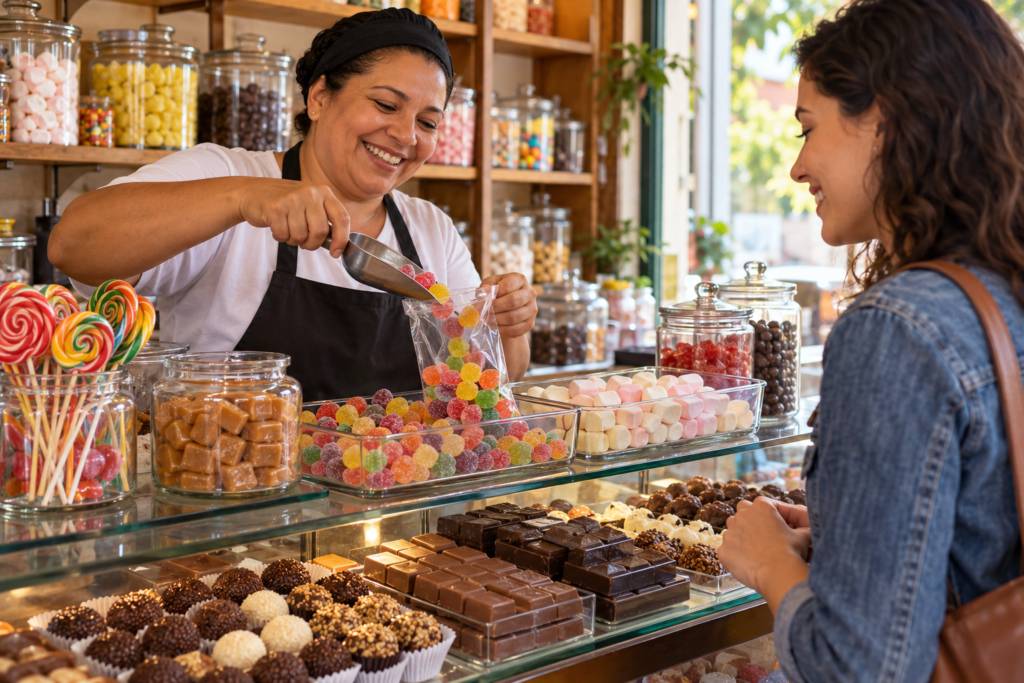
Although the picture includes cookies and potato chips, those products belong to the broader snack selection. Therefore, do not assume that every item in a loja de doces counts as a bala.
Portugal Portuguese vs. Brazilian Portuguese: What to Change
Next, separate differences in everyday usage from differences in meaning. A word from Portugal may still make sense to a Brazilian listener. Nevertheless, choosing a familiar Brazilian term makes a quick shopping conversation easier.
| Wording in the picture | Practical Brazilian wording | Explanation |
|---|---|---|
| os rebuçados | as balas | For hard candy specifically, use balas duras |
| o chupa-chupa | o pirulito | A straightforward regional vocabulary substitution |
| a pastilha elástica | o chiclete / a goma de mascar | Use chiclete for an everyday request |
| o chocolate de leite | o chocolate ao leite | Natural wording for milk chocolate in Brazil |
| o chocolate preto | o chocolate amargo | Choose by the actual product, since color alone does not define sweetness |
| a tablete de chocolate | a barra de chocolate / o tablete de chocolate | If you choose tablete, use the masculine article in Brazilian Portuguese |
| a barrita de snack | a barrinha / a barra de cereal | Choose the specific type rather than translating snack mechanically |
| o rebuçado de menta | a bala de menta | The article changes with the noun |
| o rebuçado com recheio | a bala recheada | Accurate for filled candy, but not automatically for a jelly bean |
| as gomas de fruta | as balas de goma de fruta | A useful descriptive adaptation |
| o torrão, labeled as nougat | o torrone | Avoid treating torrão as a universal Brazilian name for nougat |
| a bolacha | a bolacha / o biscoito | Both remain valid Brazilian choices |
For a dictionary check, Priberam identifies chupa-chupa as a Portugal usage. Meanwhile, Dicio defines pirulito as a sweet attached to a stick. These entries support the switch from chupa-chupa to pirulito.
Similarly, Dicio includes chiclete as a Brazilian vocabulary entry for chewing gum. For a more formal product description, goma de mascar also communicates the idea clearly.
Biscoito or Bolacha?
Both biscoito and bolacha occur in Brazilian Portuguese, and speakers have regional and personal preferences. However, you do not need to settle that debate to buy a packet of cookies.
For example, you can ask for um biscoito recheado or uma bolacha recheada. Adding the flavor or pointing to the package makes the request more specific. Consequently, the product description matters more than choosing one supposedly universal word.
Chocolate Amargo or Meio Amargo?
Use chocolate ao leite for milk chocolate and chocolate branco for white chocolate. In contrast, amargo and meio amargo help describe darker chocolate options.
However, these names alone do not tell you the exact cocoa content. Instead, read the percentage on the package or ask: Qual é a porcentagem de cacau? That means “What is the cocoa percentage?”
Doce, Bala, Bombom, and Trufa: Choose the Right Category
The English word “candy” does not always point to one Portuguese noun. Therefore, first identify the kind of sweet you mean.
Doce is the broad category. For example, a brigadeiro, a piece of fudge-like confectionery, or a spoonful of doce de leite can all fit within the world of doces. A request for um doce leaves plenty of possibilities open.
Bala usually gives the listener a narrower idea: a small candy. However, the word also has other meanings outside a food context, including “bullet.” In a candy shop, the surrounding conversation makes your meaning clear.
Bombom points toward an individual chocolate confection. Meanwhile, trufa identifies a type of chocolate sweet that may have a soft center or filling. Since recipes vary, ask about the filling rather than assuming every truffle contains the same ingredients.
Compare these requests:
- Queria um doce. “I would like a sweet.” A broad request.
- Queria uma bala de morango. “I would like a strawberry candy.” A more specific choice.
- Queria um bombom de chocolate. “I would like a chocolate bonbon.” A chocolate confection.
- Queria uma trufa com recheio de coco. “I would like a truffle with coconut filling.” A product plus filling.
As a practical rule, start with the category and then add flavor, texture, or filling. That pattern helps you communicate even when you forget a brand name.
A Translation Trap: Jelly Beans Are Not Automatically Filled Candy
The picture pairs a Portuguese expression meaning “filled candy” with the English label “jellybean.” However, those descriptions do not match precisely.
A jelly bean typically has a sugar shell around a chewy center. By contrast, bala recheada describes candy with a separate filling, such as a liquid or creamy center. Therefore, do not use recheada just because a sweet has a soft interior.
For imported jelly beans, start with the package name or describe the shape. For example, Vocês têm jelly beans, aquelas balinhas em formato de feijão? means “Do you have jelly beans, those little bean-shaped candies?” This approach identifies the product without forcing an inaccurate translation.
Likewise, bala de goma and bala de gelatina cover related candy categories, but neither guarantees an exact match for every English sweet. As a real packaging example, Fini groups Brazilian products under balas de gelatina. Use the label, appearance, and texture together when precision matters.
How to Buy Sweets by Unit, Package, or Weight
Knowing a product name answers only part of the shopping question. Next, find out whether the shop sells it individually, in a sealed package, or by weight.
Por Unidade: Buying Individual Pieces
Por unidade means “per item” or “per piece.” For example, a shop might sell a truffle or a lollipop this way.
- Quanto custa cada trufa? “How much does each truffle cost?”
- Vocês vendem por unidade? “Do you sell them individually?”
- Queria dois bombons e um pirulito, por favor. “I would like two bonbons and a lollipop, please.”
Notice the plural bombons, rather than bomboms. Similarly, um bombom becomes dois bombons.
Em Pacote or Em Caixa: Buying Packaged Sweets
Use um pacote de for a packet and uma caixa de for a box. Meanwhile, uma barra de identifies the form of a chocolate bar.
- Queria um pacote de balas de menta. “I would like a packet of mint candies.”
- Tem uma caixa de bombons para presente? “Do you have a box of chocolates for a gift?”
- Vou levar uma barra de chocolate ao leite. “I will take a milk chocolate bar.”
For chips, specify batata chips when you mean the thin packaged snack. Otherwise, batata frita can also bring French fries to mind, depending on context.
A Granel and Por Peso: Buying Loose Sweets
A granel describes loose goods rather than individually packaged retail portions. However, it does not, by itself, tell you the pricing method. Therefore, ask whether the shop charges by weight or by piece.
- Essas balas são por peso ou por unidade? “Are these candies priced by weight or by piece?”
- Quanto custa cem gramas? “How much does one hundred grams cost?”
- Posso misturar os sabores? “Can I mix the flavors?”
- Queria duzentos gramas de balas de goma. “I would like two hundred grams of gummy candies.”
In the weight expression, grama is masculine: duzentos gramas. By contrast, a grama means grass. This small grammar detail gives you a useful advantage over a simple candy word list.
Describe Flavor, Texture, and Filling
Once you know the noun, add one detail at a time. For example, bala de morango names a flavor, while bala recheada de morango specifies a strawberry filling.
| Portuguese description | English meaning | Example |
|---|---|---|
| de morango | strawberry-flavored / strawberry | uma bala de morango |
| de uva | grape-flavored / grape | um pirulito de uva |
| de coco | coconut | uma trufa de coco |
| de menta | mint | uma bala de menta |
| com recheio | with a filling | um bombom com recheio |
| sem recheio | without a filling | uma bala sem recheio |
| duro / dura | hard | uma bala dura |
| macio / macia | soft | uma bala macia |
| azedo / azeda | sour | uma bala azeda |
| crocante | crunchy | um chocolate crocante |
Notice how dura, macia, and azeda match the feminine noun bala. In comparison, um doce azedo uses the masculine form. As a result, learning the article helps you choose the adjective later.
A Short Candy-Shop Conversation
Now put the vocabulary into a small transaction. This fictional exchange shows how you can identify a product, clarify the price, and finish your purchase.
Customer: Oi! Vocês têm bala de menta?
“Hi! Do you have mint candy?”
Shop assistant: Temos, sim. Você quer um pacote ou as balas a granel?
“Yes, we do. Would you like a packet or the loose candies?”
Customer: Queria as balas a granel. Vocês vendem por peso?
“I would like the loose candies. Do you sell them by weight?”
Shop assistant: Sim, por peso.
“Yes, by weight.”
Customer: Então, vou levar cem gramas. Também queria uma barra de chocolate ao leite.
“Then I will take one hundred grams. I would also like a milk chocolate bar.”
Shop assistant: Mais alguma coisa?
“Anything else?”
Customer: Só isso, obrigada!
“That is all, thank you!”
Use obrigado if you are a male speaker, or obrigada if you are a female speaker. Meanwhile, queria creates a polite request, even though its literal grammatical form relates to the past. The phrase vou levar naturally signals your decision to buy.
Practice Brazilian Portuguese Candy Vocabulary
Finally, practice with situations rather than isolated translations. Cover the answers, say each request aloud, and then check your wording.
- Ask for a strawberry lollipop.
- Request a box of chocolates.
- Ask whether the shop prices loose sweets by weight or by piece.
- Request one hundred grams of gummy candies.
- Ask whether the shop has chewing gum.
- Ask what filling a truffle contains.
Suggested Answers
- Queria um pirulito de morango, por favor.
- Queria uma caixa de bombons.
- Esses doces são por peso ou por unidade?
- Queria cem gramas de balas de goma.
- Vocês têm chiclete?
- Qual é o recheio dessa trufa?
Alternatively, change the flavor or quantity and repeat the sentence. That simple variation turns one memorized phrase into several useful requests.
Frequently Asked Questions
How Do You Say Candy in Brazilian Portuguese?
Use bala for many small individual candies and doce for the broader category of sweets. However, chocolate bonbons, lollipops, and chewing gum have more specific names: bombom, pirulito, and chiclete.
What Is a Candy Store Called in Brazil?
Loja de doces is a clear general expression. Additionally, you may encounter bomboniere for a candy shop or confectionery counter. A doceria can also sell sweets, though its selection may focus on prepared desserts.
Does Bala de Menta Mean Chewing Gum?
Bala de menta means mint candy. For mint chewing gum, use chiclete de menta or goma de mascar sabor menta. Therefore, the flavor alone does not identify the product category.
Can I Use European Portuguese Candy Words in Brazil?
Some listeners may understand them, especially with context. Nevertheless, bala, pirulito, and chiclete are practical choices for everyday Brazilian shopping.
Turn the Vocabulary into Your Next Purchase
Brazilian Portuguese candy vocabulary becomes more useful when you connect names to actual shopping decisions. First, identify the sweet: bala, bombom, pirulito, or trufa. Then add the flavor, filling, or package you want.
Finally, clarify whether the shop sells por unidade or por peso. With those steps, you can move from recognizing a candy-shop picture to making a clear, polite request in Brazil.