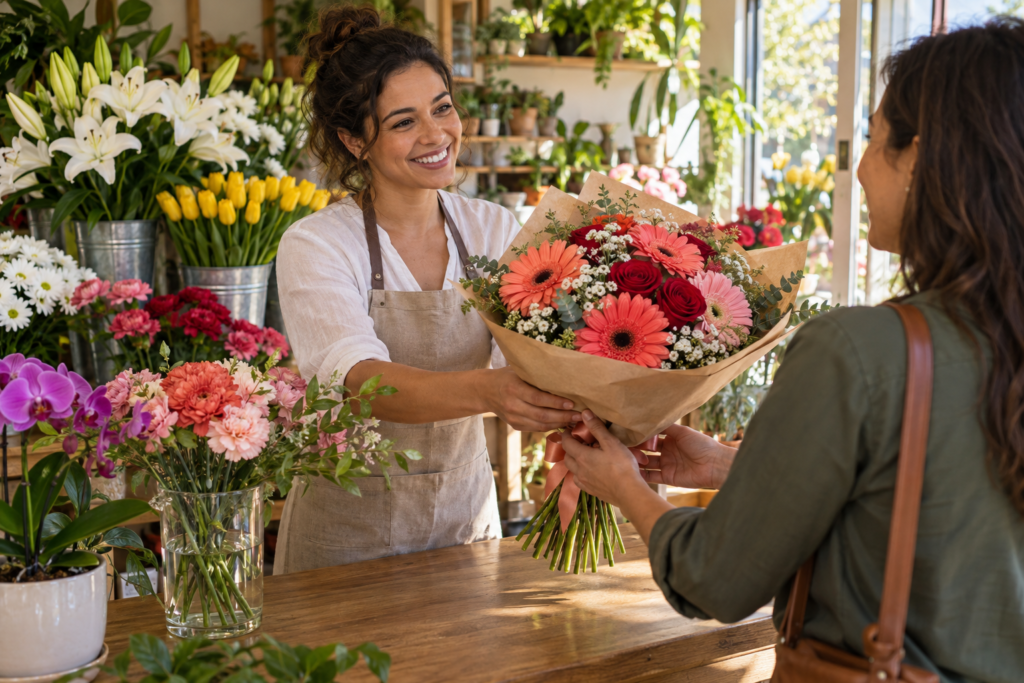

Brazilian Portuguese flower vocabulary helps you do more than recognize a rose. With the right words, you can order a bouquet, describe an arrangement, and organize a delivery. However, a dictionary translation may leave you unsure about what to say at the counter. This guide connects flower names with natural Brazilian requests, useful grammar, and common misunderstandings.
First, learn the names with their articles: a rosa, o lírio, and o buquê. Then, practice complete phrases that explain your budget and preferences. Along the way, you will discover why vaso can mean two containers and why cravo needs context.
Essential Brazilian Portuguese Flower Vocabulary
Start with the flowers in the reference pictures. Most names also work in Brazilian Portuguese. However, everyday shop vocabulary sometimes offers a more useful alternative than a botanical label.
| Portuguese | English | Useful learning note |
|---|---|---|
| a flor / as flores | flower / flowers | Learn the plural: flores, rather than “flors.” |
| a rosa | rose | Rosa also names the color pink. |
| o lírio | lily | Use lírios brancos for white lilies. |
| a margarida | daisy | Um buquê de margaridas means a bouquet of daisies. |
| o cravo | carnation | In another context, the same word can refer to a clove or a blackhead. |
| o crisântemo | chrysanthemum | Keep the written accent when naming the flower. |
| a gérbera | gerbera | Use gérberas coloridas for colorful gerberas. |
| a frésia | freesia | The plural is frésias. |
| a orquídea | orchid | Specify a potted orchid or cut stems when ordering. |
| a peônia | peony | Ask about availability before choosing a design. |
| a tulipa | tulip | Tulipas amarelas means yellow tulips. |
| o narciso | daffodil / narcissus | This is the flower name, rather than a guarantee of one exact variety. |
| o gladíolo | gladiolus | The plural is gladíolos. |
| a íris | iris | The botanical noun can also take masculine gender; this guide uses a íris. |
| a acácia | acacia | The word can name the plant as well as its flowers. |
| o goivo | stock flower | Here, “stock” refers to a flower, rather than inventory. |
| a gipsófila / o mosquitinho | baby’s breath | Mosquitinho is a useful Brazilian common name. |
| a folhagem | foliage / greenery | This describes the leaves and greenery in a design. |
For example, you can ask, “Vocês têm mosquitinho para colocar no buquê?” That means, “Do you have baby’s breath to add to the bouquet?” Brazilian grower Terra Viva lists mosquitinho among the common names for gypsophila. Therefore, learning both names helps you connect formal vocabulary with shop conversation.
The Florist, the Flower Shop, and the Bouquet
A few core nouns help you explain where you are going and what you want. In particular, distinguish the person from the business.
| Portuguese | English | Example |
|---|---|---|
| o florista / a florista | male florist / female florist | A florista montou o buquê. / The florist put the bouquet together. |
| a floricultura | flower shop; also floriculture | Vou à floricultura. / I’m going to the flower shop. |
| a loja de flores | flower shop | Tem uma loja de flores aqui perto? / Is there a flower shop nearby? |
| o buquê | bouquet | Quero um buquê de rosas. / I want a bouquet of roses. |
| o ramo / o ramalhete | bunch or bouquet of flowers | Um ramalhete de flores. / A small bunch of flowers. |
| o arranjo floral | floral arrangement | Preciso de um arranjo para a mesa. / I need an arrangement for the table. |
Notice that florista keeps the same ending for men and women. Instead, the article changes: o florista or a florista. The Dicio entry for florista confirms this grammatical pattern.
For a hand-held gift, buquê gives you a straightforward word to use in Brazil. Meanwhile, ramo and ramalhete remain valid flower terms. This Dicio entry for buquê connects these meanings and gives the plural buquês.
Adapt the Picture Vocabulary for Brazil
The reference pages include wording that learners should adapt for everyday Brazilian conversation. However, these alternatives do not make every original expression incorrect. The goal is to help you choose clear words for the specific object or action.
| Wording in the pictures | Useful Brazilian wording | Reason |
|---|---|---|
| a jarra, labeling a flower vase | o vaso de flores | Jarra commonly suggests a pitcher or jug; specify the flower container. |
| o pé, labeling a cut stem | a haste / o caule | Pé de roseira refers to a rose plant; haste clearly identifies a cut flower stem. |
| o bouquet | o buquê | Buquê is the Portuguese spelling to learn. |
| Podia dar-me um ramo…? | Você pode preparar um buquê…? | This offers a natural Brazilian request for a bouquet. |
| Posso juntar uma mensagem? | Posso incluir um cartão com uma mensagem? | The added noun explains where the message should go. |
| Pode enviá-las para…? | Vocês fazem entrega neste endereço? | This asks clearly about the shop’s delivery service. |
| Quanto tempo durarão estas? | Quanto tempo essas flores duram? | The present tense sounds natural when asking about typical longevity. |
Also, separate “Você pode fazer um arranjo?” from “Você pode embrulhar as flores?” The first asks for a floral design. By contrast, the second asks for wrapping. Consequently, treating the two requests as equivalent could lead to a different order than you intended.
Containers, Flower Parts, and Wrapping
Next, learn the words that describe how flowers look and how you want to receive them. These details help you choose between loose stems, a wrapped bouquet, and a plant in a pot.
| Portuguese | English | Practical meaning |
|---|---|---|
| o vaso | vase / plant pot | The container’s purpose determines the English translation. |
| a planta em vaso | potted plant | A plant growing in a container. |
| a flor de corte | cut flower | A flower stem for a bouquet or arrangement. |
| a haste / o caule | stem | Haste is useful when discussing cut flowers. |
| o botão de flor | flower bud | A bloom that has yet to open. |
| a pétala | petal | One of the parts surrounding the flower’s center. |
| a folha | leaf | An individual leaf, rather than foliage as a group. |
| a fita / o laço | ribbon / bow | The material and the tied decorative shape. |
| o embrulho / a embalagem | wrapping / packaging | The covering around the bouquet. |
| o papel para embrulhar | wrapping paper | Use this when requesting paper around the flowers. |
| o cartão / a mensagem | card / message | The physical card and the words you write on it. |
How to Avoid Confusion with Vaso
Vaso can describe a vase holding cut flowers or a pot holding a living plant. Therefore, add a short explanation when the distinction matters. Compare these two requests:
- “Quero um vaso para colocar o buquê.” / “I want a vase to put the bouquet in.”
- “Quero uma orquídea plantada em vaso.” / “I want a potted orchid.”
Similarly, “O vaso está incluído?” means “Is the vase or pot included?” Ask this before comparing prices, because the container may change the total.
Arrangements, Dried Flowers, and Decorative Terms
The second picture introduces several decorative forms. However, an English word such as “wreath” needs context before you choose its Portuguese equivalent.
| Portuguese | English | Context |
|---|---|---|
| as flores secas | dried flowers | Flowers that have dried; this does not automatically mean preserved flowers. |
| as flores preservadas | preserved flowers | Flowers that undergo preservation treatment. |
| a coroa de flores | floral wreath / flower crown | Specify a funeral wreath, a decorative wreath, or a headpiece. |
| a guirlanda | wreath / garland | The object’s shape and use determine the English word. |
| o cordão de flores | flower garland | A clear option for a long decorative strand. |
| o pot-pourri | potpourri | A decorative aromatic mixture, often containing dried plant material. |
For a wearable accessory, say “uma coroa de flores para usar na cabeça.” Meanwhile, “uma coroa de flores para um funeral” makes a very different purpose explicit. To describe a door decoration, try “uma guirlanda para a porta.” These added details communicate more than a one-word translation.
Describe the Colors, Size, and Scent
Once you know the names, describe the result you want. For example, a florist can work with a color preference even when you do not know every flower species.
| Portuguese phrase | English meaning |
|---|---|
| rosas vermelhas | red roses |
| lírios brancos | white lilies |
| tulipas amarelas | yellow tulips |
| flores cor-de-rosa | pink flowers |
| um buquê pequeno | a small bouquet |
| um arranjo grande | a large arrangement |
| flores perfumadas / cheirosas | fragrant flowers |
| flores sem perfume forte | flowers without a strong scent |
| flores abertas / em botão | open flowers / flowers in bud |
Why Uma Rosa Rosa Sounds Repetitive but Makes Sense
Uma rosa rosa means “a pink rose”: the first rosa names the flower, and the second describes its color. However, uma rosa cor-de-rosa separates the two meanings more clearly. Likewise, flores cor-de-rosa gives beginners an easy phrase for pink flowers.
Remember to match adjectives with the noun: uma rosa vermelha, duas rosas vermelhas, and dois lírios brancos. Meanwhile, the article in um buquê de rosas vermelhas agrees with buquê. The flowers inside the bouquet keep their own agreement.
How to Order Flowers in Brazilian Portuguese
Use a simple sequence: explain the occasion, describe the flowers, give your budget, and confirm delivery. Then, ask about packaging and the card before you finish.
- Occasion: “É um presente de aniversário.” / “It’s a birthday gift.”
- Preference: “Queria um buquê de rosas vermelhas.” / “I’d like a bouquet of red roses.”
- Budget: “Quero gastar até cento e cinquenta reais.” / “I want to spend up to 150 reais.”
- Packaging: “Pode embrulhar para presente?” / “Can you gift-wrap it?”
- Message: “Posso incluir um cartão?” / “Can I include a card?”
- Delivery: “Vocês conseguem entregar amanhã de manhã?” / “Can you deliver tomorrow morning?”
Queria literally uses a past-tense form, but it also softens a present request. Therefore, queria um buquê works much like “I’d like a bouquet.” Alternatively, gostaria de um buquê provides another polite choice.
Questions That Help You Confirm the Order
- “Quanto custa esse buquê?” / “How much does this bouquet cost?”
- “Vocês vendem por unidade?” / “Do you sell individual flowers?”
- “A entrega está incluída no valor?” / “Is delivery included in the price?”
- “Qual é a taxa de entrega?” / “What is the delivery fee?”
- “Posso retirar na loja?” / “Can I pick it up at the shop?”
- “Quanto tempo essas flores duram?” / “How long do these flowers last?”
- “Como eu cuido desse arranjo?” / “How do I care for this arrangement?”
- “Se faltar essa flor, qual vocês podem usar no lugar?” / “If this flower is unavailable, what can you use instead?”
Finally, confirm whether your budget includes delivery and the container. Otherwise, two apparently similar prices may cover different products.
A Realistic Flower Shop Dialogue
This original practice dialogue brings the vocabulary together. First, read the Portuguese exchange aloud; then check the English meaning.
Cliente: Oi! Queria um buquê para o aniversário da minha mãe.
Customer: Hi! I’d like a bouquet for my mother’s birthday.Florista: Claro! Você prefere alguma flor ou cor?
Florist: Of course! Do you have a flower or color preference?Cliente: Ela gosta de gérberas. Pode misturar com mosquitinho?
Customer: She likes gerberas. Can you combine them with baby’s breath?Florista: Sim. Quanto você quer gastar?
Florist: Yes. How much would you like to spend?Cliente: Até cento e cinquenta reais, incluindo a entrega. Vocês entregam amanhã de manhã?
Customer: Up to 150 reais, including delivery. Do you deliver tomorrow morning?Florista: Vou conferir o endereço e o horário. Você quer incluir um cartão?
Florist: I’ll check the address and time. Would you like to include a card?Cliente: Quero, sim. Posso mandar a mensagem por escrito?
Customer: Yes, please. Can I send the message in writing?
The amount in this exchange serves only as language practice. Also, the conversation leaves the delivery schedule open until the florist confirms it.
Practice with a Complete Delivery Request
Ordering by message requires more detail than naming a flower. Therefore, use this adaptable example to combine product vocabulary with logistics.
Olá! Gostaria de encomendar um buquê de gérberas com mosquitinho para um aniversário. Meu orçamento é de até R$ 150, incluindo a entrega. Vocês conseguem entregar amanhã de manhã? Também gostaria de incluir um cartão. Posso enviar o endereço e a mensagem?
English: Hello! I’d like to order a bouquet of gerberas with baby’s breath for a birthday. My budget is up to 150 reais, including delivery. Can you deliver tomorrow morning? I’d also like to include a card. May I send the address and message?
Before completing the purchase, confirm the recipient’s name, address, delivery window, and final price. In addition, explain whether the shop may substitute flowers. This gives you practice with useful words such as destinatário (recipient), endereço (address), and substituição (substitution).
Common Mistakes and Better Alternatives
Small vocabulary choices can change the meaning of an order. For that reason, practice the following distinctions before your next conversation.
| Potential confusion | Clearer choice |
|---|---|
| Using pé for a cut stem | Say haste; reserve expressions such as pé de roseira for the plant. |
| Treating arranjo as wrapping | Ask for um arranjo for a design and embrulhar for wrapping. |
| Translating every wreath as coroa | Add its purpose: para a porta, para a cabeça, or para um funeral. |
| Expecting cravo to have one meaning | Let the context identify the flower; use cravo-da-índia for the spice. |
| Using botão without context | Say botão de flor when you need to distinguish a bud from a button. |
| Confusing flores secas with flores preservadas | Ask which product or process the seller means. |
Test Your Brazilian Portuguese Flower Vocabulary
Now, translate these requests without looking at the tables. Afterward, compare your answers with the examples below.
- I’d like a bouquet of white lilies.
- Can you gift-wrap the flowers?
- Is delivery included in the price?
- I want a potted orchid.
- Can I include a card with a message?
Suggested Answers
- Gostaria de um buquê de lírios brancos.
- Você pode embrulhar as flores para presente?
- A entrega está incluída no valor?
- Quero uma orquídea plantada em vaso.
- Posso incluir um cartão com uma mensagem?
Other natural translations may work too. For example, queria can replace gostaria de in the first answer.
Use Flower Vocabulary in a Real Conversation
Brazilian Portuguese flower vocabulary becomes useful when you combine names with a clear request. Start with a flower, add its color, and explain whether you want a bouquet or a potted plant. Then, confirm the wrapping, message, and delivery details.
For your next practice session, create one order with three preferences: a flower, a budget, and an occasion. Finally, read it aloud and ask a follow-up question about delivery. That small conversation turns a vocabulary list into a skill you can use.