
Brazilian Portuguese fruit vocabulary helps you buy fresh produce, understand juice menus, and follow recipes with confidence. However, a direct translation can lead you to the wrong ingredient. In Brazil, limão often means the green fruit English speakers call a lime, while castanha-de-caju means the cashew nut.
This guide covers the fruits, nuts, and dried foods in the reference pictures, with adjustments for everyday Brazilian speech. Along the way, you will learn grammatical gender, regional names, and practical shopping phrases. Most importantly, you will discover why certain dictionary translations need more context.
Brazilian Portuguese Fruit Vocabulary: Start Here
First, learn each noun with its article: o for masculine words and a for feminine words. This habit makes descriptions easier because adjectives often change to match the noun.
| English | Brazilian Portuguese | Everyday example |
|---|---|---|
| Fruit | a fruta | Eu como fruta todos os dias. |
| Fruits | as frutas | Estas frutas estão maduras. |
| Apple | a maçã | Quero duas maçãs. |
| Banana | a banana | A banana está madura. |
| Orange | a laranja | Esta laranja está doce. |
| Lime | o limão; o limão-taiti | Preciso de limão para o suco. |
| Lemon | o limão-siciliano | A receita leva limão-siciliano. |
| Pineapple | o abacaxi | Vou cortar o abacaxi. |
| Papaya | o mamão | O mamão está bom para comer. |
| Mango | a manga | Esta manga está suculenta. |
| Grape | a uva | Vocês têm uva sem semente? |
| Strawberry | o morango | Quero uma bandeja de morangos. |
| Watermelon | a melancia | Vou levar meia melancia. |
For example, Eu como fruta todos os dias means “I eat fruit every day.” Notice that Portuguese can use singular fruta when referring to fruit in general.
Meanwhile, fruto often appears in botanical or agricultural contexts. For everyday food shopping, fruta is usually the more useful starting point.
Citrus Fruits: Why Limão Does Not Always Mean Lemon
Citrus names create one of the biggest translation traps for English speakers. In particular, Brazilian usage does not divide lemons and limes exactly as English does.
Citrus names in Brazilian Portuguese
| English | Brazilian Portuguese | Practical note |
|---|---|---|
| Orange | a laranja | A general name; sellers may specify a variety. |
| Clementine | a clementina | A specific citrus name, not a replacement for every tangerine. |
| Tangerine / mandarin | a tangerina; a mexerica; a bergamota | Usage varies by region and variety. |
| Satsuma | a tangerina satsuma | A specific mandarin type. |
| Grapefruit | a toranja | The English name grapefruit also appears on products. |
| Persian / Tahiti lime | o limão-taiti | A useful term for the common green lime. |
| Key lime | o limão-galego | A distinct lime type. |
| Lemon | o limão-siciliano | A clear everyday term for the yellow lemon. |
| Kumquat | a kinkan; o kumquat | Both names occur; kinkan is useful in Brazil. |
| Ugli fruit | a fruta ugli; o tangelo ugli | An uncommon item without a widely familiar everyday Brazilian name. |
| Citrus fruits | as frutas cítricas; os cítricos | More useful in Brazil than the heading citrinos. |
Use the variety name when the recipe matters
If an English recipe asks for lemon zest, raspas de limão-siciliano communicates the ingredient clearly. By contrast, asking only for limão may lead a Brazilian shopper to choose a green lime.
Similarly, avoid translating every English “lime” as lima. Brazilian fruit names such as lima-da-pérsia refer to particular citrus fruits, so the word alone does not reliably identify the tart lime you want.
The CEAGESP citrus guide lists Siciliano and Taiti among its market varieties. Therefore, learning those specific names helps you move from a dictionary translation to an actual purchase.
Tangerina, mexerica, and bergamota
You may hear mexerica in parts of southeastern Brazil and bergamota in parts of the South. However, these words do not always identify identical commercial varieties.
For example, CEAGESP’s tangerine reference distinguishes varieties such as Ponkan and Mexerica do Rio. As a result, asking Qual é a variedade? helps when taste or peel texture matters.
Also, do not automatically translate Brazilian bergamota as English “bergamot.” In a Brazilian fruit-market conversation, the speaker may simply mean a mandarin-type fruit.
Stone Fruits, Apples, and Pears
Next, learn the fruits that appear in desserts, preserves, and fresh-produce sections. The main adaptation from the pictures is damasco, the everyday Brazilian word for apricot.
| English | Brazilian Portuguese | Helpful distinction |
|---|---|---|
| Peach | o pêssego | Keep the circumflex in writing. |
| Nectarine | a nectarina | Feminine, unlike pêssego. |
| Apricot | o damasco | Prefer this to alperce in Brazilian shopping contexts. |
| Plum | a ameixa | Add seca when you mean a prune. |
| Cherry | a cereja | Fresh cherries are cerejas frescas. |
| Apple | a maçã | The plural is maçãs. |
| Pear | a pera | Modern spelling has no circumflex. |
| Quince | o marmelo | Related to the word marmelada. |
| Stone fruit | a fruta com caroço | A useful descriptive category. |
For example, Quero damasco seco means “I would like dried apricots.” Without seco, the word names the fruit rather than specifying its dried form.
Likewise, ameixa and ameixa seca do different jobs. English uses the separate word “prune,” but Portuguese usually adds a description.
Berries, Grapes, and Melons
The English category “berries” does not have one perfect everyday Brazilian equivalent. Although bagas works in some technical contexts, shoppers often encounter frutas vermelhas on yogurt, jam, and dessert labels.
However, frutas vermelhas is a culinary grouping, not an exact botanical category. A mix may include dark or blue fruits, so check the ingredient list when the specific fruit matters.
| English | Brazilian Portuguese | Usage note |
|---|---|---|
| Strawberry | o morango | Common in markets and desserts. |
| Raspberry | a framboesa | Different from amora. |
| Blackberry | a amora; a amora-preta | Amora-preta provides more specificity. |
| Blueberry | o mirtilo | Packaging may also use blueberry. |
| Cranberry | o cranberry | A practical retail name; oxicoco also occurs. |
| Redcurrant | a groselha-vermelha | More specific than groselha alone. |
| Blackcurrant | a groselha-preta; o cassis | Cassis appears in drinks and dessert flavors. |
| Whitecurrant | a groselha-branca | An uncommon fresh-market item. |
| Gooseberry | a groselha-espinhosa | Do not confuse it with physalis. |
| Loganberry | a loganberry | Retaining the original name avoids a misleading generic translation. |
| Grape | a uva | A bunch is um cacho de uvas. |
| Melon | o melão | The plural is melões. |
| Watermelon | a melancia | A slice is uma fatia de melancia. |
Amora needs context
In Brazilian Portuguese, amora can refer to blackberries or mulberries, depending on context. Consequently, a recipe translation may need more than the single word.
For example, ask É amora-preta ou amora de árvore? when you need to clarify. A photograph, product description, or botanical name can help with less familiar varieties.
Groselha may mean a syrup
In a drink order, groselha may refer to a sweet syrup rather than fresh currants. Therefore, Vocês têm groselha fresca? makes your intention clearer at a shop.
Similarly, the picture’s translation of loganberry as framboesa silvestre is not precise enough for identifying that particular fruit. Keep loganberry when accuracy matters, rather than treating every wild raspberry as the same thing.
Tropical and Other Fruits in Brazilian Portuguese
Now move to fruits that make Brazilian juice menus especially useful for language practice. Some names closely resemble English, while others require a complete vocabulary change.
| English | Brazilian Portuguese | Practical note |
|---|---|---|
| Avocado | o abacate | Use the Portuguese name in ordinary conversation. |
| Mango | a manga | Context separates the fruit from manga meaning sleeve. |
| Pineapple | o abacaxi | The most useful everyday Brazilian choice for ananás. |
| Papaya | o mamão | Mamão papaia names a familiar market type. |
| Passion fruit | o maracujá | Common in juice and desserts. |
| Guava | a goiaba | Goiabada is a guava sweet or paste. |
| Pomegranate | a romã | The plural is romãs. |
| Kiwi | o kiwi; o quiuí | Kiwi is common on signs and labels. |
| Lychee | a lichia | Feminine in Portuguese. |
| Cape gooseberry / goldenberry | a physalis; a físalis | Different from a true gooseberry. |
| Persimmon | o caqui | Prefer this to the European Portuguese dióspiro. |
| Feijoa / pineapple guava | a feijoa; a goiaba-serrana | Both identify this fruit. |
| Prickly pear | o figo-da-índia | Not the same fruit as an ordinary fig. |
| Starfruit | a carambola | A recognizable name on produce signs. |
| Tamarillo / tree tomato | o tamarilho; o tomate-de-árvore | A less common fruit; identification may need context. |
| Jackfruit | a jaca | The name appears in the picture’s vocabulary box. |
| Coconut | o coco | Write coco without an accent. |
| Fig | o figo | Add seco to specify dried figs. |
For example, Um suco de maracujá, por favor means “A passion fruit juice, please.” Meanwhile, Tem mamão no café da manhã? asks whether papaya is available at breakfast.
The name goiaba-serrana also connects a learner’s word list to Brazilian agricultural usage. Embrapa’s publication on the fruit identifies it with feijoa, so this is a useful alternative to recognize.
Papaya is not always just papaia
In Brazil, mamão is the broad everyday word. However, mamão papaia and mamão formosa identify familiar market types.
Consequently, replacing every mention of papaya with papaia can make your Portuguese less natural. Start with mamão, then add the type when necessary.
Coco and cocô are different words
Coco means coconut, while cocô means poop. Because the accent changes the stress and meaning, this tiny spelling detail deserves attention.
For a simple practice phrase, use água de coco: coconut water. Then compare leite de coco, which means coconut milk.
Nuts and Dried Fruit: Names That Need Extra Care
The reference page groups nuts and dried fruit together. Nevertheless, everyday Brazilian vocabulary distinguishes castanhas e nozes, oleaginosas, and frutas secas according to context.
For shopping, naming the exact product is clearer than relying on a broad category. In particular, caju and castanha-de-caju are not interchangeable.
Nuts and related foods
| English | Brazilian Portuguese | Important distinction |
|---|---|---|
| Cashew nut | a castanha-de-caju | Caju alone refers to the fleshy cashew apple in ordinary food usage. |
| Brazil nut | a castanha-do-pará; a castanha-do-brasil | Both names occur in Brazil. |
| Walnut | a noz | The plural is nozes. |
| Pecan | a noz-pecã | A distinct nut from an ordinary walnut. |
| Almond | a amêndoa | The plural is amêndoas. |
| Hazelnut | a avelã | The plural is avelãs. |
| Pistachio | o pistache | A more usual Brazilian form than pistácio. |
| Peanut | o amendoim | A legume botanically, although shops group it with snack nuts. |
| Macadamia | a macadâmia | A common packaged-nut name. |
| Chestnut | a castanha-portuguesa | More specific than castanha alone. |
| Mediterranean pine nuts | o pinoli; os pinoli | Useful for identifying the small nuts used in pesto. |
| Brazilian araucaria seed | o pinhão | A different food from Mediterranean pine nuts. |
Embrapa uses both castanha-do-brasil and castanha-do-pará. Therefore, learners should recognize both rather than memorize the picture’s less useful castanha-do-maranhão as their default.
Pinhão and pinoli are not the same purchase
The picture labels small pine nuts pinhão. In Brazil, however, pinhão commonly refers to the much larger edible seed of the araucaria tree.
Embrapa’s discussion of pinhão identifies the food with Araucaria angustifolia. As a result, a literal translation could lead you to a different ingredient.
For a pesto recipe, ask Vocês têm pinoli para fazer pesto? This extra context makes the request much clearer.
Dried fruit names
| English | Brazilian Portuguese | Useful phrase |
|---|---|---|
| Raisin | a uva-passa | arroz com uvas-passas |
| Golden raisin | a uva-passa clara; a uva-passa branca | uva-passa clara sem semente |
| Sultana | a uva-passa tipo sultana | Specify the type when a recipe requires it. |
| Zante / Corinth currants | as passas de Corinto | Small dried grapes, not fresh groselhas. |
| Date | a tâmara | tâmara sem caroço |
| Prune | a ameixa seca | ameixa seca sem caroço |
| Dried fig | o figo seco | figo seco inteiro |
| Dried apricot | o damasco seco | damasco seco picado |
| Dried fruit | a fruta seca; a fruta desidratada | mix de frutas secas |
| Candied fruit | a fruta cristalizada | bolo com frutas cristalizadas |
Here, English creates its own trap: “currants” can mean fresh berries or small dried grapes. Therefore, use groselha for the relevant fresh berry and passas de Corinto for the dried grape product.
Portugal-to-Brazil Vocabulary Corrections
Use this table as a practical adaptation checklist. Some original terms remain understandable in Brazil, but the alternatives generally work better in everyday shopping.
| Wording in the pictures | Prefer in Brazilian Portuguese | Meaning or correction |
|---|---|---|
| citrinos | frutas cítricas | Citrus fruits |
| alperce | damasco | Apricot |
| dióspiro | caqui | Persimmon |
| ananás | abacaxi | Pineapple |
| papaia | mamão; mamão papaia | General fruit versus a market type |
| sumo | suco | Juice |
| sem grainhas | sem sementes | Seedless |
| pevida | semente | Seed |
| sumarento | suculento | Juicy |
| pistácio | pistache | Pistachio |
| caju, under a nut picture | castanha-de-caju | Cashew nut |
| castanha-do-maranhão | castanha-do-pará; castanha-do-brasil | Brazil nut |
| passa | uva-passa | Raisin, with clearer context |
| coração, for an apple | miolo | Core in everyday usage |
| pelado, for nuts | sem casca; sem pele, as appropriate | Distinguish shell from thin skin. |
| amargo, translated as sour | azedo; ácido | Amargo actually means bitter. |
| viçoso, translated as crisp | crocante; firme, depending on context | Viçoso is not a general translation of crisp texture. |
In particular, azedo and amargo describe different tastes. A lime can taste azedo, whereas citrus pith can taste amargo.
Describe Ripeness, Texture, and Fruit Parts
Fruit names are only half the conversation. To choose what you want, learn how to describe the fruit’s condition and preparation.
Taste and condition
| English | Brazilian Portuguese | Example |
|---|---|---|
| Ripe | maduro / madura | A manga está madura. |
| Unripe | verde | A banana ainda está verde. |
| Sweet | doce | O melão está doce. |
| Sour | azedo / azeda | A uva está azeda. |
| Acidic | ácido / ácida | Esta fruta é ácida. |
| Bitter | amargo / amarga | A parte branca está amarga. |
| Juicy | suculento / suculenta | A laranja está suculenta. |
| Firm | firme | Quero um abacate firme. |
| Soft | mole; macio / macia | O mamão está muito mole. |
| Fresh | fresco / fresca | As frutas estão frescas. |
| Rotten | podre | Esta maçã está podre. |
| Bruised / dented | machucado / machucada; amassado / amassada | A pera está machucada. |
| In season | da estação; da época | Quais frutas estão na época? |
Although verde also means the color green, it can describe ripeness. Consequently, A banana está verde may mean the banana is not ready to eat.
However, color alone does not always settle the question. For a fruit with a naturally green peel, ask Está maduro? instead.
Parts and preparation
| English | Brazilian Portuguese |
|---|---|
| Peel / skin / rind | a casca |
| Zest | as raspas da casca |
| White citrus pith | a parte branca da casca |
| Flesh / pulp | a polpa |
| Seed | a semente |
| Pit / stone | o caroço |
| Apple core | o miolo da maçã |
| Citrus segment | o gomo |
| Slice | a fatia |
| Piece | o pedaço |
| Bunch of grapes | o cacho de uvas |
| Peeled | descascado / descascada |
| Pitted | sem caroço |
| Seedless | sem semente; sem sementes |
| Grated | ralado / ralada |
| Chopped | picado / picada |
| Whole | inteiro / inteira |
| Roasted | torrado / torrada |
| Salted | salgado / salgada; com sal |
| Unsalted | sem sal |
For example, raspas de limão means lime or lemon zest according to context. By contrast, casca de limão refers more broadly to the peel.
Also, distinguish sem casca from sem pele when buying nuts. The first can describe removal of the hard shell, while the second can describe removal of a thin outer skin.
Practical Phrases for a Brazilian Fruit Market
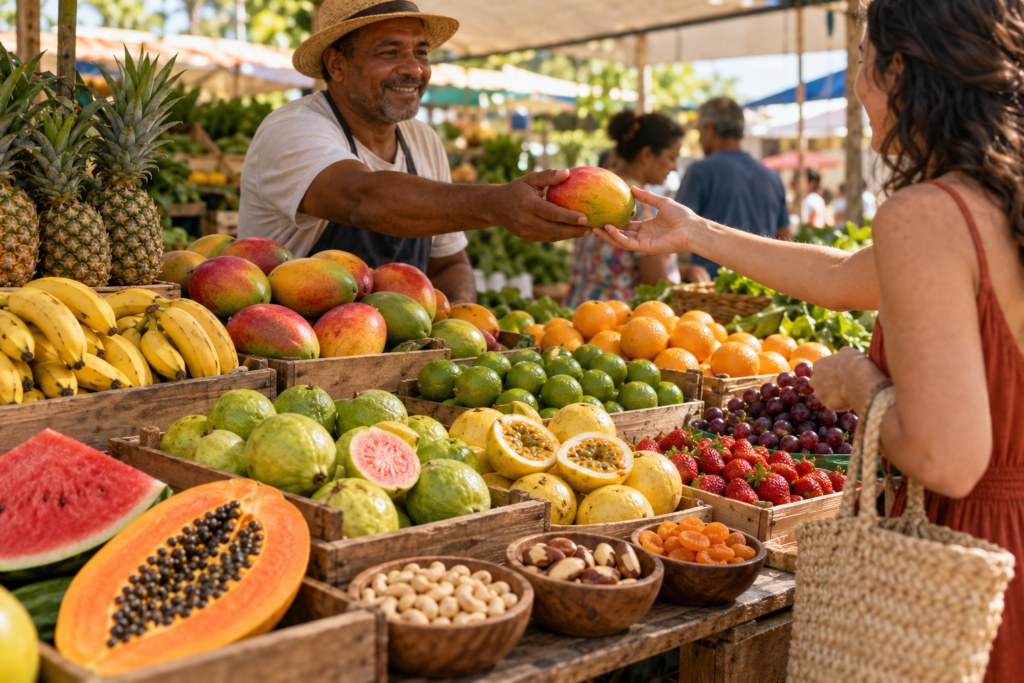
At a feira, hortifruti, or supermarket, complete phrases help you use Brazilian Portuguese fruit vocabulary immediately. Start with a quantity, then add the quality or preparation you need.
| Portuguese | English |
|---|---|
| Quanto custa o quilo? | How much is a kilo? |
| É por quilo ou por unidade? | Is it priced by kilo or per item? |
| Quero meio quilo de uva. | I would like half a kilo of grapes. |
| Vou levar uma bandeja de morangos. | I will take a tray of strawberries. |
| Tem uva sem semente? | Do you have seedless grapes? |
| Este abacate está maduro? | Is this avocado ripe? |
| Quero um mamão para comer hoje. | I would like a papaya to eat today. |
| Tem um menos maduro para amanhã? | Do you have a less ripe one for tomorrow? |
| Posso provar? | May I taste it? |
| Quanto tempo dura na geladeira? | How long does it keep in the refrigerator? |
| Quero castanha-de-caju sem sal. | I would like unsalted cashews. |
| Tem tâmara sem caroço? | Do you have pitted dates? |
Rather than guessing ripeness from a picture, tell the seller when you plan to eat the fruit. For example, para comer hoje gives a useful goal without requiring advanced vocabulary.
A short market conversation
Customer: Bom dia! Quanto custa o quilo da manga?
Good morning! How much is a kilo of mangoes?
Seller: Está oito reais. Você quer mais madura ou mais firme?
It is eight reais. Would you like it riper or firmer?
Customer: Mais madura, por favor. É para comer hoje.
Riper, please. It is for eating today.
Seller: Então pode levar estas aqui.
Then you can take these here.
Customer: Ótimo. Também quero uma bandeja de morangos.
Great. I would also like a tray of strawberries.
The price above is an invented language example, not a current market quote. Meanwhile, the conversation shows how a practical detail can guide your word choice.
Order Fruit Juice Naturally in Brazil
For everyday Brazilian speech, use suco rather than sumo. Then name the fruit after de: suco de laranja, suco de goiaba, or suco de abacaxi.
| Portuguese | English |
|---|---|
| Um suco de laranja, por favor. | An orange juice, please. |
| Sem açúcar, por favor. | No sugar, please. |
| Sem adoçante também. | No sweetener either. |
| Com água, por favor. | With water, please. |
| Sem leite. | No milk. |
| É feito com a fruta ou com polpa? | Is it made with the fruit or with fruit pulp? |
| Pode colocar pouco gelo? | Can you add only a little ice? |
Importantly, sem açúcar requests no added sugar in this ordering context; it does not mean the fruit contains no natural sugar. If you also want to avoid sweetener, add sem adoçante.
Moreover, polpa can refer to packaged fruit pulp used to prepare drinks. Consequently, asking about fruta ou polpa helps you understand preparation rather than simply memorizing the word for juice.
Small Grammar Details That Make You Sound More Natural
Match the adjective to the fruit
Use maduro with masculine nouns and madura with feminine nouns. For instance, say o mamão maduro, but a manga madura.
In the plural, add the corresponding endings: os mamões maduros and as mangas maduras. However, adjectives such as doce do not change for gender: o melão doce, a laranja doce.
Learn irregular-looking plurals together
| Singular | Plural |
|---|---|
| o limão | os limões |
| o melão | os melões |
| o mamão | os mamões |
| a noz | as nozes |
| a maçã | as maçãs |
| a romã | as romãs |
| o abacaxi | os abacaxis |
Instead of treating every ending as a separate rule, practice short shopping phrases. For example, repeat dois limões, três maçãs, and um pacote de nozes.
Frequently Asked Questions
How do you say fruit in Brazilian Portuguese?
Use fruta, with the feminine article a. For example, Esta fruta está doce means “This fruit is sweet.”
What is the difference between limão and limão-siciliano?
In everyday Brazilian contexts, limão often refers to a lime. However, limão-siciliano clearly identifies the yellow lemon familiar to English speakers.
Do Brazilians say abacaxi or ananás?
Abacaxi is the everyday word to prioritize for Brazil. Although you may encounter ananás, it is not the default choice for a beginner’s Brazilian shopping vocabulary.
What is cranberry in Brazilian Portuguese?
Cranberry is a useful name to recognize on Brazilian products. You may also encounter oxicoco, while the reference picture uses arando.
Does caju mean cashew nut?
For the nut, say castanha-de-caju. In ordinary food contexts, caju refers to the fleshy cashew apple, as in suco de caju.
How do you ask for ripe fruit?
Ask Está maduro? for a masculine noun or Está madura? for a feminine noun. Alternatively, say Quero uma fruta para comer hoje to explain that you want fruit ready to eat.
Put Your Brazilian Portuguese Fruit Vocabulary to Work
Start with the fruit you already buy, then add one useful description to each name. For example, practice mamão maduro, uva sem semente, and castanha-de-caju sem sal.
Next, build a shopping request with a quantity: Quero meio quilo de uva sem semente. Finally, use the regional and ingredient distinctions in this guide whenever a direct translation feels too vague.
Knowing a fruit’s name gets the conversation started. Understanding its variety, ripeness, and preparation helps you bring home exactly what you wanted.