
Brazilian Portuguese pantry vocabulary helps you buy the right beans, understand a recipe, and find the seasoning you need. However, a direct translation does not always identify the right ingredient. Words such as cuscuz, colorau, and açafrão need a little extra context in Brazil.
This guide covers grains, rice, legumes, seeds, herbs, and spices. Along the way, you will learn natural shopping phrases and useful differences between European and Brazilian Portuguese. More importantly, you will practice asking about the ingredient, its form, and its intended use.
Start with a few everyday essentials: arroz means rice, feijão means beans, alho means garlic, and tempero means seasoning. Then expand your vocabulary through the foods you actually buy.
Essential Brazilian Portuguese Pantry Vocabulary
First, learn the category words that organize a supermarket aisle or recipe. Although some look familiar in English, their everyday meanings do not always match.
| Brazilian Portuguese | English | Practical meaning |
|---|---|---|
| os grãos | grains; individual seeds or kernels | A broad food word, depending on context |
| os cereais | cereals; cereal grains | Wheat, rice, oats, and similar grains |
| as leguminosas | legumes; pulses | Beans, lentils, chickpeas, and related plants or foods |
| as sementes | seeds | Pumpkin, sesame, sunflower, and other seeds |
| as ervas aromáticas | culinary herbs | Aromatic leaves and plants used in cooking |
| as especiarias | spices | Cinnamon, cloves, cumin, and similar ingredients |
| os temperos | seasonings | A broad category covering herbs, spices, and seasoning mixtures |
| a farinha | flour; meal | Specify the ingredient, such as wheat or corn |
| o farelo | bran | For example, oat bran or wheat bran |
| os flocos | flakes | Common on oat and corn products |
Watch the false friend: English “legumes” translates as leguminosas, not usually legumes. In everyday Brazilian Portuguese, legumes generally refers to vegetables, such as carrots and zucchini.
For example, ask “Onde ficam os grãos e os temperos?” to say “Where are the grains and seasonings?” Alternatively, name the specific product when the store organizes these foods in separate aisles.
Grains and Rice in Brazilian Portuguese
Rice and beans provide a useful starting point for learning Brazilian food words. However, a shopping list often names the variety or processing method as well.
Common grains and grain products
| English | Brazilian Portuguese | Useful detail |
|---|---|---|
| Wheat | o trigo | Wheat flour is farinha de trigo |
| Oats | a aveia | Oat flakes are aveia em flocos |
| Barley | a cevada | Use cevada em grãos when specifying the grain |
| Corn; maize | o milho | Fresh corn commonly appears as milho-verde |
| Millet | o painço; o milheto | Names vary with the species and product |
| Quinoa | a quinoa | Commonly grouped with grains in food shopping |
| Wheat bran | o farelo de trigo | Not the same as wheat flour |
| Oat bran | o farelo de aveia | Not the same as oat flakes |
| Semolina | a sêmola; a semolina | Check which grain the product contains |
| Bulgur wheat | o trigo para quibe | A practical Brazilian shopping term for bulgur |
| Cracked wheat | o trigo quebrado; o trigo partido | A broader description, not always interchangeable with bulgur |
Although quinoa often shares a shelf with cereals, it is a pseudocereal. For everyday conversation, quinoa em grãos clearly distinguishes the whole product from flour or flakes.
Similarly, milho-miúdo in a European Portuguese reference should not automatically become one exact Brazilian grain name. English “millet” covers several grains, so check the product identity before choosing painço or milheto.
Example: “Quero aveia em flocos, não farelo de aveia.”
“I want rolled oats, not oat bran.”
Rice varieties and descriptions
| English | Brazilian Portuguese |
|---|---|
| Rice | o arroz |
| White rice | o arroz branco |
| Brown rice | o arroz integral |
| Wild rice | o arroz selvagem |
| Arborio rice | o arroz arbóreo |
| Parboiled rice | o arroz parboilizado |
| Long-grain rice | o arroz de grão longo |
| Short-grain rice | o arroz de grão curto |
| Aromatic rice | o arroz aromático |
In Brazil, arroz arbóreo is a more useful product name than a literal translation such as “Italian rice.” Meanwhile, integral means whole-grain in this context, which explains the name arroz integral for brown rice.
For instance, say “Tem arroz arbóreo para risoto?” when you want Arborio rice for risotto. To ask about the grain length, try “Esse arroz é de grão curto?”
Why cuscuz needs an extra question
Cuscuz does not identify one universal ingredient or dish. In much of northeastern Brazil, the word commonly refers to a steamed corn preparation. By contrast, cuscuz marroquino refers to the small wheat-semolina granules used for Moroccan-style couscous.
For this reason, ask for flocão de milho para cuscuz when that is the ingredient your Brazilian recipe requires. If the recipe calls for wheat couscous, use cuscuz marroquino instead.
Other regional dishes, including cuscuz paulista, add another layer of meaning. Therefore, the most useful question is “É cuscuz de milho ou cuscuz marroquino?”: “Is it corn couscous or Moroccan couscous?”
Beans and Other Legumes in Brazilian Portuguese
English speakers often use the plural “beans,” but Brazilian Portuguese commonly uses the singular feijão for the food. For example, “Vou cozinhar feijão” means “I’m going to cook beans.”
Bean names for shopping
| English | Brazilian Portuguese | Shopping note |
|---|---|---|
| Black beans | o feijão-preto | A useful addition to any Brazilian pantry list |
| Carioca beans | o feijão-carioca | Beige beans with brown streaks |
| Pinto beans | o feijão-pinto; feijão tipo pinto | Check the variety; carioca beans are not an exact synonym |
| Red beans | o feijão-vermelho | A broad color description |
| Red kidney beans | o feijão-vermelho tipo kidney | Specify the kidney type when necessary |
| White beans | o feijão-branco | A broad category with different sizes and varieties |
| Small white beans; haricot beans | o feijão-branco pequeno | Confirm the variety if a recipe requires a specific type |
| Black-eyed peas | o feijão-fradinho | A black-eyed type of cowpea |
| Adzuki beans | o feijão-azuki | Azuki is a useful Brazilian search term |
| Mung beans | o feijão-mungo | Often sold as feijão-mungo verde |
| Soybeans | a soja; a soja em grãos | More natural for everyday shopping than feijão-de-soja |
| Lima beans; butter beans | o feijão-lima; a fava, depending on usage | Common names vary; inspect the product |
| Broad beans; fava beans | a fava | The name alone may not resolve the species in Brazil |
| Flageolet beans | o feijão flageolet | A specific product, not a synonym for all white beans |
The photo reference uses feijão-frade, a European Portuguese term. In Brazil, feijão-fradinho is the practical name to learn first.
However, avoid treating every cowpea name as an exact variety match. Embrapa identifies fradinho as a commercial subtype within cowpea, while names such as feijão-de-corda can cover a broader range. See Embrapa’s explanation of fradinho.
Why bean pictures do not guarantee exact translations
Two beans may share a color or pattern without being the same commercial type. For example, a photograph of pinto beans should not automatically receive the label feijão-carioca just because both look speckled.
Likewise, fava can refer to different legumes in different markets. When exact identity matters, compare the package name, grain appearance, and scientific name rather than relying on a single translated label.
A useful question is “Esse é o mesmo tipo de feijão da receita?”: “Is this the same type of bean as in the recipe?” Better still, show the seller the original package or ingredient name.
Lentils, chickpeas, and peas
| English | Brazilian Portuguese |
|---|---|
| Lentils | a lentilha; as lentilhas |
| Brown lentils | a lentilha marrom |
| Red lentils | a lentilha vermelha |
| Pink lentils, a retail naming variant | a lentilha rosa |
| Chickpeas | o grão-de-bico |
| Green peas | a ervilha; as ervilhas |
| Dried peas | a ervilha seca |
| Split peas | a ervilha partida |
In Brazilian usage, lentilha marrom generally feels more natural than the reference’s lentilha castanha. Similarly, ervilha partida is a useful product term for split peas.
For a simple shopping request, say “Você tem lentilha vermelha e grão-de-bico?” This means “Do you have red lentils and chickpeas?”
Seeds in Brazilian Portuguese
Seed names often follow the pattern semente de + plant name. As a result, learning one structure helps you recognize several products.
| English | Brazilian Portuguese |
|---|---|
| Pumpkin seeds | a semente de abóbora; as sementes de abóbora |
| Sunflower seeds | a semente de girassol; as sementes de girassol |
| Sesame seeds | o gergelim; as sementes de gergelim |
| Mustard seeds | a mostarda em grãos; as sementes de mostarda |
| Caraway seeds | as sementes de alcarávia |
| Fennel seeds | as sementes de funcho |
The reference uses sésamo, but gergelim is the everyday Brazilian word to prioritize. Therefore, “Esse pão tem gergelim?” naturally asks “Does this bread contain sesame?”
For sunflower or pumpkin seeds, also check com casca and sem casca. These expressions mean “with shells” and “shelled,” respectively.
Example: “Quero sementes de abóbora sem casca e sem sal.”
“I’d like shelled, unsalted pumpkin seeds.”
Herbs in Brazilian Portuguese
Fresh herbs introduce several useful differences between Portugal and Brazil. In addition, market names may reflect the region or the plant variety.
| English | Brazilian Portuguese | Useful distinction |
|---|---|---|
| Parsley | a salsa; a salsinha | Salsinha is common in everyday speech |
| Cilantro; coriander leaves | o coentro | Specify sementes de coentro for coriander seeds |
| Chives; scallion greens in everyday cooking | a cebolinha | The everyday Brazilian product may differ from fine European chives |
| Fine chives | a cebolinha-francesa | Useful when the exact herb matters |
| Mint | a hortelã | A general name covering different mints |
| Basil | o manjericão | Common in sauces and fresh herb bunches |
| Oregano | o orégano | The usual Brazilian spelling |
| Rosemary | o alecrim | Prefer this over rosmaninho in Brazil |
| Thyme | o tomilho | A common recipe term |
| Sage | a sálvia | Note the accent |
| Marjoram | a manjerona | Distinct from basil |
| Tarragon | o estragão | A less everyday but useful culinary term |
| Dill | o endro; o dill | Both can appear on product labels |
| Fennel | o funcho | Check whether the recipe wants the bulb, leaves, or seeds |
| Bay leaf | a folha de louro | Louro also works as a general ingredient name |
| Lemongrass | o capim-limão; o capim-santo; o capim-cidreira | Regional common names vary |
Ask what comes in cheiro-verde
Cheiro-verde names a culinary herb combination rather than one botanical species. Many sellers use it for parsley and cebolinha. However, some regional mixtures include cilantro.
Consequently, ask “Esse cheiro-verde vem com salsa ou coentro?” if the distinction matters to your dish. The question means “Does this herb mix come with parsley or cilantro?”
This is more useful than memorizing “cheiro-verde = parsley.” In practice, the follow-up question helps you buy the combination you actually want.
Be careful with limonete and lemon-scented plants
The image labels limonete as lemongrass, but that equivalence deserves correction. The Infopédia entry for limonete identifies it with lemon verbena, also called lúcia-lima.
For culinary lemongrass in Brazil, use capim-limão or capim-santo and check the plant when needed. Moreover, the broad name erva-cidreira can refer to different lemon-scented plants, so it is not a precise universal substitute.
Funcho and erva-doce need context
You may encounter erva-doce on products with a sweet, anise-like aroma. However, common names can overlap across fennel and anise products.
If a recipe specifically requires fennel, ask for funcho and identify the part you need. For example, bulbo de funcho means fennel bulb, while sementes de funcho means fennel seeds.
Spices and Seasonings in Brazilian Portuguese
Tempero is the broad everyday word for seasoning. Meanwhile, especiaria helps you discuss spices as a category.
| English | Brazilian Portuguese | Practical note |
|---|---|---|
| Vanilla | a baunilha | A vanilla pod is fava de baunilha |
| Nutmeg | a noz-moscada | Whole or ground |
| Mace | o macis | Distinct from nutmeg, although both come from the same fruit |
| Turmeric | a cúrcuma; o açafrão-da-terra | Do not confuse with saffron |
| Cumin | o cominho | The singular form is natural in ingredient lists |
| Allspice | a pimenta-da-jamaica | A single spice, not a mixed seasoning |
| Black peppercorns | a pimenta-do-reino em grãos | Pimenta em grão alone is less specific |
| Fenugreek | o feno-grego | Prefer this term over fenacho for Brazilian shopping |
| Chili powder | a pimenta em pó | Check whether the product is pure pepper or a blend |
| Crushed chili flakes | a pimenta-calabresa em flocos | Not an exact substitute for every chili powder |
| Saffron | o açafrão; o açafrão verdadeiro | Threads may appear as açafrão em fios |
| Cardamom | o cardamomo | Pods may appear as cardamomo em bagas |
| Curry powder | o curry em pó | More common in Brazil than caril |
| Paprika | a páprica | Varieties include doce, picante, and defumada |
| Annatto-based coloring seasoning | o colorau; o colorífico | Usually associated with urucum in Brazil |
| Cinnamon | a canela | Canela em pau means cinnamon sticks |
| Cloves | o cravo-da-índia; o cravo | Prefer these over cravinho |
| Star anise | o anis-estrelado | More precise than anis alone |
| Ginger | o gengibre | Fresh or powdered |
| Garlic | o alho | A clove of garlic is um dente de alho |
| Bouquet garni | o buquê de ervas; o bouquet garni | A bundle of herbs used to flavor a preparation |
Colorau is not automatically paprika
The reference pairs colorau with “paprika,” which can mislead a shopper in Brazil. Brazilian colorau commonly means an annatto-based coloring seasoning, whereas páprica comes from peppers.
Embrapa describes colorífico, also known as colorau, among the uses of urucum. You can consult its reference on condiment plants and urucum.
Therefore, translate smoked paprika as páprica defumada, not simply colorau. Although both products can add color, their ingredients and flavors differ.
Açafrão can lead to the wrong purchase
In everyday Brazilian conversation, some speakers shorten açafrão-da-terra to açafrão. However, turmeric and true saffron are different ingredients.
To reduce confusion, ask “É cúrcuma ou açafrão em fios?” This means “Is it turmeric or saffron threads?”
For a recipe that needs turmeric, cúrcuma or açafrão-da-terra is clearer. Conversely, specify açafrão verdadeiro and inspect the label when you need saffron.
Pimenta does not identify one flavor or heat level
Pimenta can refer to black pepper or different chili peppers, depending on the expression. As a result, pimenta-do-reino, pimenta-calabresa, and pimenta em pó do not mean the same thing.
Likewise, an American-style chili powder blend may contain cumin and other seasonings. Before substituting a Brazilian product, read the ingredient list and ask “É uma mistura de temperos ou só pimenta?”
The word picante means spicy or hot. By contrast, páprica doce describes a mild paprika style, not a sugary ingredient.
Portugal-to-Brazil Vocabulary: Useful Changes
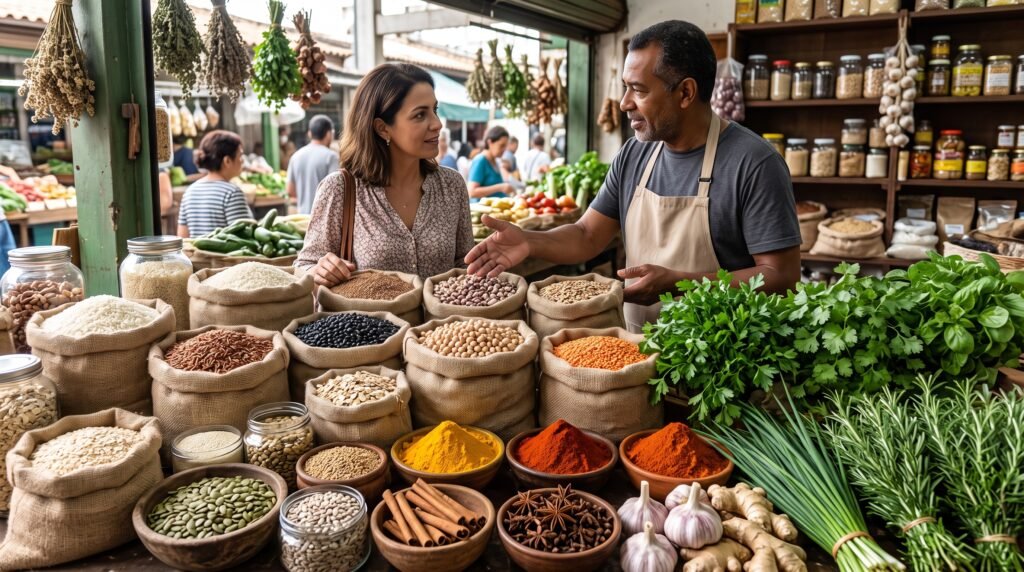
Some words in the photos remain understandable in Brazil but are less natural for everyday shopping. Other entries need a clarification rather than a simple regional replacement.
| Term in the reference | Brazilian wording to prioritize | Important qualification |
|---|---|---|
| sésamo | gergelim | Sesame |
| feijão-frade | feijão-fradinho | Black-eyed peas |
| feijão-de-soja | soja; soja em grãos | Soybeans |
| lentilha castanha | lentilha marrom | Brown lentils |
| ervilhas quebradas | ervilha partida | Split peas |
| cebolinho | cebolinha-francesa for fine chives | Everyday cebolinha may be a different product |
| orégão | orégano | Oregano |
| rosmaninho, labeled rosemary | alecrim | Common plant names can be ambiguous |
| cravinho | cravo-da-índia | Cloves |
| caril em pó | curry em pó | Curry powder |
| fenacho | feno-grego | Fenugreek |
| cominhos | cominho | Cumin |
| paus de canela | canela em pau | Cinnamon sticks |
| colorau, labeled paprika | páprica | Brazilian colorau usually refers to an annatto product |
| limonete, labeled lemongrass | capim-limão for lemongrass | Limonete can mean lemon verbena |
| anis, labeled star anise | anis-estrelado | Specify the star-shaped spice |
Instead of treating this table as a list of forbidden words, use it as a shopping shortcut. Regional variation exists within both countries, so context still matters.
Describe the Form of an Ingredient
Knowing the ingredient name is only the first step. Next, add its form so the seller understands exactly what you need.
| Portuguese | English | Example |
|---|---|---|
| em grãos | in grains; whole seeds | mostarda em grãos |
| em pó | powdered | gengibre em pó |
| em flocos | in flakes | aveia em flocos |
| em pau | in sticks, for cinnamon | canela em pau |
| em fios | in threads | açafrão em fios |
| moído / moída | ground | pimenta-do-reino moída |
| inteiro / inteira | whole | noz-moscada inteira |
| fresco / fresca | fresh | ervas frescas |
| seco / seca | dried; dry | ervilha seca |
| torrado / torrada | roasted; toasted | gergelim torrado |
| integral | whole-grain | arroz integral |
| descascado / descascada | peeled; shelled | alho descascado |
| sem casca | without a shell or husk | sementes sem casca |
| sem sal | unsalted | sementes sem sal |
| a granel | sold loose; by weight | temperos a granel |
| de cozimento rápido | quick-cooking | aveia de cozimento rápido |
Adjectives often match the noun in gender and number. For example, say alho moído, pimenta moída, and ervas secas.
However, expressions such as em pó and sem sal keep the same form. Consequently, you can use them with many ingredients without changing an ending.
Shopping Phrases You Can Actually Use
A short, specific question often works better than a long sentence. Start with the product name, then add the form or quantity.
| Brazilian Portuguese | English |
|---|---|
| Onde fica o arroz integral? | Where is the brown rice? |
| Vocês vendem temperos a granel? | Do you sell seasonings by weight? |
| Quero duzentos gramas de lentilha. | I’d like two hundred grams of lentils. |
| Tem gergelim sem casca? | Do you have hulled sesame seeds? |
| Essa páprica é doce, picante ou defumada? | Is this paprika mild, hot, or smoked? |
| Preciso de um maço de salsinha. | I need a bunch of parsley. |
| Você tem cominho em grãos? | Do you have whole cumin seeds? |
| Esse tempero já vem com sal? | Does this seasoning already contain salt? |
| Quero um pacote de feijão-fradinho. | I’d like a package of black-eyed peas. |
| Pode me mostrar a lista de ingredientes? | Can you show me the ingredient list? |
For quantities, learn um pacote (a package), um pote (a jar or container), and um maço (a bunch). Meanwhile, a granel usually signals that you can request an amount by weight.
Notice duzentos gramas, with the masculine form. Although a grama means grass, o grama refers to the unit of weight.
A short market conversation
Customer: Bom dia! Vocês têm gergelim e cominho em grãos?
English: Good morning! Do you have sesame seeds and whole cumin seeds?
Seller: Temos, sim. Quanto você quer?
English: Yes, we do. How much would you like?
Customer: Cem gramas de cada, por favor. Também preciso de páprica defumada.
English: One hundred grams of each, please. I also need smoked paprika.
Seller: A páprica fica naquela prateleira.
English: The paprika is on that shelf.
Customer: Obrigado! Esse cheiro-verde vem com coentro?
English: Thank you! Does this herb mix include cilantro?
Seller: Esse vem com salsa e cebolinha.
English: This one contains parsley and cebolinha.
Read Simple Recipe Instructions
Recipe verbs make Brazilian Portuguese pantry vocabulary easier to remember. Instead of studying isolated words, connect each ingredient with an action.
| Instruction | Meaning |
|---|---|
| Lave o arroz. | Wash the rice. |
| Deixe o feijão de molho. | Soak the beans. |
| Escorra o grão-de-bico. | Drain the chickpeas. |
| Pique a salsinha. | Chop the parsley. |
| Amasse o alho. | Crush the garlic. |
| Rale a noz-moscada. | Grate the nutmeg. |
| Refogue o alho. | Sauté the garlic. |
| Acrescente uma folha de louro. | Add a bay leaf. |
| Tempere a gosto. | Season to taste. |
| Finalize com cheiro-verde. | Finish with the herb mixture. |
Here, deixar de molho means to soak. However, molho on its own can also mean sauce, so the complete expression matters.
Likewise, a gosto means “to taste,” while uma pitada means “a pinch.” For example, “Acrescente uma pitada de cominho” means “Add a pinch of cumin.”
Practice With a Pantry Challenge
First, imagine that you need brown rice, chickpeas, sesame seeds, rosemary, and smoked paprika. Write a Brazilian Portuguese shopping list before checking the answer below.
Answer: arroz integral, grão-de-bico, gergelim, alecrim, páprica defumada.
Next, make the request more precise: choose ground or whole spices, fresh or dried herbs, and salted or unsalted seeds. This extra step turns a vocabulary exercise into a real shopping task.
Finally, try saying “Quero arroz integral, grão-de-bico e gergelim sem sal. Também preciso de alecrim fresco e páprica defumada.”
Frequently Asked Questions
How do you say beans in Brazilian Portuguese?
Use feijão for beans as a food. For a particular variety, add the name, such as feijão-preto, feijão-carioca, or feijão-fradinho.
What is the Brazilian Portuguese word for sesame?
Gergelim is the everyday word to learn. For example, sementes de gergelim means sesame seeds.
Are coentro and salsinha the same herb?
No. Coentro means cilantro or coriander leaves, while salsinha means parsley. Therefore, ask which herb a seller includes in cheiro-verde.
Does açafrão always mean saffron in Brazil?
Not in everyday usage. Some speakers use the word for turmeric, so specify cúrcuma or açafrão-da-terra for turmeric and açafrão verdadeiro for saffron.
What is the difference between temperos and especiarias?
Temperos is the broader word for seasonings and can include herbs, spices, and mixtures. By comparison, especiarias refers more specifically to spices such as cumin, cinnamon, and cloves.
Is Brazilian cuscuz the same as Moroccan couscous?
Not necessarily. Many Brazilian preparations use corn, whereas cuscuz marroquino uses wheat semolina. Consequently, check the full product name before buying.
Put Your Brazilian Portuguese Pantry Vocabulary to Work
The most useful Brazilian Portuguese pantry vocabulary combines an ingredient, its form, and a practical question. For example, gergelim sem casca, cominho em grãos, and alecrim fresco give you much more precision than isolated nouns.
Start by labeling a few products in your kitchen. Then write a shopping list and practice one market question for each item. With those small steps, you can build vocabulary that helps you shop, cook, and communicate with greater confidence.