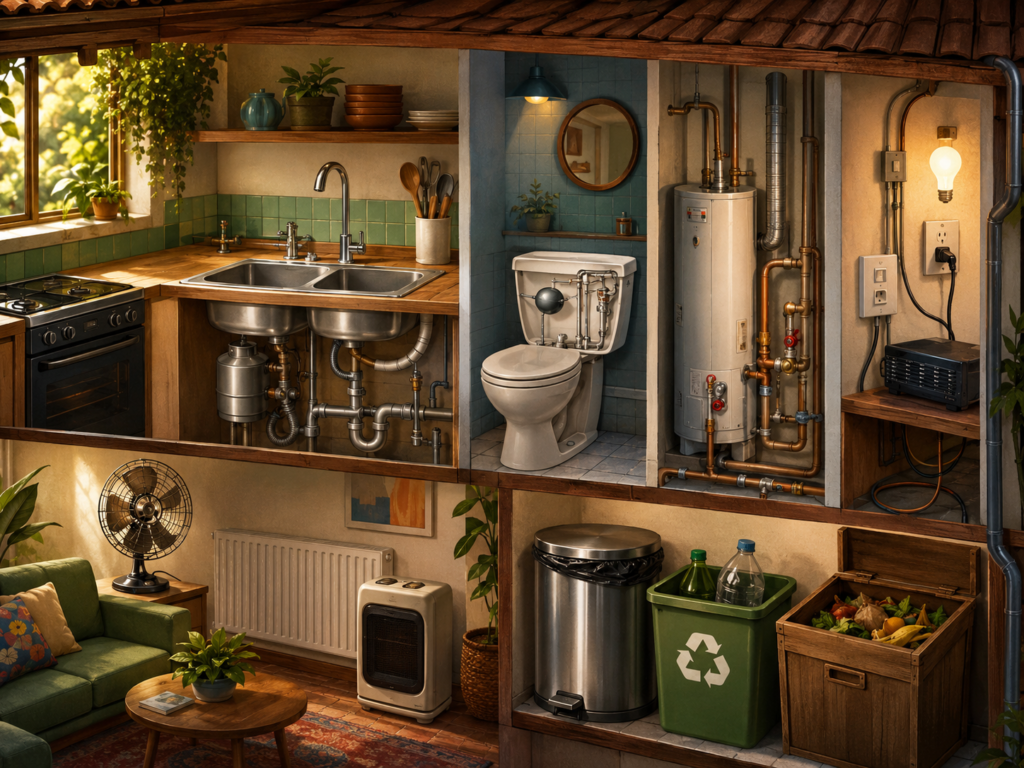

Brazilian Portuguese home vocabulary is essential for everyday life, especially when you need to talk about repairs, electricity, plumbing, bathrooms, kitchens, heating, or trash. These words help you describe problems at home, speak with landlords, understand maintenance workers, and expand your practical Portuguese vocabulary.
Why Learn Brazilian Portuguese Home Vocabulary?
Learning words for the home makes Portuguese more useful in real situations. For example, you may need to explain that the sink is clogged, the outlet is not working, or the toilet has a leak. In addition, this vocabulary helps you understand signs, product labels, apartment listings, and conversations about house maintenance.
Some words in the pictures use Portuguese from Portugal. However, Brazilian Portuguese often uses different terms. For that reason, this guide adapts the vocabulary to the way people usually speak in Brazil.
Brazilian Portuguese Vocabulary for Internal Home Systems
Internal home systems include heating, ventilation, and basic equipment used inside a house or apartment. Although some items are more common in colder countries, the vocabulary is still useful.
Heating and Ventilation Words
| English | Brazilian Portuguese |
|---|---|
| radiator | o radiador |
| space heater | o aquecedor |
| fan | o ventilador |
| fan blade | a hélice |
| convection heater | o aquecedor convector |
In Brazil, ventoinha exists, but ventilador is more common in everyday speech. Also, palheta can mean blade in some contexts, but hélice sounds more natural when talking about a fan.
Example Sentences
O ventilador está ligado.
The fan is on.
O aquecedor não está funcionando.
The heater is not working.
A hélice do ventilador está suja.
The fan blade is dirty.
Brazilian Portuguese Electricity Vocabulary
Electricity vocabulary is very practical because people use these words when talking about appliances, outlets, power outages, and electrical problems. Therefore, these terms are useful for renters, homeowners, travelers, and Portuguese learners.
Basic Electricity Words
| English | Brazilian Portuguese |
|---|---|
| electricity | a eletricidade |
| power | a energia elétrica |
| voltage | a voltagem / a tensão |
| amp | o ampere |
| fuse | o fusível |
| fuse box | a caixa de fusíveis |
| generator | o gerador |
| switch | o interruptor |
| outlet | a tomada |
| plug | o plugue / o pino |
| ground pin | o pino terra |
| grounding | o aterramento |
| wires | os fios / os cabos |
| neutral wire | o fio neutro |
| live wire | o fio fase |
| direct current | a corrente contínua |
| alternating current | a corrente alternada |
| transformer | o transformador |
| electric meter | o medidor de energia |
| power outage | a queda de energia |
| household current | a corrente elétrica residencial |
In Portugal, people often use a ficha for “plug.” In Brazil, however, o plugue or o pino is more common. Likewise, ligação à terra becomes aterramento in Brazilian Portuguese.
Example Sentences
A tomada não está funcionando.
The outlet is not working.
Houve uma queda de energia ontem à noite.
There was a power outage last night.
O interruptor fica perto da porta.
The switch is near the door.
Além disso, be careful with electrical vocabulary in real life. If there is a serious electrical problem, call a qualified professional.
Brazilian Portuguese Plumbing Vocabulary
Plumbing vocabulary helps you talk about pipes, leaks, water heaters, drains, and valves. Since these problems happen often at home, this part of Brazilian Portuguese home vocabulary is especially useful.
Plumbing and Water Heater Words
| English | Brazilian Portuguese |
|---|---|
| plumbing | o encanamento / a instalação hidráulica |
| inlet | a entrada |
| outlet | a saída |
| insulation | o isolamento |
| pressure valve | a válvula de pressão |
| overflow pipe | o tubo de extravasamento |
| tank | o tanque / o reservatório |
| water chamber | a câmara de água |
| drain valve | a válvula de drenagem |
| thermostat | o termostato |
| burner | o queimador |
| water heater | o aquecedor de água |
| heating element | a resistência |
The word canalização appears in Portugal, but encanamento sounds more natural in Brazil. Another good option is instalação hidráulica, especially in more technical contexts.
Example Sentences
O encanamento está com vazamento.
The plumbing has a leak.
A válvula de pressão precisa de manutenção.
The pressure valve needs maintenance.
O aquecedor de água parou de funcionar.
The water heater stopped working.
Brazilian Portuguese Kitchen Sink Vocabulary
The image uses lava-loiça, a term from Portugal. In Brazil, people normally say pia, especially when talking about the kitchen sink.
Sink and Faucet Words
| English | Brazilian Portuguese |
|---|---|
| sink | a pia |
| kitchen sink | a pia da cozinha |
| faucet | a torneira |
| lever | a alavanca |
| gasket | a junta / o anel de vedação |
| supply pipe | o cano de abastecimento |
| shut-off valve | o registro / a válvula de fechamento |
| drain | o ralo / o escoamento |
| waste disposal unit | o triturador de alimentos |
In Brazilian Portuguese, registro is very common for a valve that opens or closes water flow. Meanwhile, válvula de fechamento sounds more technical.
Example Sentences
A pia da cozinha está entupida.
The kitchen sink is clogged.
A torneira está pingando.
The faucet is dripping.
O registro fica embaixo da pia.
The shut-off valve is under the sink.
Brazilian Portuguese Bathroom and Toilet Vocabulary
Bathroom vocabulary changes a lot between Portugal and Brazil. The word sanita is common in Portugal, but Brazilians usually say vaso sanitário. Informally, many people also say privada.
Toilet Words in Brazilian Portuguese
| English | Brazilian Portuguese |
|---|---|
| toilet | o vaso sanitário |
| toilet, informal | a privada |
| toilet seat | o assento |
| bowl | a bacia do vaso |
| float ball | a boia |
| tank | a caixa acoplada |
| flush | a descarga |
| waste pipe | o cano de esgoto |
In Brazil, autoclismo is not the usual word. Instead, people say descarga for the flush system and caixa acoplada for the toilet tank attached to the bowl.
Example Sentences
O vaso sanitário está entupido.
The toilet is clogged.
A descarga não está funcionando.
The flush is not working.
A boia da caixa acoplada precisa ser trocada.
The float ball in the tank needs to be replaced.
Brazilian Portuguese Waste Disposal Vocabulary
Waste disposal vocabulary is useful when talking about recycling, trash cans, organic waste, and household cleaning. Because cities and buildings may have different rules, these words can help you understand signs and instructions.
Trash, Recycling, and Waste Words
| English | Brazilian Portuguese |
|---|---|
| waste disposal | o descarte de resíduos |
| bottle | a garrafa |
| recycling bin | a lixeira de reciclagem |
| trash can | a lixeira |
| lid | a tampa |
| pedal | o pedal |
| sorting bin | a lixeira de separação |
| organic waste | o lixo orgânico |
| trash | o lixo |
| recyclable waste | o lixo reciclável |
In Portugal, caixote do lixo is common. In Brazil, however, people usually say lixeira. Also, resíduos orgânicos is correct, but lixo orgânico is more common in everyday speech.
Example Sentences
A garrafa vai na lixeira de reciclagem.
The bottle goes in the recycling bin.
A lixeira tem tampa e pedal.
The trash can has a lid and a pedal.
O lixo orgânico fica separado do lixo reciclável.
Organic waste stays separate from recyclable waste.
Portugal Portuguese vs Brazilian Portuguese: Key Differences
Some words from the pictures are correct in Portuguese, but they sound more European than Brazilian. Therefore, learners should know the Brazilian alternatives.
| Portugal Portuguese | Brazilian Portuguese | English |
|---|---|---|
| a canalização | o encanamento | plumbing |
| o lava-loiça | a pia | sink |
| a sanita | o vaso sanitário / a privada | toilet |
| o autoclismo | a descarga | flush |
| a ventoinha | o ventilador | fan |
| a palheta | a hélice | blade |
| a ficha | o plugue | plug |
| a ligação à terra | o aterramento | grounding |
| o caixote do lixo | a lixeira | trash can |
These differences matter because Brazilian Portuguese learners often sound more natural when they choose the words people actually use in Brazil.
Useful Phrases for Home Problems in Brazilian Portuguese
Vocabulary becomes easier when you learn complete phrases. As a result, you can use these sentences in real conversations.
Electricity Problems
A tomada não funciona.
The outlet does not work.
A luz acabou.
The power went out.
O interruptor está quebrado.
The switch is broken.
Plumbing Problems
A torneira está vazando.
The faucet is leaking.
O ralo está entupido.
The drain is clogged.
Tem um vazamento no encanamento.
There is a leak in the plumbing.
Bathroom Problems
A descarga está fraca.
The flush is weak.
O vaso sanitário está entupido.
The toilet is clogged.
A caixa acoplada está vazando água.
The toilet tank is leaking water.
Trash and Cleaning
Preciso trocar o saco de lixo.
I need to change the trash bag.
Coloque o lixo reciclável na lixeira certa.
Put the recyclable waste in the correct bin.
Separe o lixo orgânico.
Separate the organic waste.
How to Study Brazilian Portuguese Home Vocabulary
Start with the words you use most often. For example, learn tomada, torneira, pia, vaso sanitário, lixeira, and encanamento first. After that, add more technical words like aterramento, resistência, válvula de pressão, and corrente alternada.
Another good strategy is to label items in your house. However, do not only memorize isolated words. Instead, create short sentences, because phrases help you remember how each word works in context.
You can also practice by describing problems. For instance, say: A torneira está pingando or A tomada não está funcionando. Over time, this method makes Brazilian Portuguese home vocabulary feel more natural.
Conclusion
Brazilian Portuguese home vocabulary helps you communicate clearly about electricity, plumbing, sinks, toilets, heating, and waste disposal. Since some terms from Portugal are different from the words used in Brazil, it is important to learn Brazilian alternatives such as pia, vaso sanitário, encanamento, lixeira, ventilador, and plugue.
With these words and example sentences, you can describe common household items, explain problems, and understand everyday conversations about the home in Brazilian Portuguese.



Pingback: Brazilian Portuguese Tools Vocabulary for DIY