
Introduction
Life events are some of the most important topics to learn when studying Brazilian Portuguese. These words help you talk about your personal history, family, relationships, career, celebrations, and major moments in life.
In this guide, you will learn common Brazilian Portuguese vocabulary for life events, with English translations and simple examples. Some words from European Portuguese were adapted to sound more natural in Brazil.
Brazilian Portuguese Vocabulary for Life Events
Nascer — To Be Born
Nascer means “to be born.”
Example:
Eu nasci no Brasil.
I was born in Brazil.
You can also say:
Onde você nasceu?
Where were you born?
Childhood and School Life
Ir para a escola — To Start School / Go to School
In Brazilian Portuguese, we usually say ir para a escola or começar a escola, depending on the meaning.
Ir para a escola means “to go to school.”
Começar a escola means “to start school.”
Example:
Meu filho começou a escola este ano.
My son started school this year.
Fazer amigos — To Make Friends
Fazer amigos means “to make friends.”
Example:
Ela fez muitos amigos na escola.
She made many friends at school.
This is a very useful phrase for everyday conversation.
Education and Graduation
Formar-se / Se formar — To Graduate
The book uses licenciar-se, but in Brazil, this is not the most natural word for “to graduate.” In Brazilian Portuguese, people usually say formar-se or se formar.
Example:
Eu me formei em Administração.
I graduated in Business Administration.
You can also say:
Ela vai se formar no ano que vem.
She is going to graduate next year.
Work and Career
Conseguir um emprego — To Get a Job
The book uses arranjar emprego, which can be understood in Brazil, but conseguir um emprego sounds more neutral and natural.
Example:
Ele conseguiu um emprego novo.
He got a new job.
Another common Brazilian expression is:
Arrumar um emprego
To find/get a job
Example:
Preciso arrumar um emprego.
I need to get a job.
Love and Relationships
Apaixonar-se / Se apaixonar — To Fall in Love
Apaixonar-se or se apaixonar means “to fall in love.” In everyday Brazilian Portuguese, se apaixonar is very common.
Example:
Eles se apaixonaram na faculdade.
They fell in love in college.
Casar-se / Se casar — To Get Married
Casar-se or se casar means “to get married.” In Brazil, se casar is very natural in conversation.
Example:
Eles vão se casar em dezembro.
They are going to get married in December.
O casamento — Wedding / Marriage
O casamento can mean both “wedding” and “marriage,” depending on the context.
Example:
O casamento foi muito bonito.
The wedding was very beautiful.
Example:
O casamento deles é feliz.
Their marriage is happy.
A recepção de casamento / A festa de casamento — Wedding Reception
The book uses o copo-d’água, which is European Portuguese. In Brazil, people usually say a recepção de casamento or a festa de casamento.
Example:
A festa de casamento foi em um restaurante.
The wedding reception was at a restaurant.
A lua de mel — Honeymoon
A lua de mel means “honeymoon.”
Example:
Eles viajaram para a lua de mel.
They traveled for their honeymoon.
Family and Children
Ter um filho / Ter um bebê — To Have a Child / To Have a Baby
Ter um filho means “to have a child.”
Ter um bebê means “to have a baby.”
Example:
Eles tiveram um bebê.
They had a baby.
Example:
Ela quer ter filhos no futuro.
She wants to have children in the future.
Life Documents and Important Records
A certidão de nascimento — Birth Certificate
A certidão de nascimento means “birth certificate.”
Example:
Preciso da minha certidão de nascimento.
I need my birth certificate.
Fazer um testamento — To Make a Will
Fazer um testamento means “to make a will.”
Example:
Ele decidiu fazer um testamento.
He decided to make a will.
Celebrations and Religious Events
O batizado — Christening / Baptism Ceremony
O batizado refers to the baptism or christening ceremony.
Example:
O batizado do bebê será no domingo.
The baby’s christening will be on Sunday.
O bar mitzvah — Bar Mitzvah
O bar mitzvah is also used in Portuguese. The pronunciation may sound slightly adapted, but the word is the same.
Example:
A família organizou um bar mitzvah.
The family organized a bar mitzvah.
O aniversário — Birthday / Anniversary
In Brazilian Portuguese, aniversário usually means “birthday.”
Example:
Hoje é meu aniversário.
Today is my birthday.
For “wedding anniversary,” you should be more specific:
Aniversário de casamento
Wedding anniversary
Example:
Hoje é nosso aniversário de casamento.
Today is our wedding anniversary.
Major Life Changes
Emigrar / Mudar-se para outro país — To Emigrate / Move to Another Country
Emigrar means “to emigrate,” but in everyday Brazilian Portuguese, many people say mudar-se para outro país.
Example:
Ela se mudou para outro país.
She moved to another country.
Example:
Muitas pessoas emigram em busca de novas oportunidades.
Many people emigrate in search of new opportunities.
Aposentar-se / Se aposentar — To Retire
The book uses reformar-se, which is common in Portugal. In Brazil, the correct and natural expression is aposentar-se or se aposentar.
Example:
Meu pai se aposentou no ano passado.
My father retired last year.
Divorce and Funeral Vocabulary
O divórcio — Divorce
O divórcio means “divorce.”
Example:
O divórcio foi difícil para a família.
The divorce was difficult for the family.
You can also use the verb:
Divorciar-se / Se divorciar
To get divorced
Example:
Eles se divorciaram depois de muitos anos.
They got divorced after many years.
Morrer — To Die
Morrer means “to die.”
Example:
Ele morreu há muitos anos.
He died many years ago.
A softer way to say this in Portuguese is:
Falecer
To pass away
Example:
Ela faleceu em casa.
She passed away at home.
O funeral — Funeral
O funeral means “funeral.” Another common word in Brazil is o velório, which refers to the wake or viewing before the burial.
Example:
A família foi ao funeral.
The family went to the funeral.
Example:
O velório será amanhã.
The wake will be tomorrow.
Quick Vocabulary List: Life Events in Brazilian Portuguese
Basic Life Events
Nascer — to be born
Ir para a escola — to go to school
Começar a escola — to start school
Fazer amigos — to make friends
Formar-se / Se formar — to graduate
Conseguir um emprego — to get a job
Apaixonar-se / Se apaixonar — to fall in love
Casar-se / Se casar — to get married
Ter um filho / Ter um bebê — to have a child / have a baby
Family, Marriage, and Celebrations
O casamento — wedding / marriage
A recepção de casamento — wedding reception
A festa de casamento — wedding party / reception
A lua de mel — honeymoon
O aniversário — birthday
O aniversário de casamento — wedding anniversary
O batizado — christening / baptism ceremony
O bar mitzvah — bar mitzvah
Later Life and Legal Vocabulary
Aposentar-se / Se aposentar — to retire
Emigrar — to emigrate
Mudar-se para outro país — to move to another country
A certidão de nascimento — birth certificate
Fazer um testamento — to make a will
Morrer — to die
Falecer — to pass away
O funeral — funeral
O velório — wake / viewing
O divórcio — divorce
Brazilian Portuguese vs. European Portuguese: Important Differences
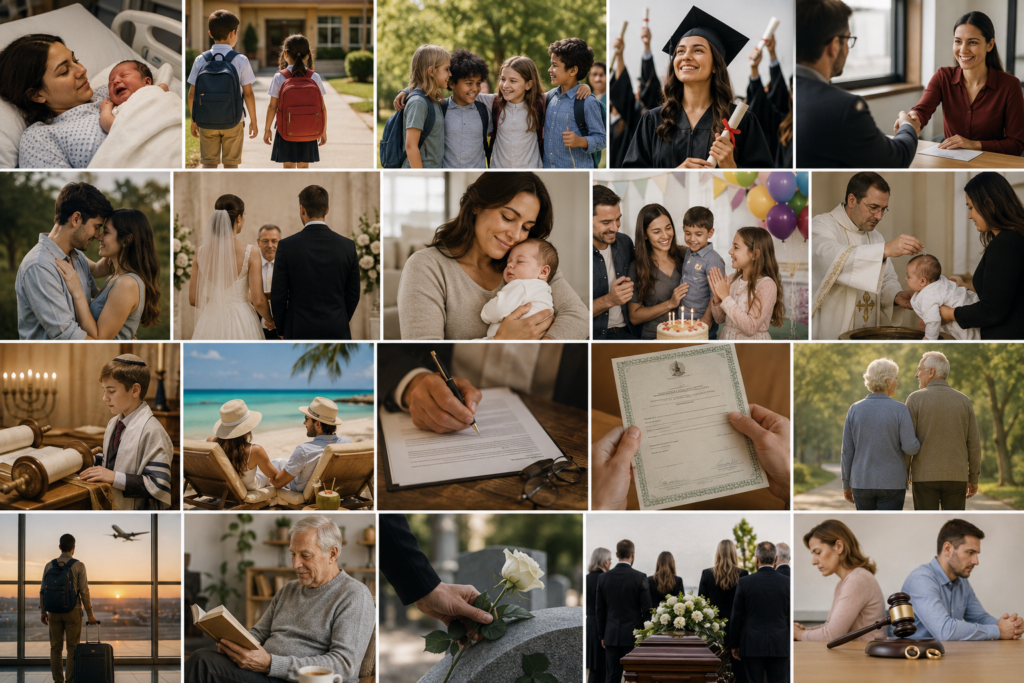
Some words in the image are more common in Portugal than in Brazil. Here are the most important changes for Brazilian Portuguese learners:
Licenciar-se → Formar-se / Se formar
Meaning: to graduate
Arranjar emprego → Conseguir um emprego / Arrumar um emprego
Meaning: to get a job
Reformar-se → Aposentar-se / Se aposentar
Meaning: to retire
O copo-d’água → A recepção de casamento / A festa de casamento
Meaning: wedding reception
These changes make your Portuguese sound more natural in Brazil.
Example Paragraph Using Life Events Vocabulary
Eu nasci no Brasil, fui para a escola quando era criança e fiz muitos amigos. Depois, me formei na universidade e consegui um emprego. Alguns anos depois, me apaixonei, me casei e tive um filho. No futuro, quero me aposentar e aproveitar mais tempo com minha família.
Translation:
I was born in Brazil, went to school when I was a child, and made many friends. Later, I graduated from university and got a job. A few years later, I fell in love, got married, and had a child. In the future, I want to retire and enjoy more time with my family.
Conclusion
Learning Brazilian Portuguese vocabulary for life events helps you talk about personal stories, family history, relationships, work, celebrations, and major changes in life. These words are useful in real conversations because people often talk about where they were born, when they graduated, how they met someone, when they got married, or what they plan to do in the future.
For learners of Brazilian Portuguese, it is especially important to use natural Brazilian expressions such as se formar, conseguir um emprego, se aposentar, and festa de casamento. These choices will make your Portuguese sound more authentic and easier to understand in Brazil.