
Numbers in Brazilian Portuguese help you do much more than count. You need them to understand prices, order food, share your age, read dates, arrange meetings, and follow everyday conversations. Fortunately, a small set of words and patterns gives you access to hundreds of useful expressions.
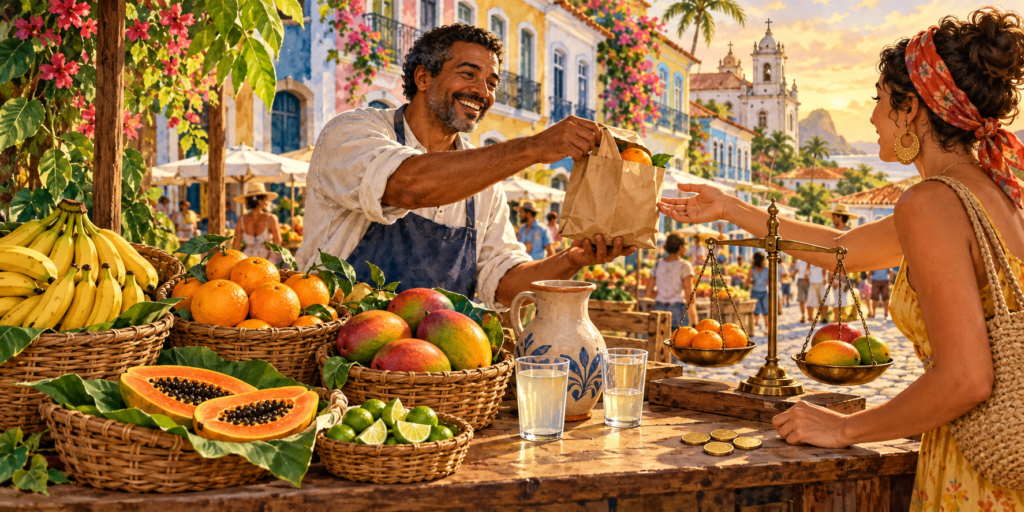
Imagine buying fruit at a Brazilian market. The seller asks how many oranges you want, tells you the price, and offers half a kilogram of another fruit. Meanwhile, your friend asks when you will arrive for lunch. Each exchange involves numbers, but each also requires a different expression.
This guide explains those connections step by step. First, you will learn cardinal numbers and the patterns that link them. Next, you will explore gender agreement, ordinal numbers, fractions, and quantities. Finally, practical dialogues and exercises will help you use the vocabulary in real situations.
The examples focus on Brazilian Portuguese. However, you will also find a few comparisons with European Portuguese, so you can recognize differences without mixing the two varieties.
What Are Cardinal and Ordinal Numbers?
Cardinal numbers tell you how many things you have. For example, três livros means “three books,” while dez pessoas means “ten people.” These numbers answer questions about quantity.
Ordinal numbers show position in a sequence. In contrast, o terceiro livro means “the third book,” and a primeira pessoa means “the first person.” These expressions answer questions about order.
| Category | Portuguese example | English meaning | Main purpose |
|---|---|---|---|
| Cardinal | dois ingressos | two tickets | Counting |
| Ordinal | o segundo ingresso | the second ticket | Showing order |
| Fraction | metade do ingresso | half of the ticket | Describing a part |
| Quantity expression | muitos ingressos | many tickets | Giving an approximate amount |
Start with cardinal numbers because they appear in so many daily exchanges. After that, the other categories become easier to understand.
Numbers in Brazilian Portuguese from 0 to 20
Learn the first twenty numbers before you move to larger combinations. Although some words share recognizable elements, beginners benefit from treating this group as essential vocabulary.
| Number | Brazilian Portuguese |
|---|---|
| 0 | zero |
| 1 | um / uma |
| 2 | dois / duas |
| 3 | três |
| 4 | quatro |
| 5 | cinco |
| 6 | seis |
| 7 | sete |
| 8 | oito |
| 9 | nove |
| 10 | dez |
| 11 | onze |
| 12 | doze |
| 13 | treze |
| 14 | quatorze / catorze |
| 15 | quinze |
| 16 | dezesseis |
| 17 | dezessete |
| 18 | dezoito |
| 19 | dezenove |
| 20 | vinte |
Notice the accent in três. Also, keep quatro and quatorze separate: the first means four, while the second means fourteen.
Is Fourteen Quatorze or Catorze?
Both quatorze and catorze are valid spellings. Therefore, you do not need to correct a speaker or text that uses the alternative form. This guide uses quatorze for consistency.
Reference: Priberam dictionary entry for quatorze.
Brazilian and European Forms for the Teen Numbers
Brazilian Portuguese uses dezesseis, dezessete, and dezenove. By comparison, European Portuguese commonly uses dezasseis, dezassete, and dezanove.
| Number | Brazilian Portuguese | European Portuguese |
|---|---|---|
| 16 | dezesseis | dezasseis |
| 17 | dezessete | dezassete |
| 19 | dezenove | dezanove |
These differences do not change the numerical value. However, choosing one variety makes your spelling more consistent when you write.
Reference: Ciberdúvidas explanation of dezassete and related forms.
Counting from 21 to 99
Once you know the tens, you can build most two-digit numbers with a simple pattern. This is one of the most useful shortcuts for learning numbers in Brazilian Portuguese. Connect the tens and units with e, which means “and.”
Learn the Tens First
| Number | Portuguese |
|---|---|
| 20 | vinte |
| 30 | trinta |
| 40 | quarenta |
| 50 | cinquenta |
| 60 | sessenta |
| 70 | setenta |
| 80 | oitenta |
| 90 | noventa |
Pay special attention to sessenta and setenta. Because they look and sound similar, learners sometimes confuse sixty with seventy.
Use E Between Tens and Units
The basic structure is tens + e + units. For example, twenty-three becomes vinte e três.
| Number | Portuguese |
|---|---|
| 21 | vinte e um |
| 28 | vinte e oito |
| 34 | trinta e quatro |
| 46 | quarenta e seis |
| 57 | cinquenta e sete |
| 63 | sessenta e três |
| 72 | setenta e dois |
| 85 | oitenta e cinco |
| 99 | noventa e nove |
Therefore, you do not need to memorize every two-digit number separately. Instead, learn the components and practice joining them.
Reference: Ciberdúvidas explanation of the conjunction e in numbers.
Complete Reference for Numbers from 21 to 99
Use this table when you need to check a number quickly. However, practice producing the words before looking at the answer.
| Number | Portuguese | Number | Portuguese | Number | Portuguese |
|---|---|---|---|---|---|
| 21 | vinte e um | 48 | quarenta e oito | 75 | setenta e cinco |
| 22 | vinte e dois | 49 | quarenta e nove | 76 | setenta e seis |
| 23 | vinte e três | 50 | cinquenta | 77 | setenta e sete |
| 24 | vinte e quatro | 51 | cinquenta e um | 78 | setenta e oito |
| 25 | vinte e cinco | 52 | cinquenta e dois | 79 | setenta e nove |
| 26 | vinte e seis | 53 | cinquenta e três | 80 | oitenta |
| 27 | vinte e sete | 54 | cinquenta e quatro | 81 | oitenta e um |
| 28 | vinte e oito | 55 | cinquenta e cinco | 82 | oitenta e dois |
| 29 | vinte e nove | 56 | cinquenta e seis | 83 | oitenta e três |
| 30 | trinta | 57 | cinquenta e sete | 84 | oitenta e quatro |
| 31 | trinta e um | 58 | cinquenta e oito | 85 | oitenta e cinco |
| 32 | trinta e dois | 59 | cinquenta e nove | 86 | oitenta e seis |
| 33 | trinta e três | 60 | sessenta | 87 | oitenta e sete |
| 34 | trinta e quatro | 61 | sessenta e um | 88 | oitenta e oito |
| 35 | trinta e cinco | 62 | sessenta e dois | 89 | oitenta e nove |
| 36 | trinta e seis | 63 | sessenta e três | 90 | noventa |
| 37 | trinta e sete | 64 | sessenta e quatro | 91 | noventa e um |
| 38 | trinta e oito | 65 | sessenta e cinco | 92 | noventa e dois |
| 39 | trinta e nove | 66 | sessenta e seis | 93 | noventa e três |
| 40 | quarenta | 67 | sessenta e sete | 94 | noventa e quatro |
| 41 | quarenta e um | 68 | sessenta e oito | 95 | noventa e cinco |
| 42 | quarenta e dois | 69 | sessenta e nove | 96 | noventa e seis |
| 43 | quarenta e três | 70 | setenta | 97 | noventa e sete |
| 44 | quarenta e quatro | 71 | setenta e um | 98 | noventa e oito |
| 45 | quarenta e cinco | 72 | setenta e dois | 99 | noventa e nove |
| 46 | quarenta e seis | 73 | setenta e três | ||
| 47 | quarenta e sete | 74 | setenta e quatro |
The table uses the default masculine forms for numbers ending in one or two. When you count feminine nouns, change the relevant ending, as the next section explains.
When Numbers Change Gender
Gender agreement gives numbers in Brazilian Portuguese a closer connection to the nouns around them. Portuguese nouns have grammatical gender. As a result, certain numbers change form to match the noun they describe.
The most important early examples are um/uma and dois/duas. Most other basic cardinal numbers do not change gender.
Um and Uma: One
Use um with a masculine noun and uma with a feminine noun.
| Masculine example | English | Feminine example | English |
|---|---|---|---|
| um livro | one book | uma revista | one magazine |
| um ingresso | one ticket | uma passagem | one travel ticket |
| um café | one coffee | uma água | one bottle or serving of water |
The word um can also mean “a,” depending on the sentence. For instance, quero um café may simply mean “I want a coffee.” However, the same form can emphasize the number one when the context contrasts quantities.
Dois and Duas: Two
Use dois with masculine nouns. By contrast, choose duas with feminine nouns.
- Dois livros: two books.
- Duas revistas: two magazines.
- Dois dias: two days.
- Duas semanas: two weeks.
This pattern also applies inside compound numbers. Consequently, you say vinte e duas pessoas, because pessoa is feminine.
Hundreds Also Have Gender Forms
The hundreds from two hundred through nine hundred change gender too. For example, duzentos alunos means “two hundred male students or students as a mixed group,” while duzentas alunas means “two hundred female students.”
However, cem, cento, and mil do not change gender. You say both cem livros and cem revistas.
Reference: Ciberdúvidas on invariant mil and gender-changing cardinals.
Numbers in Brazilian Portuguese from 100 to 999
Hundreds introduce one of the most useful distinctions in Portuguese: cem versus cento. Fortunately, the basic rule is straightforward.
Cem or Cento?
Use cem for exactly one hundred. When you add units or tens to that hundred, use cento instead.
| Number | Portuguese |
|---|---|
| 100 | cem |
| 101 | cento e um |
| 110 | cento e dez |
| 125 | cento e vinte e cinco |
| 150 | cento e cinquenta |
| 199 | cento e noventa e nove |
For example, cem reais means exactly one hundred reais. In contrast, cento e cinco reais means one hundred and five reais.
Do not assume that every number larger than one hundred requires cento. The expressions cem mil and cem milhões retain cem, because it directly multiplies a larger unit.
Reference: Ciberdúvidas explanation of cem and cento.
The Hundreds from 200 to 900
| Number | Masculine form | Feminine form |
|---|---|---|
| 200 | duzentos | duzentas |
| 300 | trezentos | trezentas |
| 400 | quatrocentos | quatrocentas |
| 500 | quinhentos | quinhentas |
| 600 | seiscentos | seiscentas |
| 700 | setecentos | setecentas |
| 800 | oitocentos | oitocentas |
| 900 | novecentos | novecentas |
Next, add the remaining tens and units with e. The number 347, for instance, becomes trezentos e quarenta e sete.
Try these combinations:
- 208: duzentos e oito.
- 416: quatrocentos e dezesseis.
- 582: quinhentos e oitenta e dois.
- 731: setecentos e trinta e um.
- 999: novecentos e noventa e nove.
When a feminine noun follows, apply gender agreement where needed. For example, 231 houses becomes duzentas e trinta e uma casas.
Thousands, Millions, and Billions
Large numbers in Brazilian Portuguese combine the vocabulary you already know with words for scale. Therefore, focus on grouping rather than memorizing long strings.
How to Use Mil
Mil means one thousand. In ordinary counting, say mil, rather than um mil.
| Number | Portuguese |
|---|---|
| 1,000 | mil |
| 2,000 | dois mil |
| 5,000 | cinco mil |
| 10,000 | dez mil |
| 25,000 | vinte e cinco mil |
| 100,000 | cem mil |
For longer combinations, do not insert e at every group boundary. Compare mil e duzentos for 1,200 with mil duzentos e trinta e quatro for 1,234.
Similarly, 1,025 becomes mil e vinte e cinco. Meanwhile, 2,150 becomes dois mil cento e cinquenta.
Reference: Ciberdúvidas on linking thousands, hundreds, and smaller numbers.
How to Use Milhão and Milhões
One million is um milhão. For two million or more, use the plural milhões.
When an exact multiple of a million directly quantifies a noun, include de: um milhão de pessoas or dois milhões de reais. By comparison, mil pessoas does not need de.
However, a number that continues into smaller units follows a different structure. For example, 1,200,000 people becomes um milhão e duzentas mil pessoas.
Reference: Ciberdúvidas explanation of milhão de.
What Does Bilhão Mean in Brazil?
In Brazil, um bilhão means 1,000,000,000. Therefore, it matches “one billion” in modern American English.
| English value | Brazilian Portuguese |
|---|---|
| 1,000,000 | um milhão |
| 2,000,000 | dois milhões |
| 1,000,000,000 | um bilhão |
| 2,000,000,000 | dois bilhões |
| 1,000,000,000,000 | um trilhão |
Nevertheless, large-number terminology can differ across Portuguese-speaking countries. Always confirm the numerical value when you compare international financial or statistical texts.
Reference: Priberam entry for bilhão, including its Brazilian meaning.
Decimal Commas and Thousands Separators
Brazilian everyday notation generally uses a comma for decimals. A period often separates thousands in prices and ordinary prose.
| English-style notation | Common Brazilian notation | Value |
|---|---|---|
| 2.5 | 2,5 | two and a half |
| 1,000 | 1.000 | one thousand |
| 12,450.75 | 12.450,75 | twelve thousand four hundred fifty and seventy-five hundredths |
Consequently, R$ 25,90 represents twenty-five reais and ninety centavos. It does not mean two thousand five hundred ninety reais.
For a decimal such as 2,5, say dois vírgula cinco. In measurements, you may also hear dois e meio when the context makes the unit clear.
Reference: Brazilian Senate guidance on numbers and decimal notation.
Ordinal Numbers in Brazilian Portuguese
Ordinal numbers in Brazilian Portuguese help you describe rankings, floors, positions, and stages. Unlike most cardinals, ordinals generally have masculine and feminine forms.
Ordinal Numbers from First to Tenth
| Position | Masculine | Feminine |
|---|---|---|
| 1st | primeiro | primeira |
| 2nd | segundo | segunda |
| 3rd | terceiro | terceira |
| 4th | quarto | quarta |
| 5th | quinto | quinta |
| 6th | sexto | sexta |
| 7th | sétimo | sétima |
| 8th | oitavo | oitava |
| 9th | nono | nona |
| 10th | décimo | décima |
For example, o primeiro dia means “the first day.” By contrast, a primeira semana means “the first week.”
Other useful expressions include o terceiro andar for “the third floor” and a quinta tentativa for “the fifth attempt.” However, remember that quarto can also mean “bedroom” or “room,” depending on the sentence.
Ordinal Numbers Beyond Ten
Build many larger ordinals by combining the relevant parts. For instance, eleventh becomes décimo primeiro.
| Position | Masculine | Feminine |
|---|---|---|
| 11th | décimo primeiro | décima primeira |
| 12th | décimo segundo | décima segunda |
| 15th | décimo quinto | décima quinta |
| 20th | vigésimo | vigésima |
| 21st | vigésimo primeiro | vigésima primeira |
| 30th | trigésimo | trigésima |
| 100th | centésimo | centésima |
In writing, use 1º for the masculine form and 1ª for the feminine form. These ordinal indicators differ from the degree symbol used for temperature.
The Brazilian Senate also provides editorial guidance for spelling out ordinals and using figures. However, those publishing conventions do not replace the grammatical need for gender agreement.
Reference: Brazilian Senate manual on ordinal numbers.
Fractions: Half, Thirds, Quarters, and More
Fractions describe parts of a whole. You will encounter them in recipes, shopping, mathematics, and discussions about time.
| Fraction | Portuguese | English |
|---|---|---|
| 1/2 | um meio / metade | one half / half |
| 1/3 | um terço | one third |
| 2/3 | dois terços | two thirds |
| 1/4 | um quarto | one quarter |
| 3/4 | três quartos | three quarters |
| 1/5 | um quinto | one fifth |
| 2/5 | dois quintos | two fifths |
| 1/8 | um oitavo | one eighth |
| 1/10 | um décimo | one tenth |
For example, um terço dos alunos means “one third of the students.” Meanwhile, três quartos da pizza means “three quarters of the pizza.”
In mathematical contexts, you can also read a fraction as a division. Thus, três dividido por quatro expresses the operation three divided by four.
Metade, Meio, and Meia
Metade works as a noun meaning “half.” For example, a metade do bolo means “half of the cake.”
When meio directly describes a masculine noun as “half,” use the masculine form. In contrast, choose meia before a feminine noun.
- Meio litro: half a liter.
- Meio quilo: half a kilogram.
- Meia hora: half an hour.
- Meia xícara: half a cup.
However, meio stays unchanged when it means “somewhat” or “a little” as an adverb. Therefore, ela está meio cansada means “she is somewhat tired.”
Reference: Instituto Claro educational explanation of meio and meia.
Dozen and Half a Dozen
Uma dúzia means twelve, while meia dúzia means six. These expressions are especially useful when buying eggs, pastries, or other items that sellers group together.
For example, quero uma dúzia de ovos means “I want a dozen eggs.” Alternatively, meia dúzia de pães means “half a dozen bread rolls.”
Notice that dúzia takes de before the item. As a result, “two dozen eggs” becomes duas dúzias de ovos.
How to Ask How Much and How Many
Questions about numbers in Brazilian Portuguese often start with a form of quanto. English distinguishes “how much” from “how many.” Portuguese uses forms of quanto, but the wording depends on what you ask about.
Quanto Custa? Asking About Price
Use quanto custa? to ask “How much does it cost?” For multiple items, choose quanto custam?.
| Portuguese | English |
|---|---|
| Quanto custa este livro? | How much does this book cost? |
| Quanto custam essas maçãs? | How much do those apples cost? |
| Quanto é? | How much is it? |
| Quanto fica tudo? | How much does everything come to? |
The last expression helps you ask for a total. Therefore, it works well after you order several items.
Quanto, Quanta, Quantos, and Quantas
Match these forms to the noun in your question. For example, quantos livros? asks about masculine plural objects, while quantas pessoas? asks about feminine plural people.
| Form | Example | English |
|---|---|---|
| quanto | Quanto dinheiro você tem? | How much money do you have? |
| quanta | Quanta água você quer? | How much water do you want? |
| quantos | Quantos ingressos você precisa comprar? | How many tickets do you need to buy? |
| quantas | Quantas garrafas você quer? | How many bottles do you want? |
Although pessoas refers to people of any gender, the noun itself is grammatically feminine. Consequently, use quantas pessoas, rather than quantos pessoas.
Useful Quantity Words for Everyday Conversations
Exact numbers are not always necessary. Sometimes you only need to say “a little,” “many,” “more,” or “none.”
A Little, Some, and a Few
| Portuguese | Typical English meaning | Example |
|---|---|---|
| um pouco de | a little / some | um pouco de água |
| um pouquinho de | a little bit of | um pouquinho de açúcar |
| alguns | some / a few, masculine plural | alguns livros |
| algumas | some / a few, feminine plural | algumas frutas |
| poucos | few, masculine plural | poucos minutos |
| poucas | few, feminine plural | poucas opções |
For example, quero um pouco de café means “I want a little coffee.” By comparison, quero algumas maçãs means “I want a few apples.”
However, poucos often emphasizes scarcity. The sentence tenho poucos amigos aqui means “I have few friends here,” which differs from the more neutral tenho alguns amigos aqui.
Muito, Muita, Muitos, and Muitas
Use these forms before nouns to describe a large quantity. For instance, muita água means “a lot of water,” while muitos livros means “many books.”
| Portuguese | English |
|---|---|
| muito dinheiro | a lot of money |
| muita comida | a lot of food |
| muitos problemas | many problems |
| muitas pessoas | many people |
Nevertheless, muito does not always describe a noun. In ela trabalha muito, it modifies the verb and means “she works a lot.”
Likewise, muito stays unchanged before an adjective. You say muito bonita for “very beautiful,” rather than muita bonita.
More and Less: Mais and Menos
Mais means “more,” and menos means “less” or “fewer.” Neither word changes gender in these quantity expressions.
- Mais água: more water.
- Mais duas cadeiras: two more chairs.
- Menos açúcar: less sugar.
- Menos pessoas: fewer people.
Be careful with spelling: mais means “more,” whereas mas means “but.” Although the words look similar, they serve different purposes.
Tudo, Todo, Toda, Todos, and Todas
Tudo usually refers to everything in a general sense. For example, entendi tudo means “I understood everything.”
In contrast, forms of todo can describe a specific whole or group. Compare o bolo todo for “the whole cake” with todos os bolos for “all the cakes.”
| Portuguese | English |
|---|---|
| tudo | everything |
| o dia todo | the whole day |
| a semana toda | the whole week |
| todos os alunos | all the students |
| todas as cadeiras | all the chairs |
Do not use tuda as a feminine version of tudo. Instead, choose toda when the structure calls for agreement with a feminine noun.
Nenhum, Nenhuma, Nada, and Ninguém
English “none” does not have a single Portuguese translation for every situation. Therefore, identify whether you mean no item, nothing, or nobody.
| Portuguese | English |
|---|---|
| Não tenho nenhum livro. | I do not have any books. |
| Não tenho nenhuma dúvida. | I do not have any questions or doubts. |
| Não quero nada. | I do not want anything. |
| Não conheço ninguém aqui. | I do not know anyone here. |
When these negative words follow the verb, não commonly appears before it. However, a negative word before the verb can make não unnecessary, as in ninguém chegou for “nobody arrived.”
Prices and Money in Brazilian Portuguese
Brazil uses the real, with the plural reais. For smaller amounts, use centavo or centavos.
The currency symbol is R$, and the international code is BRL. You can verify these identifiers through the Central Bank of Brazil’s currency dataset.
How to Say Common Prices
| Written price | Full spoken form | English value |
|---|---|---|
| R$ 1,00 | um real | one real |
| R$ 2,00 | dois reais | two reais |
| R$ 10,50 | dez reais e cinquenta centavos | ten reais and fifty centavos |
| R$ 25,90 | vinte e cinco reais e noventa centavos | twenty-five reais and ninety centavos |
| R$ 100,00 | cem reais | one hundred reais |
| R$ 150,00 | cento e cinquenta reais | one hundred fifty reais |
In a clear shopping context, a speaker may shorten dez reais e cinquenta centavos to dez e cinquenta. However, beginners should practice the full version first, especially when accuracy matters.
A Simple Shopping Dialogue
Customer: Quanto custa esta camiseta?
English: How much does this T-shirt cost?
Seller: Custa quarenta e nove reais e noventa centavos.
English: It costs forty-nine reais and ninety centavos.
Customer: E duas camisetas?
English: And two T-shirts?
Seller: Noventa e nove reais e oitenta centavos.
English: Ninety-nine reais and eighty centavos.
Customer: Certo. Vou levar duas.
English: Okay. I will take two.
Notice how duas matches camisetas. Meanwhile, reais takes masculine number forms because real is masculine.
Ages, Dates, and Years
Numbers in Brazilian Portuguese also help you share personal information and understand schedules. However, Portuguese structures these expressions differently from English in several ways.
How to Say Your Age
Use ter, meaning “to have,” when you state your age. For example, tenho vinte e nove anos means “I am twenty-nine years old.”
- Quantos anos você tem?: How old are you?
- Tenho dezoito anos: I am eighteen years old.
- Minha irmã tem trinta e dois anos: My sister is thirty-two years old.
Do not translate “I am” directly in this expression. Instead, learn tenho … anos as a complete pattern.
How to Read Dates
Brazil generally uses day/month/year in everyday numerical dates. Thus, 07/10/2026 means October 7, 2026.
In words, this date becomes sete de outubro de dois mil e vinte e seis. Also, month names normally begin with lowercase letters in Portuguese.
Reference: FUNAG guidance on dates and month names.
The first day of the month commonly uses the ordinal primeiro. For example, primeiro de maio means “May first.” After that, use cardinals such as dois de maio and três de maio.
Reference: Brazilian Senate guidance on dates.
How to Read Years
Read years as complete numbers rather than copying English century-style groupings. For example, 1997 becomes mil novecentos e noventa e sete.
| Year | Portuguese |
|---|---|
| 2000 | dois mil |
| 2001 | dois mil e um |
| 2015 | dois mil e quinze |
| 2026 | dois mil e vinte e seis |
In ordinary year notation, write 2026, rather than 2.026. The Senate’s number-writing manual explicitly distinguishes years from quantities that use thousands separators.
Telling the Time in Brazilian Portuguese
To ask the time, say que horas são? For the answer, use é with one o’clock, noon, and midnight. In contrast, use são for the other numbered hours.
Whole Hours and Minutes
| Time | Portuguese |
|---|---|
| 1:00 | É uma hora. |
| 2:00 | São duas horas. |
| 3:15 | São três e quinze. |
| 4:30 | São quatro e meia. |
| 5:45 | São cinco e quarenta e cinco. |
| 12:00 noon | É meio-dia. |
| 12:00 midnight | É meia-noite. |
The word meia in quatro e meia refers to half an hour. Therefore, it does not mean the digit six in that expression.
Alternatively, you can express time remaining before the next hour. For instance, são quinze para as seis means “it is a quarter to six.”
Morning, Afternoon, and Night
Add da manhã, da tarde, or da noite when the context needs clarification.
- Oito da manhã: eight in the morning.
- Duas da tarde: two in the afternoon.
- Nove da noite: nine at night.
For written schedules, you may see forms such as 14h30. The Brazilian Senate recommends this compact format in its editorial guidance, while also recommending spoken expressions such as “three in the afternoon” for broadcasting.
Reference: Brazilian Senate manual on writing times.
At What Time? A Que Horas?
Use a que horas? to ask when an event happens. Compare a que horas começa a aula? with que horas são?: the first asks about a scheduled event, while the second asks for the current time.
| Portuguese | English |
|---|---|
| A aula começa à uma. | The class starts at one. |
| A reunião começa às duas. | The meeting starts at two. |
| O almoço começa ao meio-dia. | Lunch starts at noon. |
| A loja abre às nove da manhã. | The store opens at nine in the morning. |
Notice the difference between à uma and às duas. The article agrees with the singular or plural hour expression.
Phone Numbers: Why Meia Can Mean Six
When Brazilians read strings of digits, they may use meia instead of seis for six. The expression comes from meia dúzia, meaning half a dozen.
However, this usage does not change ordinary counting. You still say seis livros for six books.
Consider the fictional digit sequence 3068. A speaker might read it as três, zero, meia, oito.
Reference: Ciberdúvidas on meia as a spoken form of six.
To avoid confusion, confirm unfamiliar numbers one digit at a time. For example, pode repetir os números mais devagar? means “Can you repeat the numbers more slowly?”
Percentages and Measurements
Numbers in Brazilian Portuguese become especially useful when you shop, cook, or compare information. Percentages and measurements connect counting with practical decisions.
How to Say Percentages
Use por cento after the number. For example, 10% becomes dez por cento.
| Percentage | Portuguese |
|---|---|
| 5% | cinco por cento |
| 25% | vinte e cinco por cento |
| 50% | cinquenta por cento |
| 100% | cem por cento |
| 2,5% | dois vírgula cinco por cento |
Although cento appears in por cento, one hundred percent starts with cem. Consequently, the complete expression is cem por cento.
Reference: Ciberdúvidas on cento in percentage expressions.
Common Measurement Expressions
| Portuguese | English |
|---|---|
| um litro de água | one liter of water |
| dois litros de leite | two liters of milk |
| meio quilo de queijo | half a kilogram of cheese |
| duzentos gramas de farinha | two hundred grams of flour |
| duas xícaras de arroz | two cups of rice |
| uma colher de açúcar | one spoonful of sugar |
| três quilômetros | three kilometers |
In the expression duzentos gramas, the measurement noun grama is masculine. However, a grama means grass and is a different word in meaning and gender.
Reference: Priberam dictionary entry for gramas.
For recipes, focus on the unit as well as the number. A spoonful, a cup, and a kilogram represent very different quantities.
Practical Dialogues with Numbers and Quantities
The following dialogues combine counting with useful sentence patterns. First, read each exchange for meaning. Afterward, replace the quantities and repeat it aloud.
Buying Fruit at a Market
Customer: Bom dia! Quanto custa o quilo de maçã?
English: Good morning! How much does a kilogram of apples cost?
Seller: Oito reais.
English: Eight reais.
Customer: Quero meio quilo, por favor.
English: I would like half a kilogram, please.
Seller: Certo. Mais alguma coisa?
English: Okay. Anything else?
Customer: Sim, duas bananas.
English: Yes, two bananas.
Here, meio agrees with quilo. Meanwhile, duas agrees with bananas.
Ordering at a Café
Customer: Quero dois cafés e uma água, por favor.
English: I would like two coffees and one water, please.
Server: Com açúcar?
English: With sugar?
Customer: Só um pouquinho, por favor.
English: Just a little bit, please.
Server: Mais alguma coisa?
English: Anything else?
Customer: Não, obrigado. Quanto fica tudo?
English: No, thank you. How much does everything come to?
The quantity um pouquinho helps you make a request without choosing an exact measurement. In addition, quanto fica tudo? asks about the combined price.
Scheduling a Meeting
Ana: A que horas começa a reunião?
English: What time does the meeting start?
Bruno: Às duas e meia da tarde.
English: At half past two in the afternoon.
Ana: E quanto tempo vai durar?
English: And how long will it last?
Bruno: Uma hora.
English: One hour.
This exchange distinguishes a clock time from a duration. Therefore, às duas e meia and uma hora answer different questions.
Common Mistakes with Numbers in Brazilian Portuguese
Small errors can make a quantity harder to understand. Fortunately, a few targeted corrections solve many beginner problems.
Mixing Up One Hundred and One Hundred One
Use cem for 100 and cento e um for 101. For example, a price of R$ 101 requires cento e um reais.
However, retain cem in cem mil. The difference depends on the number’s structure, rather than simply its overall size.
Forgetting Gender Agreement
Say duas pessoas, rather than dois pessoas. Likewise, choose vinte e uma cadeiras, because cadeira is feminine.
An efficient practice method is to learn nouns together with quantities. For instance, memorize duas semanas as a small phrase rather than studying duas alone.
Reading a Decimal Comma as a Thousands Separator
The price R$ 15,50 means fifteen reais and fifty centavos. Therefore, always identify the decimal separator before reading a Brazilian price.
When you compare documents from different countries, check their notation conventions. The same punctuation can represent different things across contexts.
Treating Every English Quantity Word as a Direct Translation
“Some” may become alguns, algumas, or um pouco de. Similarly, “none” can require nenhum, nenhuma, or a different negative expression.
Instead of choosing a translation in isolation, look at the complete sentence. This approach helps you distinguish countable items from general amounts and negative statements.
Confusing Meia in Different Contexts
Meia hora means half an hour. In contrast, meia in a spoken phone number can mean six.
Context resolves the difference. Nevertheless, asking someone to repeat a number is a useful habit when details matter.
How to Practice Portuguese Numbers More Effectively
Reading a list of numbers in Brazilian Portuguese gives you a starting point. However, real communication also requires listening, recall, and quick responses.
Practice in Both Directions
First, look at a digit and say the Portuguese word. Then reverse the task: listen to the word and write the digit.
For example, ask a partner to say five prices without showing you the written amounts. Afterward, compare your notes with the original list.
This exercise helps reveal whether you recognize a number only when you see it. Consequently, you can give more practice time to the weaker skill.
Use Contrast Pairs
Practice similar-looking numbers side by side. Useful pairs include 6 and 16, 7 and 17, 60 and 70, and 100 and 101.
Next, place each pair inside a sentence. Compare sessenta reais with setenta reais, rather than repeating the words without context.
Build a Short Daily Routine
| Practice stage | Suggested activity |
|---|---|
| Counting | Count forward and backward within a small range. |
| Recall | Read random digits without following numerical order. |
| Prices | Say five imaginary shopping prices. |
| Agreement | Alternate masculine and feminine nouns. |
| Listening | Write down numbers from a recording or a partner. |
| Conversation | Use the numbers in a short question and answer. |
Begin with comfortable material. Once you can respond accurately, add larger values, fractions, and time expressions.
For listening practice, explore the University of Texas at Austin’s COERLL Portuguese learning materials. Its resources include native-speaker recordings and contextual language activities. However, choose material that matches your current level rather than trying to understand every word immediately.
Exercises: Test Your Understanding
Try the questions before reading the answers. Then review the rule behind each correction, so you can apply it to a new example.
Exercise 1: Write These Numbers in Portuguese
- 14
- 27
- 63
- 100
- 101
- 248
- 1,000
- 1,200
- 1,234
- 2,000,000
Exercise 2: Choose the Correct Form
- Quero ___ maçãs. (dois / duas)
- Tenho ___ livro. (um / uma)
- A viagem dura ___ hora. (meio / meia)
- Ela tem vinte e ___ anos. (um / uma)
- A escola recebeu ___ cadeiras. (duzentos / duzentas)
- Quero ___ café. (um pouco de / algumas)
- Não tenho ___ dúvida. (nenhum / nenhuma)
- Esta é a ___ vez. (primeiro / primeira)
Exercise 3: Translate into Brazilian Portuguese
- How much does this book cost?
- I would like half a kilogram of apples.
- She is twenty-nine years old.
- The meeting starts at three thirty in the afternoon.
- I need two more chairs.
- One third of the cake.
- All the students.
- Twenty-five percent.
Answer Key
Exercise 1
- Quatorze or catorze.
- Vinte e sete.
- Sessenta e três.
- Cem.
- Cento e um.
- Duzentos e quarenta e oito.
- Mil.
- Mil e duzentos.
- Mil duzentos e trinta e quatro.
- Dois milhões.
Exercise 2
- Duas: maçãs is feminine plural.
- Um: livro is masculine singular.
- Meia: hora is feminine singular.
- Um: anos is masculine.
- Duzentas: cadeiras is feminine plural.
- Um pouco de: coffee is a general amount here.
- Nenhuma: dúvida is feminine singular.
- Primeira: vez is feminine singular.
Exercise 3: Suggested answers
- Quanto custa este livro?
- Quero meio quilo de maçãs.
- Ela tem vinte e nove anos.
- A reunião começa às três e meia da tarde.
- Preciso de mais duas cadeiras.
- Um terço do bolo.
- Todos os alunos.
- Vinte e cinco por cento.
Alternative wording may also work. However, keep the number, gender agreement, and intended meaning consistent.
Frequently Asked Questions About Portuguese Numbers
How Do You Count from One to Ten in Brazilian Portuguese?
Say um, dois, três, quatro, cinco, seis, sete, oito, nove, dez. When you count feminine nouns, use uma and duas for one and two.
What Is the Difference Between Cem and Cento?
Cem expresses exactly one hundred. In contrast, cento appears in combinations from 101 to 199, such as cento e vinte.
However, expressions such as cem mil retain cem. You also use cento in por cento for percentages.
Do All Portuguese Numbers Change Gender?
No. The main cardinal forms that change gender are um/uma, dois/duas, and the hundreds from duzentos/duzentas through novecentos/novecentas.
Ordinal numbers also have gender forms. Therefore, primeiro becomes primeira when it describes a feminine noun.
How Do You Say Half in Portuguese?
Use metade as a noun, as in metade do bolo. Alternatively, use meio or meia before a noun, as in meio litro and meia hora.
How Do You Say Twenty-One in Portuguese?
The default counting form is vinte e um. However, use vinte e uma when the number describes a feminine noun, as in vinte e uma pessoas.
What Does Meia Mean in a Phone Number?
In a spoken digit sequence, meia can represent six. Nevertheless, use seis for ordinary quantities such as seis dias.
How Do You Ask the Price in Portuguese?
Say quanto custa? for a singular item. For several items, use quanto custam?, or ask quanto fica tudo? when you want the total.
Start Using Numbers in Brazilian Portuguese Every Day
Numbers in Brazilian Portuguese become easier when you connect them to real actions. Start by counting familiar objects, saying prices, and asking simple questions. Then add gender agreement, fractions, dates, and time expressions as your confidence grows.
Keep a few patterns close at hand: vinte e dois, cento e cinco, duas pessoas, meio quilo, and quanto custa? Together, they cover several common situations and give you a useful foundation.
Finally, practice understanding numbers as often as you practice saying them. A number you can recognize in a quick conversation is far more useful than one you can only find in a vocabulary table.