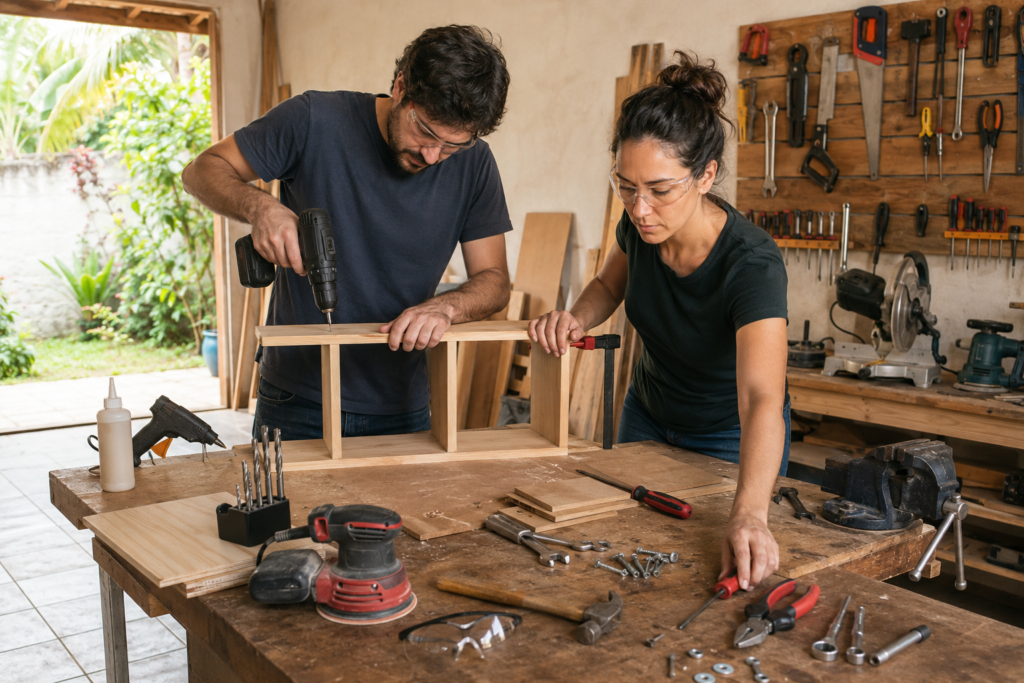

Brazilian Portuguese tools vocabulary helps you shop for hardware, follow a repair video, explain a DIY project, and ask for the right tool without pointing at everything on the shelf. This guide covers the workshop words shown in the reference images, but it adapts Portugal-specific terms to the language people commonly use in Brazil. Therefore, you will learn furadeira instead of berbequim, trena instead of fita métrica, and many other practical differences.
Essential Brazilian Portuguese Tools Vocabulary
If you only want the most useful words, begin with the list below. These terms appear constantly in hardware stores, workshops, construction sites, and home-repair videos in Brazil.
| Brazilian Portuguese | English |
|---|---|
| a ferramenta | tool |
| a caixa de ferramentas | toolbox |
| a oficina | workshop or repair shop |
| a bancada de trabalho | workbench |
| a furadeira | drill |
| a parafusadeira | electric screwdriver or drill driver |
| a broca | drill bit |
| o martelo | hammer |
| a chave de fenda | flathead screwdriver |
| a chave Phillips | Phillips screwdriver |
| o alicate | pliers |
| a chave inglesa | adjustable wrench |
| a trena | tape measure |
| o nível | level |
| o serrote | handsaw |
| a serra tico-tico | jigsaw |
| a serra circular | circular saw |
| a lixadeira | sander |
| o parafuso | screw |
| o prego | nail |
Notice that Portuguese usually uses an article with a noun: a furadeira, o martelo, and a broca. Learning each word with its article makes gender agreement easier later. In addition, the article helps the vocabulary sound like a natural phrase instead of an isolated dictionary entry.
European and Brazilian Portuguese Workshop Terms
The vocabulary in the source pages follows European Portuguese in several places. Brazilians may understand some of those words, especially from context, but they normally choose different terms in everyday speech.
| Portuguese from Portugal | Natural Brazilian Portuguese | English |
| o berbequim | a furadeira | drill |
| o berbequim recarregável | a furadeira a bateria or sem fio | cordless drill |
| o berbequim manual | o arco de pua or a furadeira manual | bit brace or hand drill |
| a serra de vaivém | a serra tico-tico | jigsaw |
| o torno de bancada | o torno de bancada or a morsa de bancada | bench vise |
| a prensa | o grampo de aperto or o sargento | clamp |
| a chave de fendas | a chave de fenda | screwdriver |
| as pontas da chave de fendas | as pontas de chave or os bits | screwdriver bits |
| a fita métrica | a trena | tape measure |
| o x-ato | o estilete | utility knife |
| o roquete | a catraca | ratchet |
| a chave de caixa | o soquete | socket |
| a chave umbraco | a chave Allen | Allen key |
| a chave de estrela | a chave Phillips | Phillips screwdriver |
| o alicate de pontas finas | o alicate de bico fino | needle-nose pliers |
| a anilha | a arruela | washer |
| o descarnador de fios | o desencapador de fios | wire stripper |
| o ferro de soldar | o ferro de solda | soldering iron |
| a fita isoladora | a fita isolante | electrical tape |
| o contraplacado | o compensado | plywood |
| o cartão prensado | a chapa dura or o painel de fibra | hardboard |
| o corante de madeiras | o tingidor para madeira | wood stain |
| a serra de metais | o arco de serra | hacksaw |
| o papel de lixa | a lixa or a folha de lixa | sandpaper |
| a pistola de cola | a pistola de cola quente | hot-glue gun |
| as aparas de madeira | os cavacos or as aparas de madeira | wood shavings |
| a broca manual | a furadeira manual | hand drill |
| o escalpelo | o estilete de precisão | craft knife |
| a serra de recortes | o arco de serra tico-tico | fretsaw |
| a palha-d’aço | a palha de aço | steel wool |
Terms that require context
Some translations depend on the tool rather than the English label alone. For example, Brazilians use chave inglesa for an adjustable wrench. However, the large toothed wrench pictured on the final page is a pipe wrench, which people in Brazil call chave grifo or chave para tubos.
The term torno de bancada does not require replacement. Brazilian manufacturers use both torno de bancada and morsa for bench vises. Thus, either name can help you find the tool in Brazil.
The hand-cranked tool on the final page needs a different correction. Brazilians call the complete tool furadeira manual, while broca names only the bit that makes the hole. As a result, broca manual can confuse the tool with one of its parts.
The word prensa also exists in Brazilian Portuguese, but it usually describes equipment that applies pressure through a pressing mechanism. For an ordinary woodworking clamp, grampo de aperto offers the clearest general term. Meanwhile, many carpenters and woodworkers also say sargento.
Another useful distinction concerns wood waste. Cavacos or aparas de madeira are curled chips and shavings. By contrast, serragem means the fine dust or small particles produced by sawing.
Brazilian Portuguese Tools Vocabulary: Power Tools
Power tools often have names based on the action they perform. Once you know that furar means “to drill” and lixar means “to sand,” words such as furadeira and lixadeira become easier to remember.
This part of Brazilian Portuguese tools vocabulary also reveals how Brazilian stores combine functions in product names. For instance, Bosch Brazil categorizes combination models as furadeiras/parafusadeiras a bateria.
Drills, saws, and powered tools
| Brazilian Portuguese | English | Usage note |
| a furadeira elétrica | electric drill | Often shortened to furadeira |
| a furadeira a bateria | cordless drill | Furadeira sem fio is also clear |
| a furadeira/parafusadeira | drill driver | Common product name in Brazilian stores |
| o mandril | chuck | The part that holds the bit |
| a broca | drill bit | Choose the bit according to the material |
| a serra tico-tico | jigsaw | Replaces Portugal’s serra de vaivém |
| a serra circular | circular saw | Used for straight cuts |
| a lixadeira | sander | A general term for a powered sander |
| a tupia | router | A woodworking router, not an internet router |
| a pistola de cola quente | hot-glue gun | Usually shortened to pistola de cola when context is clear |
| a lâmina | blade | Used for saw, knife, or cutter blades |
| a bateria | battery or battery pack | Used with cordless tools |
In Brazil, a salesperson may ask whether you need a furadeira or a parafusadeira. A drill primarily makes holes, whereas a power screwdriver drives and removes screws. Nevertheless, many household models combine both functions and carry the label furadeira/parafusadeira.
Benches, storage, and workshop accessories
| Brazilian Portuguese | English | Usage note |
| a oficina | workshop | It can also mean a repair shop, especially for vehicles |
| a marcenaria | woodworking shop | Use this for a space or business devoted to woodworking |
| a bancada de trabalho | workbench | Bancada is common when the context is obvious |
| o torno de bancada or a morsa de bancada | bench vise | Both names appear in Brazilian catalogs |
| o grampo de aperto | clamp | A safe general term |
| o sargento | woodworking clamp | Common among woodworkers |
| o organizador de ferramentas | tool organizer | A box, panel, rack, or cabinet can serve this purpose |
| o painel de ferramentas | tool board or rack | Common for a wall-mounted organizer |
| a extensão elétrica | extension cord | Often shortened to extensão |
| a cola para madeira | wood glue | Cola de madeira also occurs in casual speech |
| os cavacos de madeira | wood shavings | Use serragem for finer particles |
Although oficina translates as “workshop,” its meaning changes with context. An oficina mecânica repairs cars, while a marcenaria makes or repairs wooden furniture. Therefore, someone looking for a woodworking class should search for curso de marcenaria, not only curso de oficina.
Hand Tools and Toolbox Vocabulary
The natural general expression in Brazil is caixa de ferramentas, without das. Although caixa das ferramentas can mean “the box for those specific tools,” it sounds less natural as the generic name of the object.
Screwdrivers, wrenches, and pliers
| Brazilian Portuguese | English | Important distinction |
| a chave de fenda | flathead screwdriver | Brazil uses the singular fenda |
| a chave Phillips | Phillips screwdriver | Also written chave phillips informally |
| a ponta de chave | screwdriver bit | People also use the English loanword bit |
| o bit de segurança | security bit | A bit for tamper-resistant screws |
| a chave Allen | Allen key or hex key | Chave hexagonal is the descriptive alternative |
| a chave de boca | open-end wrench | The opening grips two sides of a nut |
| a chave inglesa | adjustable wrench | Its movable jaw changes width |
| a chave grifo | pipe wrench | Used on pipes and round fittings |
| a catraca | ratchet | The handle that turns sockets |
| o soquete | socket | Attaches to a ratchet or socket wrench |
| o alicate universal | combination pliers | Often called simply alicate |
| o alicate de bico fino | needle-nose pliers | Useful in narrow spaces |
| o alicate de corte | wire cutters or diagonal cutters | Used to cut wire |
| o desencapador de fios | wire stripper | Removes insulation without cutting the conductor |
The word chave appears in many tool names because it can mean a key, wrench, or screwdriver. Consequently, context matters. A chave de fenda turns a screw, a chave de boca turns a nut, and a chave Allen fits a hexagonal recess.
Be careful with chave de estrela. In Portugal, the phrase may refer to a Phillips screwdriver. Brazilian usage, however, usually reserves chave estrela for a closed box-end wrench. Use chave Phillips when you mean the cross-shaped screwdriver.
Measuring, marking, cutting, and safety tools
| Brazilian Portuguese | English | Usage note |
| a trena | tape measure | The standard everyday Brazilian term |
| o nível de bolha | spirit level | Often shortened to nível |
| o estilete | utility knife | A retractable cutting tool |
| o estilete de precisão | craft knife | Bisturi de precisão also appears in craft stores |
| o martelo | hammer | The basic general term |
| os óculos de proteção | safety goggles or glasses | Óculos de segurança is also correct |
| a lima | file | A metalworking or woodworking file |
| a pedra de amolar | whetstone | Used to sharpen a cutting edge |
| a caixa de meia-esquadria | miter box | Guides angled cuts |
| o desentupidor | plunger | Clears a clogged sink, toilet, or drain |
Safety vocabulary matters as much as tool names. For example, Coloque os óculos de proteção antes de cortar means “Put on safety glasses before cutting.” Likewise, Desligue a furadeira da tomada tells someone to unplug the drill.
Saws and Woodworking Tools in Brazilian Portuguese
Portuguese uses several different words for saws. The motorized tool usually takes serra, while the common manual wood saw often takes serrote. Still, specific designs have their own established names.
| Brazilian Portuguese | English | What it does |
| a serra tico-tico | jigsaw | Makes straight or curved cuts with a reciprocating blade |
| a serra circular | circular saw | Makes fast, straight cuts with a circular blade |
| o serrote | handsaw | General manual saw for wood |
| o serrote de costa | backsaw or tenon saw | Has a reinforced spine for controlled cuts |
| o arco de serra | hacksaw | Commonly cuts metal or plastic |
| o arco de serra tico-tico | fretsaw | Makes delicate curves and interior cuts |
| a plaina | plane | Flattens or smooths a wooden surface |
| o formão | chisel | Cuts or carves wood |
| a tupia | router | Hollows, trims, or shapes wood |
| o corta-tubos | pipe cutter | Produces a controlled cut around a pipe |
The pictured deep-frame fretsaw is commonly sold as an arco de serra tico-tico in Brazil. Serra de marchetaria and arco de serra para marchetaria also describe tools for delicate curved cuts. Meanwhile, serra de recortes remains understandable, but it is less useful as a Brazilian shopping term.
For a hacksaw, Brazilians commonly say arco de serra because the replaceable blade sits under tension in a metal frame. The phrase serra de metais sounds descriptive, yet it is not the usual product name in many Brazilian stores.
Brazilian Portuguese Tools Vocabulary: Drill Bits and Fasteners
A drill bit must match both the material and the job. Therefore, knowing only broca may not be enough when you ask for help at a hardware store.
| Brazilian Portuguese | English | Typical use |
| a broca para madeira | wood drill bit | Drilling wood |
| a broca chata | flat wood bit or spade bit | Making wider holes in wood |
| a broca para metal | metal drill bit | Drilling metal |
| a broca para alvenaria | masonry bit | Drilling brick, block, or masonry |
| a broca para concreto | concrete bit | Often used with a hammer drill |
| o escareador | countersink bit or tool | Recessing a screw head |
| o mandril | chuck | Holding the drill bit |
| o parafuso | screw | Threaded fastener |
| o prego | nail | Smooth fastener driven with a hammer |
| a cabeça do prego | nail head | The upper flat part of a nail |
| a porca | nut | Threads onto a bolt |
| a arruela | washer | Sits beneath a nut or bolt head |
Brazilian stores classify bits by material, diameter, and sometimes shank type. For example, you can ask, Você tem uma broca para concreto de oito milímetros? If the bit must fit a particular drill, add Ela serve neste mandril?, meaning “Does it fit this chuck?”
The source image translates escareador as “reamer,” but the illustrated workshop kit suggests a countersinking tool or bit. In Brazilian Portuguese, escareador creates a conical recess so a screw head can sit flush. A true reamer, by contrast, enlarges and finishes an existing hole and may be called alargador in technical contexts.
Workshop Materials in Brazilian Portuguese
Materials often look similar at first, but their names reveal how manufacturers make them. As a result, the correct vocabulary can prevent an expensive purchasing mistake.
Wood and wood-based panels
| Brazilian Portuguese | English | Explanation |
| a madeira | wood | The general material |
| a madeira maciça | solid wood | Wood rather than an engineered panel |
| a madeira dura | hardwood | A broad botanical or practical category |
| a madeira de lei | valuable or durable native hardwood | Not an exact synonym for every hardwood |
| o MDF or a chapa de MDF | medium-density fiberboard | A smooth engineered wood panel |
| o compensado | plywood | Layers of wood veneer bonded together |
| o aglomerado | particle board | Wood particles pressed with resin |
| a chapa dura | hardboard | A dense fiber panel |
| o painel de fibra | fiberboard | A broader technical description |
| o verniz | varnish | A transparent protective finish |
| o tingidor para madeira | wood stain | Changes or enhances the wood color |
| o stain para madeira | penetrating wood stain or finish | Common product wording in Brazil |
| a cola para madeira | wood glue | Adhesive made for wood joints |
| a lixa | sandpaper | Also sold as folha de lixa |
| a palha de aço | steel wool | Used for cleaning or finishing |
The expression madeira nobre exists in Brazil, but it does not translate every use of “hardwood.” It usually suggests a valuable, attractive, or high-quality species. Therefore, use madeira dura for the broad material category and name the species whenever precision matters.
Similarly, MDF is so common that Brazilians rarely say the full translation fibra de média densidade. In a store, ask for uma chapa de MDF. You can then specify the thickness, finish, or color.
Metal and electrical materials
| Brazilian Portuguese | English | Example combination |
| o metal | metal | uma peça de metal |
| o aço inoxidável | stainless steel | um parafuso de aço inoxidável |
| o aço galvanizado | galvanized steel | um arame galvanizado |
| o arame | wire | Usually bare metal wire |
| o fio | electrical wire | Usually a conductor, often insulated |
| o cabo | cable | Often thicker or made of several conductors |
| a solda | solder | The filler material or the resulting joint |
| o ferro de solda | soldering iron | The heated hand tool |
| a fita isolante | electrical tape | Used to insulate electrical connections |
English often uses “wire” broadly, whereas Brazilian Portuguese distinguishes arame from fio. Use arame for metal wire used in fencing, fastening, crafts, or reinforcement. Conversely, choose fio for a thin electrical conductor and cabo for a thicker electrical cable or a bundle of conductors.
Brazilian Portuguese Tools Vocabulary: Actions and DIY Verbs
Learning actions makes Brazilian Portuguese tools vocabulary usable in complete sentences. Most verbs below are regular, although their spelling and pronunciation still deserve practice.
| Portuguese verb | English | Example in Brazilian Portuguese | English meaning |
| cortar | to cut | Vou cortar esta peça. | I am going to cut this piece. |
| serrar | to saw | Ele precisa serrar a madeira. | He needs to saw the wood. |
| furar | to drill or pierce | Marque o ponto antes de furar. | Mark the spot before drilling. |
| martelar | to hammer | Não martele perto da borda. | Do not hammer near the edge. |
| aplainar | to plane | Vamos aplainar a superfície. | We are going to plane the surface. |
| tornear | to turn on a lathe | Ela sabe tornear madeira. | She knows how to turn wood. |
| talhar | to carve | O artesão talhou o detalhe à mão. | The artisan carved the detail by hand. |
| soldar | to solder or weld | Preciso soldar este fio. | I need to solder this wire. |
| lixar | to sand | Lixe a madeira antes do verniz. | Sand the wood before varnishing. |
| medir | to measure | Meça duas vezes antes de cortar. | Measure twice before cutting. |
| parafusar | to screw in | Vou parafusar a dobradiça. | I will screw in the hinge. |
| desparafusar | to unscrew | Primeiro, desparafuse a tampa. | First, unscrew the cover. |
| apertar | to tighten | Aperte a porca com a chave. | Tighten the nut with the wrench. |
| afrouxar | to loosen | Afrouxe o parafuso devagar. | Loosen the screw slowly. |
| colar | to glue | Cole as duas partes. | Glue the two parts together. |
| desencapar | to strip a wire | Desencape apenas a ponta do fio. | Strip only the end of the wire. |
| amolar or afiar | to sharpen | Vou afiar o formão. | I am going to sharpen the chisel. |
The difference between soldar and a solda
Soldar is the verb “to solder” or “to weld,” while a solda is the noun. For example, Vou soldar os fios describes the action. On the other hand, A solda ficou firme describes the finished joint.
Brazilian Portuguese may use soldagem for the process, particularly in technical settings. Still, everyday workshop speech relies heavily on solda and soldar.
Useful commands in a workshop
Instructions often use the imperative. For instance, corte, fure, lixe, and aperte mean “cut,” “drill,” “sand,” and “tighten” when you address one person politely or use the common Brazilian você pattern.
| Brazilian Portuguese | English |
| Meça antes de cortar. | Measure before cutting. |
| Segure a peça com o grampo. | Hold the piece with the clamp. |
| Troque a broca. | Change the drill bit. |
| Aperte o mandril. | Tighten the chuck. |
| Use óculos de proteção. | Wear safety glasses. |
| Tire a ferramenta da tomada. | Unplug the tool. |
| Espere a lâmina parar. | Wait for the blade to stop. |
| Não force a serra. | Do not force the saw. |
Useful Portuguese Phrases at a Hardware Store
Brazil does not rely on a single kind of “hardware store.” A loja de ferragens sells tools, fasteners, locks, and related items. Meanwhile, a loja de materiais de construção usually carries a wider range of construction supplies. Large retailers may describe themselves as a home center.
Use these phrases to find and confirm what you need:
| Brazilian Portuguese | English |
| Onde ficam as ferramentas? | Where are the tools? |
| Estou procurando uma furadeira a bateria. | I am looking for a cordless drill. |
| Você tem uma broca para madeira? | Do you have a wood drill bit? |
| Preciso de um parafuso mais curto. | I need a shorter screw. |
| Esta lâmina serve na minha serra? | Does this blade fit my saw? |
| Qual é o tamanho deste soquete? | What size is this socket? |
| Esta chave é ajustável? | Is this wrench adjustable? |
| A bateria vem incluída? | Is the battery included? |
| Tem uma versão sem fio? | Is there a cordless version? |
| Posso usar isto em concreto? | Can I use this on concrete? |
| Qual lixa você recomenda para madeira? | Which sandpaper do you recommend for wood? |
| Onde encontro fita isolante? | Where can I find electrical tape? |
| Quanto custa esta caixa de ferramentas? | How much does this toolbox cost? |
A short hardware-store dialogue
Cliente: Boa tarde. Estou procurando uma furadeira a bateria.
Atendente: Você precisa apenas furar ou também quer parafusar?
Cliente: Quero as duas funções. Este modelo vem com bateria?
Atendente: Sim, vem com duas baterias e um carregador.
Cliente: Ótimo. Também preciso de brocas para madeira e concreto.
Atendente: Elas ficam no corredor ao lado das serras.
The dialogue highlights a common shopping question: vem com…? means “does it come with…?” Moreover, ficar can describe location, so Elas ficam no corredor means “They are in the aisle.”
Grammar Tips for Brazilian Portuguese Tools Vocabulary
Learn the article with every noun
Tool names do not follow one simple gender rule. For example, Portuguese uses a furadeira and a serra, but it uses o martelo and o serrote. Therefore, memorize the article as part of the word.
Adjectives must agree when they change for gender or number:
- uma furadeira elétrica
- um cabo elétrico
- duas serras elétricas
- dois cabos elétricos
Form the plural naturally
Most terms add -s: brocas, serras, ferramentas, and martelos. Words ending in -al usually change to -ais when they form the plural, as in ferramenta manual versus ferramentas manuais. Nouns ending in -ão vary, so it helps to learn their plurals individually.
Several useful irregular-looking plurals include:
- o formão → os formões
- a extensão → as extensões
- o alicate → os alicates
- o papel de lixa → os papéis de lixa
Use de, para, and com correctly
Portuguese tool names frequently use three short prepositions. De identifies a type or material, as in caixa de ferramentas and broca de aço. Next, para expresses purpose, as in broca para madeira. Finally, com introduces a feature, as in furadeira com bateria.
Compare these examples:
- uma broca de aço means a bit made of steel.
- uma broca para aço means a bit designed to drill steel.
- uma furadeira com duas baterias means a drill supplied with two batteries.
Common Brazilian Portuguese Tools Vocabulary Mistakes
Literal translation can produce an understandable phrase that no Brazilian shopper would normally use. Fortunately, a few corrections solve most problems.
- Say furadeira, not berbequim, in Brazil.
- Choose serra tico-tico for a jigsaw instead of translating “jigsaw” word by word.
- Ask for a trena, not a fita métrica, when you mean a retractable builder’s tape measure.
- Use chave de fenda in the singular, rather than Portugal’s chave de fendas.
- Call a washer arruela, because anilha sounds foreign or specialized to many Brazilians.
- Use catraca for a ratchet and soquete for the removable socket.
- Distinguish chave inglesa from chave grifo, since they grip different shapes.
- Say fita isolante, not fita isoladora, for electrical tape.
- Use compensado for plywood, whereas contraplacado strongly signals European Portuguese.
- Ask for lixa or folha de lixa instead of the less natural generic phrase papel de lixa.
Regional variation still exists within Brazil. A woodworker may say sargento, while a general retailer may list the same category as grampo. Thus, learning a common term plus one trade-specific synonym gives you the best chance of understanding everyone.
How to Memorize Brazilian Portuguese Tools Vocabulary
First, label five tools or workshop objects that you actually own. A physical connection helps more than memorizing an abstract list. Next, practice one action with each noun, such as usar a furadeira, apertar o parafuso, and cortar com o serrote.
After that, group the words by task rather than alphabetically. For example, connect furadeira, mandril, broca, and furo. Similarly, study catraca, soquete, porca, and arruela together.
Finally, describe a small project aloud in Portuguese. You might say, Primeiro, vou medir a madeira. Depois, vou cortar e lixar a peça. Por fim, vou colar e parafusar as partes. This sequence practices vocabulary, transitions, and verb forms at the same time.
Quick Brazilian Portuguese Tools Vocabulary Quiz
Test yourself before checking the answers.
- What do Brazilians usually call a drill?
- Which word means “tape measure” in a workshop?
- How do you say “jigsaw” in Brazil?
- What is the difference between chave inglesa and chave grifo?
- Which term replaces Portugal’s contraplacado?
- How do you ask, “Do you have a wood drill bit?”
- Which verb means “to tighten”?
- What should you wear to protect your eyes?
Quiz answers
- A furadeira.
- A trena.
- A serra tico-tico.
- A chave inglesa is an adjustable wrench, while a chave grifo is a pipe wrench.
- O compensado.
- Você tem uma broca para madeira?
- Apertar.
- Óculos de proteção.
Brazilian Portuguese Tools Vocabulary FAQ
How do you say “tool” in Brazilian Portuguese?
The word is ferramenta. Its plural is ferramentas. A toolbox is caixa de ferramentas, while a tool store can be called loja de ferramentas or loja de ferragens, depending on what it sells.
How do you say “drill” in Brazil?
Brazilians say furadeira. A cordless drill is furadeira a bateria or furadeira sem fio. By contrast, berbequim is the standard word in Portugal and sounds unusual in Brazil.
What is “screwdriver” in Brazilian Portuguese?
A flathead screwdriver is chave de fenda, and a Phillips screwdriver is chave Phillips. If you mean a powered tool, use parafusadeira.
What is the Brazilian Portuguese word for jigsaw?
The usual term is serra tico-tico. Although serra de vaivém appears in European Portuguese materials, Brazilian stores and DIY creators overwhelmingly use serra tico-tico.
Do Brazilians say trena or fita métrica?
Both expressions exist, but they usually refer to different forms. Brazilians commonly use trena for a retractable workshop or construction tape measure. Meanwhile, fita métrica often describes the flexible measuring tape used for sewing or body measurements.
Is a chave inglesa the same as a wrench?
Chave inglesa specifically means an adjustable wrench in common Brazilian usage. Since English “wrench” covers several tools, the best translation may instead be chave de boca, chave estrela, chave grifo, or another specific type.
What do Brazilians call a hardware store?
Common options include loja de ferragens, loja de ferramentas, and loja de materiais de construção. A large store may also use the English expression home center in its branding.
Are tool names the same throughout Brazil?
Most basic names remain stable, but trades and regions create variation. For example, a clamp may be grampo de aperto or sargento. Therefore, learn the broad national term first and add regional synonyms as you encounter them.
Build Your Practical Portuguese One Project at a Time
Brazilian Portuguese tools vocabulary becomes much easier when every noun connects to an action and a real object. Start with furadeira, martelo, chave de fenda, alicate, and trena. Then add the materials and specialized tools that match your own projects.
To connect these workshop terms with repairs, electricity, and plumbing around the house, continue with the Brazilian Portuguese Home Vocabulary Guide.
Most importantly, choose Brazilian terms when you plan to shop, work, or follow tutorials in Brazil. Words such as berbequim, contraplacado, and anilha may be correct in Portugal, but furadeira, compensado, and arruela will sound more natural to Brazilian speakers. With those differences clear, you can enter a hardware store or workshop with far more confidence.